
Chef Freja
Butterdejs-Tarteletskaller
Danish puff pastry tartelet shells folded and chilled in patient layers, baked tall and golden until they shatter at the first bite. The architecture that holds a hundred different fillings.
A cooking platform built around craft, culture, and the stories behind what we eat.
Created by Chef Freja
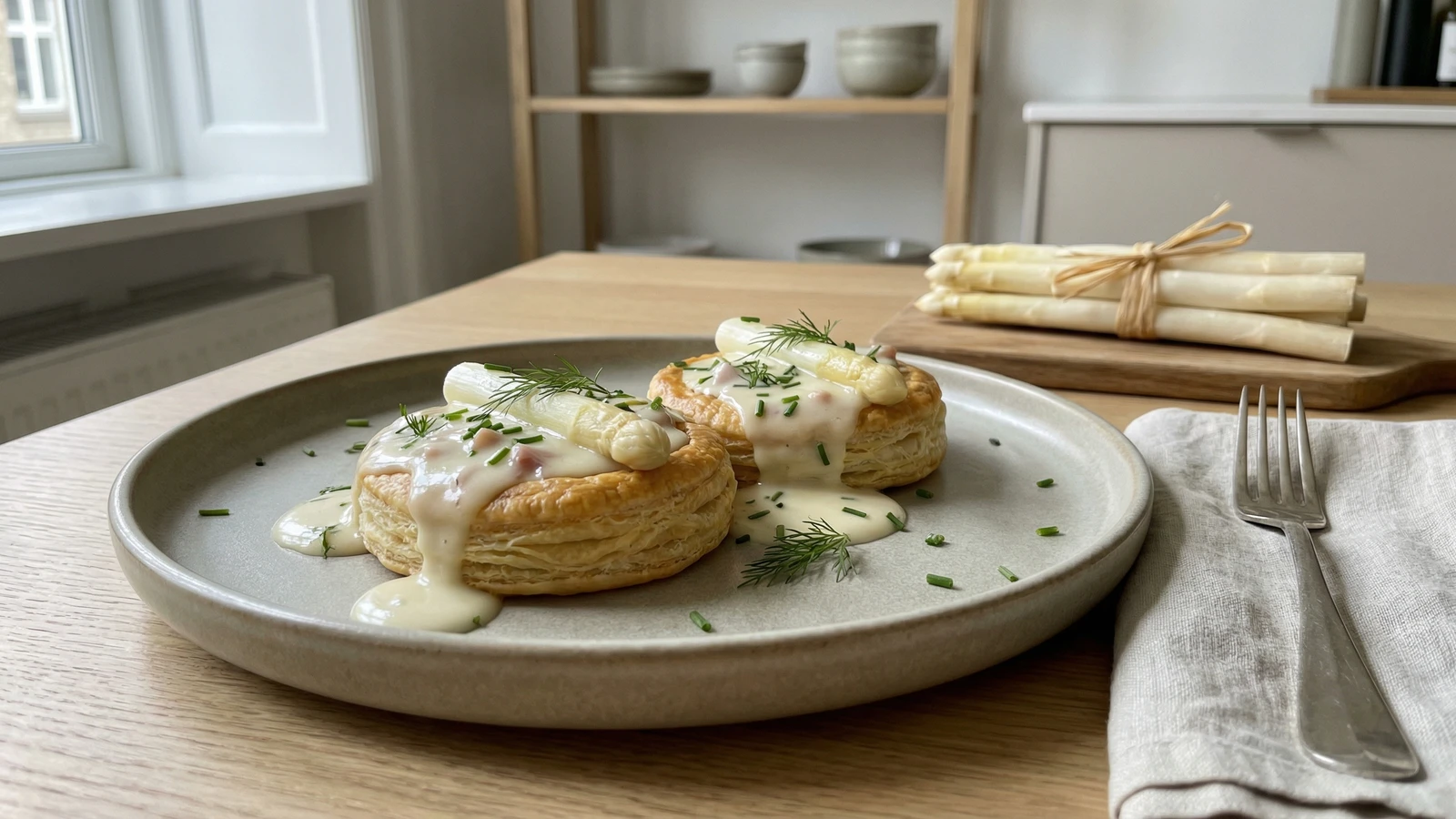
Crisp Danish puff pastry shells filled with white asparagus and ham in a silky cream sauce. The Easter-lunch tarteletter, served when the first white asparagus arrives and the table is dressed for spring.
White asparagus arrives in Denmark at the end of April, sometimes the first week of May, and the moment it appears on the market stalls the Danish kitchen reorients itself. The pale spears sit in neat bundles, tied with raffia, waxy and almost translucent. They have a short window. Six weeks at most. This is the joy of waiting, and tarteletter med asparges is what you make when the waiting is over.
There are two great Danish tarteletter. The first is hons i asparges, chicken and asparagus, the everyday classic that Danish children grow up eating at birthday parties and family lunches. The second is this one, the Easter variant, where the chicken is replaced by good cooked ham and the dish takes its place on the long table at the paaskefrokost, the Easter lunch that anchors the Danish spring. Both versions share the same architecture: a crisp puff pastry shell, a creamy sauce built from asparagus stock, and the tender white spears folded through. The ham gives this version its salt, its weight, its place at the holiday table.
What I want you to understand before you begin is that this dish is built on one ingredient: the asparagus. Everything else serves it. The peels go into the cooking water and become your stock. The stock becomes your sauce. The tips garnish the top. Nothing is wasted, and every part of the spear earns its place. If you can find Danish white asparagus in season, use it. If you cannot, use the best European white asparagus you can buy, and make this in late April or May when the season is true. White asparagus from a tin will not give you this dish. It will give you something else, something sad. The season decides.
Pay attention to two moments. The first is when you build the sauce: add the warm liquid slowly, whisk steadily, and the sauce stays smooth. The second is when you fill the shells: the shells must be warm and the sauce must be hot, and they meet at the very last second. Get those two right and you'll know when it's right.
Tarteletter entered the Danish kitchen in the late 1800s, a borrowing from French haute cuisine that the rising bourgeoisie of Copenhagen made their own. By the early twentieth century the chicken-and-asparagus version, hons i asparges, had become a fixed point in the Danish repertoire, served at confirmations, christenings, and birthday parties. The ham variant developed as the Easter cousin, taking its place at the paaskefrokost alongside the herring, the eggs, and the lamb. White asparagus has been cultivated in Denmark since the 1880s, when growers on the sandy soils of Samso and northern Sjaelland discovered that the climate suited the spears that ripened underground.
Quantity
8
ready-baked
Quantity
500g
peeled and trimmed
Quantity
300g
cut into 1cm dice
Quantity
50g
Quantity
40g
Quantity
400ml
Quantity
150ml
Quantity
100ml
Quantity
1 teaspoon, plus more for the asparagus water
Quantity
1 teaspoon
Quantity
freshly ground, to taste
Quantity
a small grating
Quantity
1 tablespoon
Quantity
small bunch
snipped
Quantity
to finish
| Ingredient | Quantity |
|---|---|
| puff pastry tartelet shellsready-baked | 8 |
| white asparaguspeeled and trimmed | 500g |
| good-quality cooked hamcut into 1cm dice | 300g |
| unsalted butter | 50g |
| plain flour | 40g |
| asparagus cooking liquid | 400ml |
| whole milk | 150ml |
| double cream | 100ml |
| fine sea salt | 1 teaspoon, plus more for the asparagus water |
| caster sugar | 1 teaspoon |
| white pepper | freshly ground, to taste |
| nutmeg | a small grating |
| lemon juice | 1 tablespoon |
| fresh chivessnipped | small bunch |
| fresh dill fronds | to finish |
White asparagus must be peeled. This is not optional. The skin is woody and bitter and will ruin the sauce if you leave it on. Lay each spear flat on the counter and peel from just below the tip down to the base with a vegetable peeler, turning as you go. Snap off the dry woody end where it gives easily. Save every peel and every trimming. They're going into the cooking water and they're where half the flavor lives.
Bring a wide pan of water to a gentle simmer. Add a good pinch of salt, the teaspoon of sugar, and all the peels and trimmings. Let them infuse for five minutes. This is your stock now, and it tastes like asparagus the way nothing else does. Lift the peels out with a slotted spoon and discard them. Slide the peeled spears in and simmer gently for eight to twelve minutes, depending on thickness. They are done when a knife slides into the thickest part with no resistance. Lift them out with tongs and lay them on a clean cloth. Keep the cooking liquid. You'll need 400ml of it for the sauce.
When the spears are cool enough to handle, cut them into pieces about two centimetres long. Keep the tips whole and set them aside. The tips go in last so they stay intact. The stem pieces fold into the sauce and disappear into its texture.
Melt the butter in a heavy saucepan over medium-low heat. Once it's foaming and just starting to smell nutty, add the flour all at once and stir with a wooden spoon. Cook this paste, the roux, for two minutes. You're not browning it. You're cooking the raw taste out of the flour. The paste should look pale and smell faintly biscuity. If it darkens, you've gone too far. Start again. White sauce wants a white roux.
Pour in the warm asparagus cooking liquid in a slow, steady stream, whisking constantly. Lumps form when you add liquid too fast or too cold. Slow and warm, and the sauce stays smooth. Once all the asparagus liquid is in, add the milk and the cream the same way. Bring to a gentle simmer, whisking, and let it cook for five minutes. The sauce will thicken into something glossy and pourable, the consistency of double cream. Season with salt, white pepper, and a small grating of nutmeg. Taste it. Adjust. The sauce should taste of asparagus first and dairy second.
While the sauce simmers, slide the tartelet shells onto a baking tray and warm them in a 150C oven for five minutes. Cold shells go soggy the moment the sauce hits them. Warm shells stay crisp. This small step is the difference between tarteletter that hold their architecture and tarteletter that collapse into mush.
Stir the diced ham and the cut asparagus stem pieces into the sauce. Let everything warm through gently for two minutes. Don't boil it. Boiling toughens the ham and breaks the cream. Add the lemon juice last. The lemon lifts the whole sauce and stops it from feeling heavy. Slide the asparagus tips in at the very end and stir once, just to coat them. You want the tips to keep their shape.
Set two warm tartelet shells on each plate. Spoon the sauce generously into each one, letting it spill a little over the rim. That's the sign of a Danish tartelet, filled past the edge, never neat. Lay an asparagus tip on top of each one so it shows. Scatter the snipped chives and a few dill fronds across the top. Serve immediately, while the shells are still crisp and the sauce still hot. Tak for mad.
1 serving (about 325g)
Culinary guides, cultural storytelling, and the editorial depth that makes cooking meaningful.
Discover Culinary ExplorerChef Freja
Danish puff pastry tartelet shells folded and chilled in patient layers, baked tall and golden until they shatter at the first bite. The architecture that holds a hundred different fillings.

Chef Freja
Danish pork crackling, simmered tender, dried until parchment, then fried until it puffs and shatters. The beer snack of every Danish kro, salty and golden and made for cold pilsner and good company.

Chef Freja
Hard-boiled egg halves heaped with cold-water fjord shrimp, dill mayonnaise, and a single frond of dill standing upright. The piece that disappears first from any Danish julefrokost table.

Chef Freja
Egg halves crowned with creme fraiche and the season's first stenbiderrogn, Danish lumpfish roe. A late-winter ritual along the Danish coasts when the fish come in and the kitchen reorients around them.