
Chef Juliana
Açaí com Farinha de Tapioca
You don't need a blender trick or a sweet shop bowl. Thick unsweetened açaí, crunchy farinha de tapioca, and the discipline to read the label solve this Belém spoon plate.
A cooking platform built around craft, culture, and the stories behind what we eat.
Created by
You don't need talent for tapioca. You need hydrated goma, a sieve, a hot dry pan, and the sense to stop poking once the crepe holds together.
You might be standing there thinking, isso não é pra mim, because tapioca looks like one of those foods that belongs to somebody else's hand. I know that little voice. Mine used to say the same thing about beans, rice, onions, all of it. Then I learned the boring truth that saves dinner: cozinhar não é dom, é um aprendizado.
A tapioca bem feita is not a packet trick. It's cassava, water, heat, and attention. In the Northeast, cassava and corn are the floor under so much everyday eating, next to cuscuz, queijo coalho, carne de sol, coco, refogado, seafood broths, and the plates people actually live on. Not decorative food. Food that resolves breakfast, lunch, a quick supper, the hungry child at the table, the adult who says there's nothing in the house.
The method is small, but it has rules with reasons. Hydrate the goma so the starch grains swell evenly. Peneirar, sieve it, so it falls like damp sand instead of hitting the pan in clumps. Use a hot dry pan because tapioca makes its own thin crepe when the starch touches heat; oil makes it patchy and greasy, and then you blame yourself when the pan was the nonsense.
We'll do two fillings, because a gente is practical: queijo coalho with coconut for breakfast or carne de sol with a quick refogado for something more like dinner. Both are comida de verdade. Both are achievable tonight.
Tapioca crepes come from Indigenous cassava knowledge, later carried through kitchens across Brazil and especially through the Northeast, where cassava starch became daily food long before wheat was ordinary. The word tapioca is tied to Tupi language roots for the starch residue or clot that appears in cassava processing, and the thin skillet crepe is one of the simplest ways that starch entered the home table. Regional fillings vary widely, from queijo coalho and coconut to carne de sol, and the best teachers for each local style are the cooks who make it where they live.
Quantity
2 cups
not polvilho azedo
Quantity
1/2 cup, plus 1 to 2 tablespoons more if needed
Quantity
1/2 teaspoon
Quantity
1 cup
grated
Quantity
1/2 cup
Quantity
1 teaspoon
Quantity
1 tablespoon
for the carne de sol filling
Quantity
1/2 small
finely chopped
Quantity
1/4 cup
finely chopped
Quantity
1/2 medium
seeded and chopped
Quantity
1 small clove
minced
Quantity
1 cup
desalted if needed
Quantity
2 tablespoons
chopped
| Ingredient | Quantity |
|---|---|
| tapioca starch (polvilho doce)not polvilho azedo | 2 cups |
| water | 1/2 cup, plus 1 to 2 tablespoons more if needed |
| salt | 1/2 teaspoon |
| queijo coalhograted | 1 cup |
| fresh grated coconut | 1/2 cup |
| butter (optional) | 1 teaspoon |
| neutral oil or butterfor the carne de sol filling | 1 tablespoon |
| onionfinely chopped | 1/2 small |
| red or green bell pepperfinely chopped | 1/4 cup |
| tomatoseeded and chopped | 1/2 medium |
| garlicminced | 1 small clove |
| cooked shredded carne de soldesalted if needed | 1 cup |
| fresh cilantrochopped | 2 tablespoons |
Put the polvilho doce and salt in a bowl. Sprinkle in 1/2 cup water with your fingers while rubbing the starch between your palms. Stop when it feels like damp beach sand and holds together when squeezed, then breaks apart when pressed. This matters because dry starch stays dusty and cracks, while soaked starch turns into paste. Hydrated goma is the middle ground that makes a crepe.
Pass the damp starch through a fine sieve into a clean bowl, pressing the little lumps with your fingers. It should fall softly, like coarse flour that knows a secret. Peneirar is not fuss. Clumps hit the pan as hard little islands, and then your tapioca cooks unevenly, with dry spots and thick patches.
Squeeze a small handful. If it falls apart like dust, sprinkle in 1 tablespoon water and rub again. If it smears like paste, add 1 tablespoon dry polvilho and sieve again. The right ponto is damp, loose, and siftable. Anota aí: goma that won't fall through the sieve isn't ready for the pan.
For the carne de sol filling, warm the oil or butter in a small pan over medium heat. Add the onion and bell pepper and refogar until they soften and smell sweet, about 4 minutes. Add the tomato and cook until it slumps, then add the garlic for 1 minute, just until fragrant. This base gives the meat real flavor, not the loud salt of a packet pretending to help.
Stir in the shredded carne de sol and cook until it is hot and lightly glossy, about 3 minutes. Taste before adding any salt, because carne de sol often brings plenty with it. Turn off the heat and stir in the cilantro. Fresh coentro at the end tastes green and alive; boiled to death, it tastes tired.
Set a 20 cm nonstick or well-seasoned skillet over medium heat for 2 to 3 minutes. Do not oil it. Flick in a pinch of goma: it should set on contact, not brown hard or sit there looking sad. Tapioca needs direct dry heat so the hydrated starch grains fuse into one flexible sheet. Oil gets between the starch and the pan, and then the crepe turns spotty.
Sprinkle about 1/2 cup sifted goma evenly over the pan, filling gaps with your fingers or a spoon until you have a thin round layer. Let it cook without pressing hard or stirring. In about 1 to 2 minutes, the surface will turn matte and the edges will lift slightly. That's the crepe telling you it has become one piece.
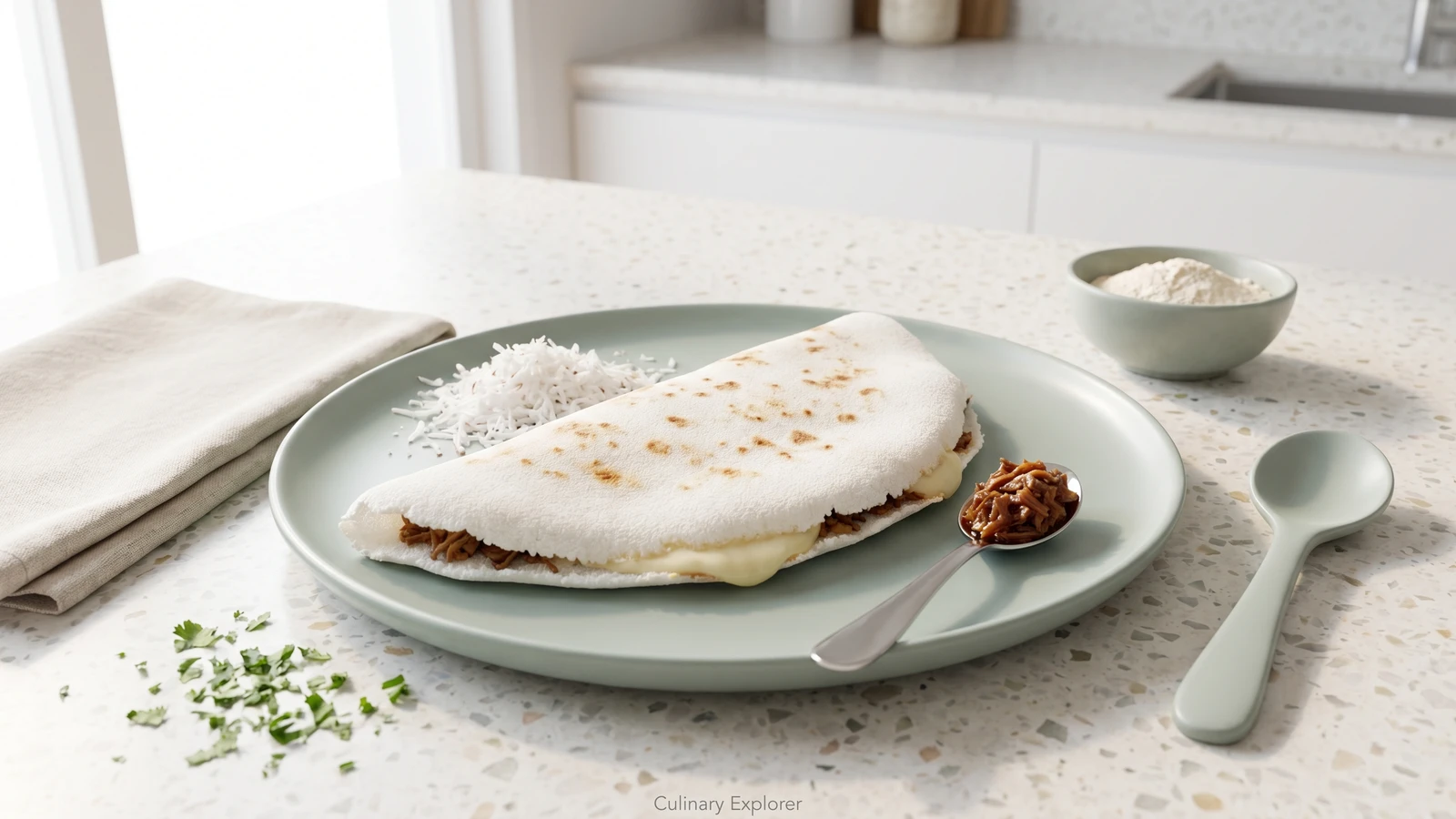
For queijo and coconut, scatter 1/4 cup queijo coalho and 2 tablespoons coconut over one half, add a tiny bit of butter if you want, and fold when the cheese starts to soften. For carne de sol, spoon 1/4 cup filling over one half and fold. Cook 30 seconds more, just until the filling warms through. Too long and the tapioca dries out, and nobody asked for a cassava cracker.
Slide the tapioca onto a plate and eat it right away, while the outside is tender and the filling is warm and glossy. Repeat with the remaining goma, wiping the pan with a dry cloth if stray starch browns. Tapioca waits badly. That's not drama, it's starch.
1 serving (about 185g)
Culinary guides, cultural storytelling, and the editorial depth that makes cooking meaningful.
Discover Culinary ExplorerChef Juliana
You don't need a blender trick or a sweet shop bowl. Thick unsweetened açaí, crunchy farinha de tapioca, and the discipline to read the label solve this Belém spoon plate.

Chef Juliana
You don't need a shop to make a thick açaí bowl. You need real frozen pulp, a ripe banana, and the discipline to stop blending before it becomes juice.

Chef Juliana
You don't need boxed cereal to get breakfast on the table. Fine cassava farinha, milk, salt, and steady stirring turn into a warm Amazonian bowl that actually carries you.

Chef Juliana
If you think two ingredients can't feed you, anota aí. Good farinha d'água, cold water, and salt make a bowl that's plain, Brazilian, and smarter than the packet.