
Chef Fai
Isan Beef Larb (Larb Nua)
No sugar. That's the rule. Isan larb strips Thai cuisine down to three pillars: nam pla for salt, manao for sour, prik for heat, bound by the smoky crunch of freshly pounded khao khua. The absence defines the dish.
A cooking platform built around craft, culture, and the stories behind what we eat.
Created by
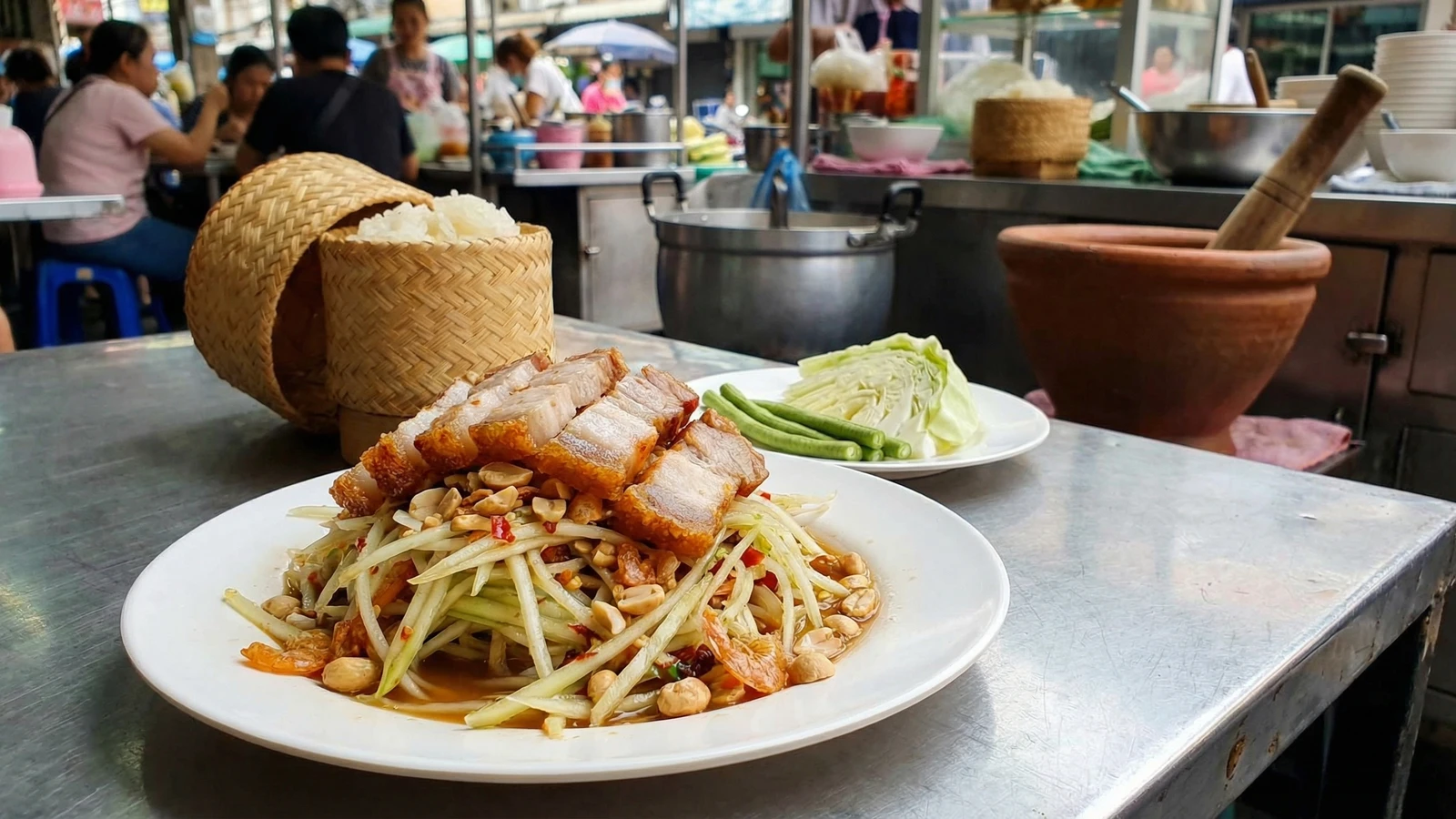
Shattered crispy pork belly meets the four pillars in a clay mortar. Fat is the fifth element nobody talks about, the one that carries every other flavor to your tongue and refuses to let go.
Fat carries flavor. That's not opinion, that's chemistry. And this dish is the proof.
Ajarn always said the four pillars govern Thai cuisine: nam pla for salt, nam tan pip for sweet, manao for sour, prik for heat. He's right. But there's a reason the best som tam stalls in Bangkok serve a plate of moo krob (crispy pork belly) alongside the mortar. Fat is the vehicle that delivers those four pillars to every corner of your mouth and holds them there. Sour without fat is sharp and fleeting. Sour with fat is round, persistent, coating your tongue while the lime and fish sauce do their work underneath. The pork belly doesn't break the system. It amplifies it.
Tam moo krob follows the exact same mortar technique as every som tam in the collection. Garlic and chilies first, pounded to a rough paste in the krok din. Long beans and tomatoes next, bruised until they crack. Green papaya goes in last, tossed and struck until each strand absorbs the dressing. Pound, taste, adjust. The only difference is what lands on top: slabs of pork belly, deep-fried until the skin shatters like glass and the fat layer underneath has gone golden and yielding.
I started seeing tam moo krob at stalls in Saphan Khwai and Ari maybe ten years ago, vendors who already sold som tam adding a tray of crispy pork belly to the cart because their customers wanted something richer. It spread fast. The principle held. The mortar didn't change. The dressing didn't change. The technique didn't change. They just added an element that made the whole thing hit harder. That's innovation within the framework. That's what Ajarn means when he says you can create anything new as long as you understand the governing rules. Principles, not recipes.
Tam moo krob is a relatively recent Bangkok street food innovation, emerging in the 2010s as som tam vendors in neighborhoods like Saphan Khwai and Ari began pairing their mortars with trays of deep-fried pork belly (moo krob). The combination draws on the Isan som tam tradition while reflecting Central Thai preferences for richer, fattier accompaniments. Crispy pork belly itself has deep roots in Chinese-Thai cuisine, where roasted and deep-fried pork belly (mu krob, หมูกรอบ) has been sold in Bangkok's Chinatown for over a century, making this dish a collision point between Isan mortar technique and Sino-Thai protein traditions.
Quantity
300g
in one piece
Quantity
1 tablespoon
Quantity
1 teaspoon
Quantity
for deep-frying
Quantity
2 cups
shredded
Quantity
3 cloves
Quantity
5, or to taste
Quantity
2
cut into 1-inch pieces
Quantity
5
halved
Quantity
2 tablespoons
Quantity
1 tablespoon
Quantity
2 tablespoons
Quantity
1 tablespoon
Quantity
3 tablespoons (about 2-3 limes)
Quantity
for serving
Quantity
for the side plate
cabbage wedges, long beans, white turmeric
| Ingredient | Quantity |
|---|---|
| pork belly, skin onin one piece | 300g |
| white vinegar | 1 tablespoon |
| salt | 1 teaspoon |
| vegetable oil | for deep-frying |
| green papaya (malakor)shredded | 2 cups |
| garlic | 3 cloves |
| bird's eye chilies (prik khi nu) | 5, or to taste |
| long beans (thua fak yao)cut into 1-inch pieces | 2 |
| cherry tomatoeshalved | 5 |
| dried shrimp (goong haeng) | 2 tablespoons |
| unsalted roasted peanuts | 1 tablespoon |
| fish sauce (nam pla) | 2 tablespoons |
| palm sugar (nam tan pip) | 1 tablespoon |
| lime juice (nam manao) | 3 tablespoons (about 2-3 limes) |
| sticky rice (khao niew) | for serving |
| raw vegetablescabbage wedges, long beans, white turmeric | for the side plate |
Bring a pot of water to a boil. Blanch the whole pork belly piece for 10 minutes. This renders some of the excess fat and tightens the skin so it fries evenly later. Pull it out, pat the skin completely dry with paper towels. Score the skin in a crosshatch pattern with a sharp knife, cutting through the skin but not into the fat. Rub the skin side with white vinegar and salt. The vinegar dehydrates the skin. Dry skin blisters. Wet skin cheats you of crunch. Set the pork belly on a rack, skin side up, and refrigerate uncovered for at least 20 minutes. An hour is better if you have it. The fridge pulls even more moisture out of the skin.
Heat enough vegetable oil in a wok or deep pot to submerge the pork belly. You need about 170°C (340°F). Lower the pork belly in carefully, skin side down. The oil will erupt. Stand back. Use a splatter guard if you have one. Fry for 15-20 minutes, flipping halfway, until the skin is deeply golden and blistered all over. The sound changes: it starts violent and angry, then settles to a steady crackle. When the crackling sound gets quieter and the skin looks like it could shatter from a hard look, it's done. Pull it out and rest on a wire rack for 5 minutes. Do not rest it on paper towels. The trapped moisture underneath will soften the skin you just spent all that time getting crispy.
Once the pork belly has rested, slice it crosswise into pieces about 1 centimeter thick. You should hear the skin crack as the knife goes through. If it doesn't crack, it's not crispy enough. Each piece should have three distinct layers: shattered golden skin, a thin strip of rendered fat, and tender pink meat. Set aside. These go on top of the som tam at the very end. Not in the mortar. On top.
In a large krok din (clay mortar) with the wooden pestle, pound the garlic and bird's eye chilies to a rough paste. Not smooth. You want visible chunks of garlic and split chili seeds. The heat hits your nose before it hits your mouth. That's how you know you're there. Add the long beans and give them four or five firm strikes. You're bruising, not destroying. The beans should crack and bend, still holding their shape.
Drop the dried shrimp and peanuts into the mortar. Three or four light strikes to crack them open. The peanuts should split, not crumble. The dried shrimp should fray slightly, releasing their briny funk into the mortar. Don't overwork this. A few hits. Move on.
Add the fish sauce, palm sugar, and lime juice to the mortar. Use the pestle to stir and dissolve the palm sugar into the liquid. Taste the dressing off the pestle. This version leans Isan: less sweet than som tam Thai. The lime should lead. The fish sauce sits right behind it. The sugar rounds the edges but doesn't dominate. If it tastes sweet first, you've got too much sugar. Pull it back with more lime. Ajarn always said: add sour last, add sour slowly. Here, you're building the dressing in the mortar, so taste as you go.
Add the shredded green papaya and halved cherry tomatoes to the mortar. Now the rhythm: strike down with the pestle, then use a long spoon in your other hand to toss and fold from the bottom. Strike, toss, strike, toss. Ten to fifteen rounds. You're bruising the papaya so each strand absorbs the dressing while keeping its crunch. The tomatoes should burst slightly, their juice mixing into the dressing. The papaya should look glossy and slightly wilted but still snap when you bite it. Not soft. Not limp. Dressed and alive. Taste a strand. If it's crunchy, sour, salty, with heat building at the back, you're done.
Transfer the som tam from the mortar to a plate. Lay the sliced crispy pork belly across the top. Don't bury it in the salad. It sits on top so the skin stays shattered and dry until the moment you eat it. The first bite should give you that skin crunch, then the fat hits the sour dressing on your tongue, and everything changes. Serve with sticky rice (khao niew) and the raw vegetable plate: cabbage wedges, long beans, white turmeric. Eat immediately. Som tam does not hold. The lime is already working on the papaya. Five minutes from now, it's a different dish. A worse one.
1 serving (about 475g)
Culinary guides, cultural storytelling, and the editorial depth that makes cooking meaningful.
Discover Culinary ExplorerChef Fai
No sugar. That's the rule. Isan larb strips Thai cuisine down to three pillars: nam pla for salt, manao for sour, prik for heat, bound by the smoky crunch of freshly pounded khao khua. The absence defines the dish.

Chef Fai
No sugar. That's the line between Isan and Central Thai larb. Grilled catfish flaked while warm, dressed with nam pla, manao, khao khua, prik pon, and a storm of fresh herbs. The plateau on a plate.

Chef Fai
No sugar. That's the rule. Isan larb strips Thai cuisine down to three pillars: nam pla for salt, manao for sour, prik for heat, with khao khua tying it together in a way nothing else can.

Chef Fai
Duck brings gamey depth to the Isan larb formula. No sugar. Lime, fish sauce, khao khua, prik pon, and a wall of fresh herbs. This is the celebration table standard, and the governing rule is restraint.