Culinary Explorer

A cooking platform built around craft, culture, and the stories behind what we eat.
Discover Culinary Explorer
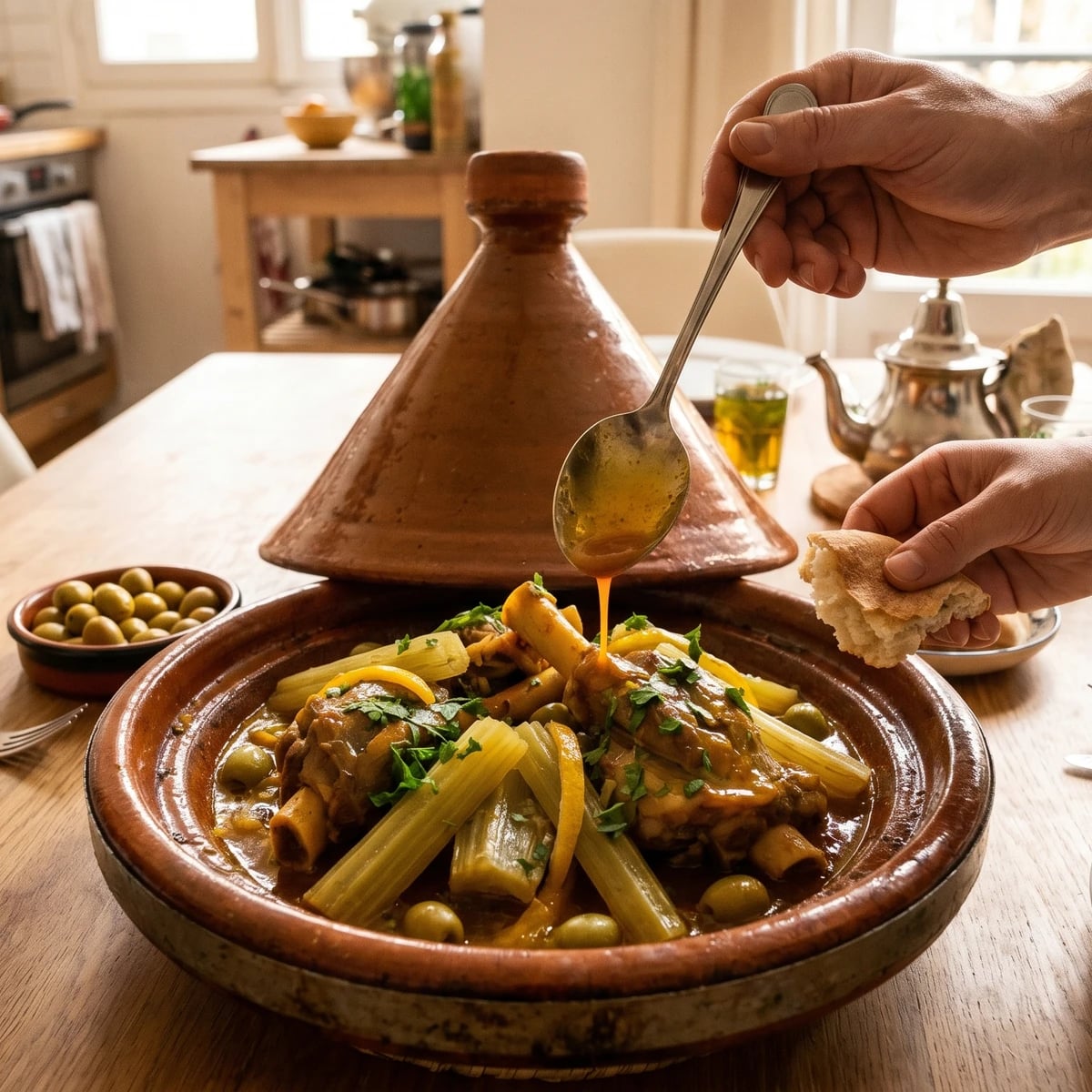
Tagine d'Agneau aux Cardons

Tagine d'Agneau aux Cardons

Created by

A Fassi winter tagine where lamb braises slowly with khorchef, preserved lemon, saffron, and olives until the cardoons turn tender and the sauce gathers itself around the meat.

Main Dishes
Moroccan
Comfort Food
Weeknight
45 min
Active Time
2 hr cook2 hr 45 min total
Yield6 servings

When khorchef arrives in the winter souks, pale green and a little thorny, I change my cooking. Cardoon is not a vegetable you bully. You trim it, pull away the strings, rub it with lemon, and give it time in the pot until its bitterness softens into something silky and deep.

This tagine belongs to the colder months, when lamb has the patience for a long braise and preserved lemon brings the sharp gold the dish needs. The one thing that decides it is the cleaning of the cardoons: if you leave the strings, they fight you at the table. Pull them away well, and the stems drink the saffron sauce like they were made for it.

In Fez, this is comfort food with manners, not a ceremony but not careless either. Serve it in the middle, with khobz to chase the sauce, and make room for one more hand reaching in. Une table, c'est une porte qu'on laisse ouverte, a table is a door you leave open.

Cardoons, Cynara cardunculus, belong to the old Mediterranean thistle family cultivated and gathered around North Africa and southern Europe since antiquity, and in Morocco they are known in the winter market as khorchef or kharchouf. The lamb and cardoon tagine is especially associated with the Fassi citadin kitchen, where preserved lemon, saffron, ginger, and olives show the Andalusi and trans-Saharan spice routes meeting in a household pot. Its exact date is not fixed in writing, but the technique sits clearly inside the long urban braising repertoire of Fez from the medieval Marinid period onward.

The technique, the tradition, and the story behind every dish.

Discover Culinary Explorer

Ingredients

lamb shoulder or neck

Quantity

1.4 kg

cut into large pieces

fresh cardoons (khorchef)

Quantity

1.2 kg

trimmed and stripped of strings, cleaned weight about 700g

preserved lemons

Quantity

2

pulp removed and rind cut into strips

green or violet Moroccan olives

Quantity

150g

rinsed

onions

Quantity

2 large

grated

garlic cloves

Quantity

4

crushed

flat-leaf parsley

Quantity

1 small bunch

tied with kitchen string

fresh coriander

Quantity

1 small bunch

tied with kitchen string

saffron threads

Quantity

1 pinch

bloomed in 3 tbsp warm water

ground ginger

Quantity

2 tsp

ground turmeric

Quantity

1 tsp

freshly ground black pepper

Quantity

1/2 tsp

ras el hanout (optional)

Quantity

1 small pinch

optional, from a trusted spice merchant

olive oil

Quantity

4 tbsp

lemon juice

Quantity

1 tbsp

for holding the cardoons

sea salt

Quantity

to taste

water

Quantity

500ml

plus more as needed

Equipment Needed

  • Heavy clay tagine with diffuser or wide braising pot
  • Small knife or vegetable peeler for stripping cardoons
  • Kitchen string for herb bundles

Instructions

  1. 1

    Clean the cardoons

    Pull off the leaves and tough edges from the cardoon stalks, then strip away the long strings with a small knife or peeler. Cut the stalks into 8cm pieces and drop them into cold water with the lemon juice. This matters because cardoon darkens quickly, and the strings never become tender no matter how long you cook them.

    Wear gloves if your hands stain easily. Good khorchef should feel firm and fresh, not dry or hollow.
  2. 2

    Start the lamb

    Set a heavy tagine base or braising pot over medium heat. Add the olive oil, grated onions, garlic, ginger, turmeric, black pepper, saffron water, and a careful pinch of salt. Add the lamb and turn it through the spices until every piece is yellow-gold and fragrant.

  3. 3

    Braise gently

    Add the parsley and coriander bundles, then pour in enough water to come halfway up the meat. Cover and cook gently for about 1 hour, turning the lamb once or twice, until it has begun to soften and the onions have melted into the sauce. Keep the flame low. A tagine forgives time better than haste.

  4. 4

    Add the cardoons

    Drain the cardoons and tuck them around and under the lamb so they sit in the sauce, not dry on top. Cover again and simmer for 45 to 60 minutes, until the stems are tender when pierced and the lamb pulls easily from the bone. Add a little water only if the pot is catching.

  5. 5

    Finish the sauce

    Add the preserved lemon rind and olives for the last 15 minutes. Uncover if the sauce is thin and let it reduce until glossy, saffron-gold, and spoon-coating. Taste before salting again, because preserved lemon and olives bring their own salt.

  6. 6

    Serve communally

    Lift out the herb bundles and arrange the lamb in the center with the cardoons around it, then spoon the sauce over everything. Serve from the tagine or a warm platter with round khobz. The bread is not decoration here, it is how you gather the sauce.

Chef Tips

  • Buy cardoons in winter, when the stalks are firm and the market is honest. If they are limp, stringy, or dry at the cut end, cook another tagine that day.
  • Use preserved lemon, not fresh lemon, for the finish. Fresh lemon gives sharpness, but preserved lemon gives salt, perfume, and that deep citrus note Moroccan braises depend on.
  • Bloom saffron threads in warm water before they touch the pot. The powdered yellow is not saffron, and it will not give you the same dish.
  • If you use ras el hanout here, keep it a whisper. This is a cardoon tagine, not mrouzia. Buy it from someone who'll tell you what's in it, because avec le ras el hanout, on ne triche pas.
  • The scale is in the eyes, la balance est dans les yeux. Reduce the sauce until it clings to the spoon and shines, then stop before the cardoons break apart.

Advance Preparation

  • The cardoons can be cleaned up to 4 hours ahead and kept in lemon water in the refrigerator.
  • The tagine can be made 1 day ahead; reheat gently with a splash of water so the sauce loosens without breaking the cardoons.
  • Add olives and preserved lemon during reheating if making ahead, so their flavor stays bright and they don't dominate the sauce.

Frequently Asked Questions

Nutrition Information

1 serving (about 360g)

Calories
595 calories
Total Fat
48 g
Saturated Fat
17 g
Trans Fat
0 g
Unsaturated Fat
31 g
Cholesterol
115 mg
Sodium
1250 mg
Total Carbohydrates
14 g
Dietary Fiber
5 g
Sugars
3 g
Protein
29 g

Note: Chef personas and recipes are created with AI assistance. Cook with care: follow safe food-handling practices, check doneness with a thermometer when needed, and adapt for allergies and your kitchen.

Where cooking meets culture.

Culinary guides, cultural storytelling, and the editorial depth that makes cooking meaningful.

Discover Culinary Explorer

More from Tagines of Poultry, Lamb & Vegetables

Browse the full collection