
Chef Zohra
Poulet M'hammer aux Amandes (دجاج محمر)
A celebration chicken simmered low in saffron onion sauce, browned until golden, then carried to the table with fried almonds scattered over the top.
A cooking platform built around craft, culture, and the stories behind what we eat.
Created by
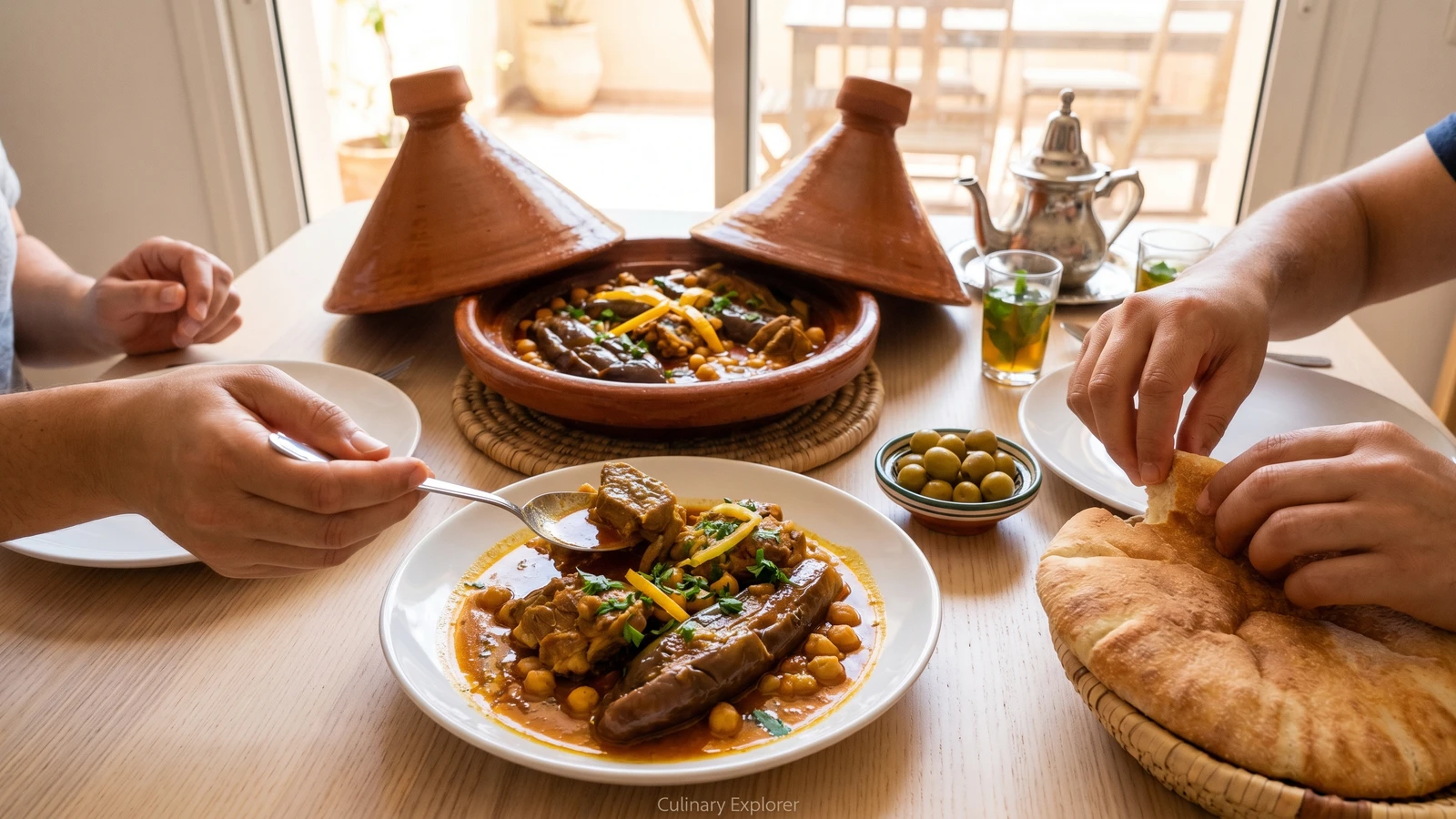
An eastern Moroccan tagine where lamb or beef braises with chickpeas until tender, then eggplant cooks past soft into saffron-gold silk. Bring khobz, because the sauce asks for hands.
The eggplant tells you whether you've respected this tagine. It can't stay a tidy cube, and it can't be rushed into a wet pot where it drinks everything and sulks. Give it its own heat first, let the edges turn gold, then fold it back into the saffron sauce only when the meat is tender. That is the gesture that decides the dish: the eggplant keeps its depth, then gives itself over into silk.
Braniya is not the tagine people expect when Morocco is flattened to couscous and chicken with lemon. It belongs to des cuisines marocaines, the many Moroccan kitchens, and I think of it with the eastern table, Oujda facing Tlemcen, where eggplant, chickpeas, lamb or beef, and a good hand with spices make comfort without noise. Use real saffron threads, bloomed in warm water. The powdered yellow is only color pretending.
Cook this when the eggplants are glossy and heavy for their size. If the market gives you tired, seedy ones, choose another dish that day; no gesture rescues a tired vegetable. This is la cuisine du lien, the cooking of connection, on a weeknight. Put the pot in the center, tear the khobz, and let the sauce be chased from the plate. Une table, c'est une porte qu'on laisse ouverte, a table is a door you leave open.
Braniya, also heard as beraniya, sits in the eastern Moroccan repertoire around Oujda, with close relatives across the Tlemcen corridor in Algeria; that border has long been a kitchen passage, not a wall. Eggplant was established in Arabic-speaking North African cooking by the medieval period, described by Andalusi agronomists between the 11th and 13th centuries, and chickpeas and saffron moved through the market routes linking Fez, Tlemcen, and the eastern towns. The exact date of this Moroccan tagine isn't fixed in writing, and assigning it a false century would be less honest than saying it lived first in households.
Quantity
1 kg
cut into 4 cm pieces
Quantity
2 medium, about 700g total
cut into thick half-moons or large cubes
Quantity
1 1/2 tsp
divided
Quantity
4 tbsp
divided
Quantity
2 medium
grated or very finely chopped
Quantity
3
grated
Quantity
2
peeled and grated, or use 200g canned crushed tomatoes
Quantity
1 tsp
Quantity
1 tsp
Quantity
1/2 tsp
Quantity
1/2 tsp
Quantity
1/2 tsp
Quantity
1/2 tsp
fresh, optional, only if your household uses it
Quantity
1 pinch
bloomed in 3 tbsp warm water
Quantity
1 small bunch total
half tied into a bouquet, half chopped
Quantity
300g
drained
Quantity
1 small strip
pulp discarded, rind thinly sliced
Quantity
300ml
plus more as needed
| Ingredient | Quantity |
|---|---|
| lamb shoulder or beef chuckcut into 4 cm pieces | 1 kg |
| eggplantscut into thick half-moons or large cubes | 2 medium, about 700g total |
| fine sea saltdivided | 1 1/2 tsp |
| olive oildivided | 4 tbsp |
| onionsgrated or very finely chopped | 2 medium |
| garlic clovesgrated | 3 |
| ripe tomatoespeeled and grated, or use 200g canned crushed tomatoes | 2 |
| ground ginger | 1 tsp |
| sweet paprika | 1 tsp |
| ground cumin | 1/2 tsp |
| ground turmeric | 1/2 tsp |
| freshly ground black pepper | 1/2 tsp |
| ras el hanout (optional)fresh, optional, only if your household uses it | 1/2 tsp |
| saffron threadsbloomed in 3 tbsp warm water | 1 pinch |
| fresh coriander and flat-leaf parsleyhalf tied into a bouquet, half chopped | 1 small bunch total |
| cooked chickpeasdrained | 300g |
| preserved lemon rind (optional)pulp discarded, rind thinly sliced | 1 small strip |
| water or light unsalted brothplus more as needed | 300ml |
Crush the saffron threads gently between your fingers into 3 tablespoons warm water and let them bloom while you prepare the vegetables. Cut the eggplants into thick half-moons or large cubes, toss them with 1 teaspoon of the salt, and leave them in a colander for 20 minutes, then pat them dry. The salt pulls surface water away, so the eggplant browns in the pot instead of thinning the sauce before its time.
Warm 2 tablespoons of the olive oil in a wide tagine set on a diffuser, or in a Dutch oven, over medium heat. Brown the eggplant in one layer, in batches if needed, until the cut sides are golden and the flesh has begun to soften, 3 to 4 minutes per side. Lift it out onto a plate; don't cook it to collapse yet, because it will finish in the sauce.
Add the remaining 2 tablespoons olive oil to the same pot. Add the onions, meat, remaining 1/2 teaspoon salt, black pepper, ginger, paprika, cumin, turmeric, garlic, and the ras el hanout if you're using it. Turn the meat through the onions and spices for 8 to 10 minutes, until the onion loses its raw smell and the spices cling to the meat without scorching.
Stir in the grated tomatoes and the tied herb bouquet. Pour in the bloomed saffron with its water and 300ml water or light broth; the liquid should come halfway up the meat, not drown it. Cover and simmer gently until the meat is tender, about 1 hour 15 minutes to 1 hour 30 minutes for lamb, or 1 hour 45 minutes to 2 hours for beef. The pot should only murmur; a hard boil tightens the meat and throws the sauce against the lid.
When the meat gives easily to a spoon, add the cooked chickpeas. Simmer uncovered or partly covered for 15 to 20 minutes, until the sauce turns saffron-amber and glossy, thick enough to coat the chickpeas but still loose enough for bread to gather.
Nestle the browned eggplant back into the sauce, along with the preserved lemon rind if your household uses it. Spoon sauce over the pieces, cover, and cook 10 to 15 minutes more. Shake the pot or use the spoon gently; hard stirring breaks the eggplant before it has time to become silky.
Remove the tied herb bouquet and taste for salt. Scatter over the chopped coriander and parsley, then let the tagine rest off the heat for 10 minutes so the sauce settles around the meat and eggplant. Serve from the pot with warm khobz, and make one more place at the table.
1 serving (about 400g)
Culinary guides, cultural storytelling, and the editorial depth that makes cooking meaningful.
Discover Culinary ExplorerChef Zohra
A celebration chicken simmered low in saffron onion sauce, browned until golden, then carried to the table with fried almonds scattered over the top.

Chef Zohra
An Amazigh tagine from the Atlas spirit: seasonal vegetables stood upright over onion and tomato, cooked tight under the lid until their own juices make the sauce.

Chef Zohra
The spring tagine Morocco waits for: artichoke hearts and fresh peas braised just until tender, with preserved lemon, ginger, saffron, olives, and herbs keeping the sauce bright.

Chef Zohra
A Fassi winter tagine where lamb braises slowly with khorchef, preserved lemon, saffron, and olives until the cardoons turn tender and the sauce gathers itself around the meat.