
Chef Lupita
Birria Tacos with Consome
Jalisco's goat birria, born around Cocula and carried into Guadalajara's markets, slow-braised in ancho, guajillo, cascabel, and chile de arbol, then tucked into corn tortillas crisped in its own red fat.
A cooking platform built around craft, culture, and the stories behind what we eat.
Created by
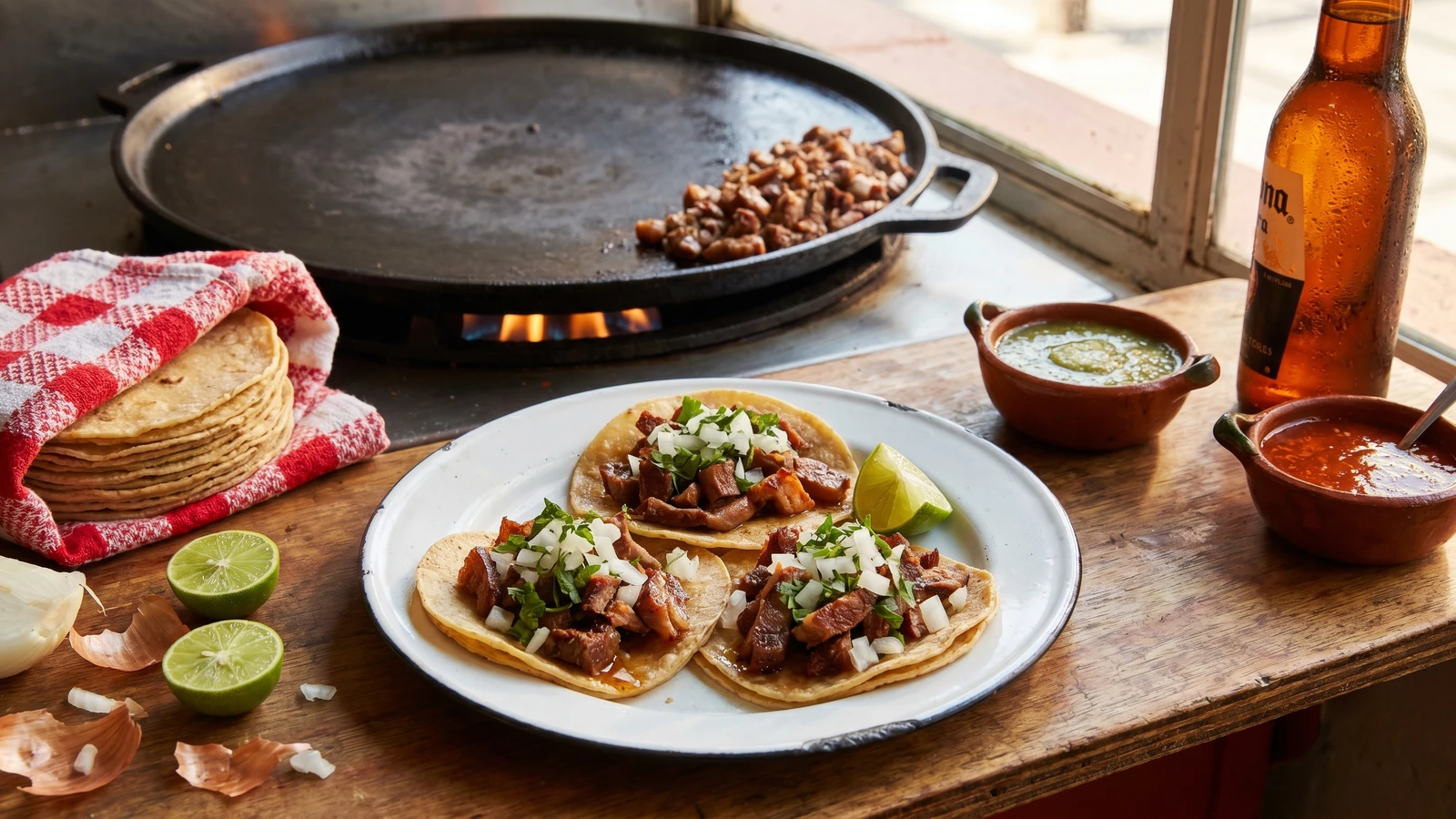
Mexico City's late-night taco, thin beef confited in its own fat on the concave comal, chopped fine, crisped to order, served on two tortillas with raw onion, cilantro, lime, and salsa. Con todo.
This is a Mexico City taco. Not a generic 'Mexican taco.' A taco de suadero belongs to the sidewalks of the Centro, to the corner of Bucareli at one in the morning, to the taquerias of Roma Norte and Doctores and Tepito where the comal is concave, the size of a wagon wheel, and the meat sits in a moat of its own fat at the perimeter while the carnitero chops to order at the center.
Suadero is a specific cut. It is the thin sheet of beef between the flank and the rib, fat layer still attached. It is not brisket exactly and it is not flank. In Mexico the carnicero hands it to you in a slab and you know what you are getting. Outside Mexico you have to ask, and you have to be willing to substitute carefully. What you cannot do is buy lean stew meat and call it suadero. La manteca es el sabor. The fat is not a flaw to be trimmed. The fat is the taco.
The technique is a confit, slow cooking the meat in rendered fat until it surrenders, then chopping it fine, then crisping it on a hot comal in some of the same fat. Two tortillas, not one. Raw white onion, cilantro, lime, salsa. The order is 'con todo.' The tortillas are small because you are supposed to eat four or five. Cada estado, su propia cocina, and this one is chilango through and through.
My mother did not make suadero at home. Nobody does, really. This is a street dish, the kind you eat standing at a tin counter under a yellow light bulb. But I have spent twenty years watching taqueros work the comal, asking what cut they buy, watching them chop, and what follows is as close to the corner of Bucareli as you can get in your own kitchen. Recetas probadas y garantizadas.
The word 'suadero' likely derives from the Spanish 'sudadero,' a reference either to the way the meat appears to sweat as it cooks in its own fat or to the saddle pad of the same name, which sits between the saddle and the horse the way the cut sits between flank and rib. Tacos de suadero became a defining street food of Ciudad de Mexico in the mid-20th century, when migration from the bajio brought the carnitas confit technique to the capital and local taqueros adapted it to beef, building the characteristic concave 'choricera' comal where suadero, longaniza, and tripa could cook side by side. The cut itself is rare outside Mexico because American and European butchering traditions break the carcass differently; the suadero is typically subdivided into brisket plate, flank, and rib trim before it ever reaches the retail counter.
Quantity
2 pounds
in one piece
Quantity
1 pound
Quantity
1 pound
Quantity
1 medium
halved
Quantity
1
halved crosswise
Quantity
2
Quantity
1 tablespoon, plus more to taste
Quantity
1 teaspoon
Quantity
1
halved
Quantity
1
for a faint background heat
Quantity
36
hand-pressed if you can get them
Quantity
1 large
finely diced
Quantity
1 cup
Quantity
for serving
Quantity
for serving
Quantity
for serving
| Ingredient | Quantity |
|---|---|
| beef brisket (thin belly cut between flank and rib)in one piece | 2 pounds |
| beef trim with fat or short rib meat with fat cap | 1 pound |
| pork lard (manteca de cerdo) | 1 pound |
| white onionhalved | 1 medium |
| head of garlichalved crosswise | 1 |
| bay leaves | 2 |
| kosher salt | 1 tablespoon, plus more to taste |
| whole black peppercorns | 1 teaspoon |
| orangehalved | 1 |
| dried chile de arbol (optional)for a faint background heat | 1 |
| small corn tortillashand-pressed if you can get them | 36 |
| white onion (for serving)finely diced | 1 large |
| chopped cilantro | 1 cup |
| lime wedges | for serving |
| salsa verde cruda | for serving |
| salsa roja de chile de arbol | for serving |
Suadero is not a name for a cooking method. It is a specific cut: the thin sheet of beef between the flank and the rib, with its layer of fat still attached. In Mexico the carnicero will hand you a flat slab the size of a notebook. Outside Mexico, ask for the bottom of the brisket plate, or the thin end of the brisket. If you cannot get it, use brisket with the fat cap on and add extra beef trim. What you cannot do is use lean stew meat. The fat is half of the dish.
Cut the brisket into pieces about the size of your palm so they fit in the pot. Place the brisket and the beef trim in a heavy 6-quart Dutch oven or wide cazuela. Add the lard, halved onion, halved garlic, bay leaves, salt, peppercorns, the squeezed orange halves, and the chile de arbol if using. The lard should come about halfway up the meat. Set over medium heat until the lard melts and a few lazy bubbles rise around the meat.
Lower the heat until the fat is barely shimmering. You want the slowest possible simmer, a bubble every few seconds, not a boil. Cook uncovered for two hours, turning the pieces every 30 minutes so each side spends time submerged. The meat is ready when a fork goes in without resistance but the pieces still hold their shape. This is the moment Mexico City's taqueros call the meat 'rendida,' surrendered. No me vengas con atajos. The two hours are the recipe.
Lift the meat out with a slotted spoon and set it on a tray to rest for at least 15 minutes. Strain the rendered fat through a fine-mesh sieve and reserve it. You will need a few tablespoons for the next step and the rest is a treasure: it will keep in the refrigerator for months and it makes the next pot of beans or rice taste like a taqueria. Discard the spent onion, garlic, orange, and bay leaves.
On a large cutting board, chop the meat with a heavy knife or a cleaver. You want pieces small enough to spoon onto a tortilla, about the size of a corn kernel. Chop the fat right in with the meat. Do not separate them. The Mexico City taqueros at the corner of Bucareli chop directly on the convex side of the comal in front of you, fat and meat going together in a steady rhythm. That texture, fine but not minced, is the signature of a real taco de suadero.
Heat a large flat comal, cast iron skillet, or heavy griddle over medium-high. Add two tablespoons of the reserved fat and let it shimmer. Spread a handful of the chopped suadero in a thin layer and press it down with a spatula. Leave it alone for two or three minutes until the bottom turns deep brown and crisp. Stir, press again, and let the other side catch color. The meat should crackle audibly. That sound is the dish telling you it is ready.
While the suadero crisps, warm the tortillas on a second comal or off to the side of the same one. They should puff slightly and pick up a few darkened spots. Stack them in a cloth servilleta to keep them warm. Use two tortillas per taco. This is not optional. The bottom tortilla catches the fat from the meat. The top tortilla is the one you fold. One tortilla alone will fall apart in your hand and the taquero in Roma Norte will laugh at you for it.
Lay two warm tortillas slightly overlapping on a plate. Spoon a generous tablespoon of the crisped suadero down the middle. Top with diced raw white onion, a pinch of cilantro, a squeeze of lime, and the salsa of the house. In Ciudad de México the standard order is 'con todo,' with everything. Eat it standing up if you can. That is how it is meant to be eaten. Así se hace y punto.
1 serving (about 310g)
Culinary guides, cultural storytelling, and the editorial depth that makes cooking meaningful.
Discover Culinary ExplorerChef Lupita
Jalisco's goat birria, born around Cocula and carried into Guadalajara's markets, slow-braised in ancho, guajillo, cascabel, and chile de arbol, then tucked into corn tortillas crisped in its own red fat.

Chef Lupita
Sonora's working morning burrito: chicharrón de cáscara stewed in chile colorado with diced potato, rolled tight in a paper-thin tortilla sobaquera and eaten standing up at the carreta.

Chef Lupita
Mocorito's pork chilorio, shredded and confited in lard with chile ancho and pasilla, rolled into a thin handmade flour tortilla. The burrito Sinaloa sends out into the world.

Chef Lupita
Sonora's morning burrito of mashed pinto frijoles puercos and melted queso asadero, wrapped in a paper-thin sobaquera and seared on the comal until the cheese pulls in long strings.