
Chef Lupita
Birria Tacos with Consome
Jalisco's goat birria, born around Cocula and carried into Guadalajara's markets, slow-braised in ancho, guajillo, cascabel, and chile de arbol, then tucked into corn tortillas crisped in its own red fat.
A cooking platform built around craft, culture, and the stories behind what we eat.
Created by
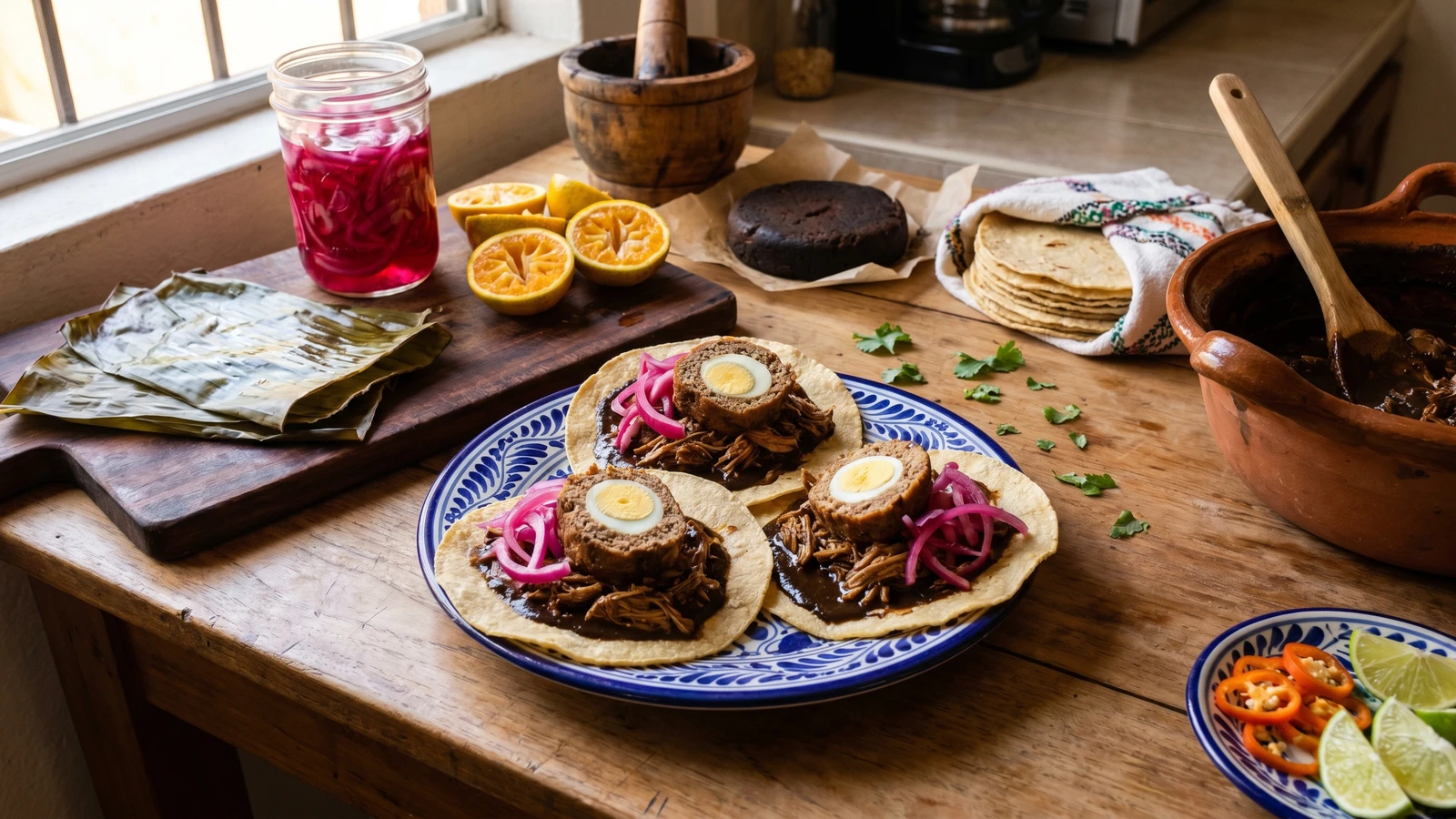
Yucatán's tacos of shredded turkey braised in recado negro, the charred-chile black sauce, finished with a slice of but, the egg-stuffed meatball, and a heap of pickled red onion.
Relleno negro belongs to Yucatán. Not to Mexico in the generic sense. To the Peninsula, where the cooks speak a different culinary language: recado instead of mole, naranja agria instead of lime, banana leaf instead of corn husk, achiote where the rest of the country uses tomato. If you do not understand this grammar, you do not understand Yucatecan food.
The dish takes its name from the rellena, the stuffing inside the turkey, and from the negro, the black sauce that drowns it. That blackness is not from chocolate or huitlacoche. It is from chiles burned to carbon on a comal. Burned, not toasted. Yucatecan cooks are the only people in Mexico who intentionally char chiles past the point any other regional cook would call ruined. The result is a sauce that tastes of smoke, clove, allspice, and the green herbal note of banana leaf. Nothing else in Mexican cuisine tastes like it.
The but, the meatball with a whole boiled egg hidden inside, is the architecture. You slice it crosswise and the egg appears at the center of the dark slab like a moon. This is not decoration. This is the dish telling you it is for a special day. Relleno negro is what families in Valladolid and Mérida make for weddings, baptisms, and funerals. It is not weeknight food.
The tacos are how Yucatecans eat the leftovers, and frankly, how many of us prefer to eat it. The flavors concentrate overnight. The pickled red onions in naranja agria cut the depth of the recado. The habanero, sliced raw, is there for the cook who wants it. This is the Peninsula's grammar on a warm tortilla. Cada estado, su propia cocina, and this one is Yucatán's.
Relleno negro descends directly from pre-Columbian Maya cooking, where wild turkey (pavo de monte) was the ceremonial protein and chiles were charred over open wood fires as a deliberate flavor technique, not an accident. The Spanish arrival in the 16th century introduced pork, hard-boiled eggs, and the technique of stuffed meatballs (rellena), which the Maya integrated into their existing recado-and-turkey tradition to create the dish in its current form. The recado, a paste of ground spices preserved with citrus and salt, predates refrigeration and reflects the Yucatán Peninsula's tropical climate and isolation from central Mexico; the Peninsula's cuisine was historically more connected by sea to Cuba and Veracruz than overland to Mexico City, which explains why dishes like relleno negro share little with the moles of Puebla or Oaxaca.
Quantity
1 (about 2.5 pounds)
or 2 bone-in turkey thighs
Quantity
1 pound
Quantity
1/2 pound
or use additional ground pork
Quantity
12
stemmed and seeded
Quantity
6
stemmed and seeded
Quantity
4
stemmed and seeded
Quantity
1 cake (3.5 ounces)
or make from scratch using the chiles above
Quantity
1
unpeeled
Quantity
1 medium
halved
Quantity
6
peeled (4 for the but, 2 sliced for garnish)
Quantity
1/2 cup
or 1/3 cup orange juice with 3 tablespoons lime juice and 2 tablespoons white vinegar
Quantity
2 tablespoons
Quantity
1 tablespoon
Quantity
1 teaspoon
oregano yucateco if you can find it
Quantity
1 teaspoon
Quantity
1/2 teaspoon
Quantity
1/2 teaspoon
Quantity
4 whole
Quantity
1
passed over an open flame to soften
Quantity
2 tablespoons
dissolved in 1/4 cup water
Quantity
to taste
Quantity
16
warmed on a comal
Quantity
1 large
sliced into thin half-moons, for pickled onions
Quantity
1/2 cup
or substitute as above
Quantity
1 teaspoon
Quantity
2
sliced thin, for serving
Quantity
for serving
| Ingredient | Quantity |
|---|---|
| whole turkey leg quarteror 2 bone-in turkey thighs | 1 (about 2.5 pounds) |
| ground pork | 1 pound |
| ground turkey breastor use additional ground pork | 1/2 pound |
| dried chile chilmole (chile seco yucateco)stemmed and seeded | 12 |
| dried chile anchostemmed and seeded | 6 |
| dried chile guajillostemmed and seeded | 4 |
| prepared recado negro paste (optional)or make from scratch using the chiles above | 1 cake (3.5 ounces) |
| head of garlicunpeeled | 1 |
| white onionhalved | 1 medium |
| hard-boiled eggspeeled (4 for the but, 2 sliced for garnish) | 6 |
| fresh naranja agria juiceor 1/3 cup orange juice with 3 tablespoons lime juice and 2 tablespoons white vinegar | 1/2 cup |
| manteca de cerdo (pork lard) | 2 tablespoons |
| achiote paste (recado rojo) | 1 tablespoon |
| dried Mexican oreganooregano yucateco if you can find it | 1 teaspoon |
| ground cumin | 1 teaspoon |
| ground allspice (pimienta gorda) | 1/2 teaspoon |
| ground cloves | 1/2 teaspoon |
| black peppercorns | 4 whole |
| large banana leafpassed over an open flame to soften | 1 |
| masa harinadissolved in 1/4 cup water | 2 tablespoons |
| kosher salt | to taste |
| hand-pressed corn tortillaswarmed on a comal | 16 |
| red onionsliced into thin half-moons, for pickled onions | 1 large |
| fresh naranja agria juice (for pickled onions)or substitute as above | 1/2 cup |
| kosher salt (for pickled onions) | 1 teaspoon |
| fresh chile habanero (optional)sliced thin, for serving | 2 |
| lime wedges (optional) | for serving |
If you have a prepared cake of recado negro from a Yucatecan vendor, use it and skip to step 3. If you are making the recado from scratch, you need to burn the chiles. Not toast, burn. In a heavy comal over high heat, lay down the stemmed and seeded chile chilmole, ancho, and guajillo in batches. Let them blacken almost completely, turning once. They should smoke. Take them outside or open every window in the kitchen. The carbon is the recado. This is the only dish in Mexican cooking where you intentionally burn the chiles, and it is what gives relleno negro its name and its color.
Soak the charred chiles in hot water for 20 minutes. Hot water, not boiling. Drain and transfer to a blender with the peppercorns, allspice, cloves, cumin, oregano, half the head of garlic (peeled), and 1/2 cup of fresh water. Blend until you have a thick, near-black paste. Strain through a fine-mesh sieve. This is your recado negro. The Maya cooks of Yucatán have made this paste for centuries, and every family in Mérida has a slightly different balance of spices.
Place the turkey leg in a heavy pot. Cover with cold water by two inches. Add the halved white onion, the remaining half head of garlic, a tablespoon of salt, and a bay leaf if you have one. Bring to a low simmer and cook for 90 minutes, until the turkey pulls cleanly from the bone. Skim the gray foam in the first 20 minutes. Reserve the broth. This is the canvas. The broth carries the recado later, so keep it clean.
While the turkey simmers, mix the ground pork and ground turkey in a bowl with a teaspoon of salt, the achiote paste, and a pinch of allspice. Work it with your hands until it is uniform. Take one peeled hard-boiled egg and wrap it in a generous layer of the meat mixture, sealing the seams so no egg shows. Repeat with three more eggs. You should have four large meatballs, each hiding an egg at the center. The but is the architecture of relleno negro. Without it, you have stewed turkey. With it, you have the dish.
Pass the banana leaf over an open flame for a few seconds on each side until it turns deep green and supple. Cut it into squares large enough to wrap each meatball. Wrap each but tightly in banana leaf and tie with kitchen string. Lower the wrapped meatballs gently into the simmering turkey broth (after you have removed the turkey to a plate). Poach for 30 minutes at a low simmer. The banana leaf perfumes the meat with that green, herbal note that nothing else can replicate. The Peninsula's grammar.
In a wide cazuela or heavy pot, melt the lard over medium heat. Pour in the recado negro paste (or crumble in the prepared cake) and fry it for about five minutes, stirring constantly. It will deepen and the kitchen will smell of smoke and clove. La manteca es el sabor. Ladle in 4 cups of the reserved turkey broth, the naranja agria juice, and the masa-water slurry. Whisk smooth. Simmer for 15 minutes. The sauce should coat the back of a spoon and read deep black-brown, almost like burnt coffee. Taste for salt now.
Pull the cooled turkey meat from the bones in generous shreds. Discard skin and bones, or save the bones for next time. Add the shredded turkey to the simmering recado negro and let it warm through for 10 minutes. The meat should drink the sauce. If the pot looks dry, ladle in more broth. The consistency is a thick stew, not a soup.
While the relleno finishes, slice the red onion into thin half-moons. Place in a glass jar or bowl, pour over the naranja agria juice and the salt, and toss. Let sit for at least 15 minutes. The onions will turn bright pink. Every Yucatecan table has a bowl of these onions. Cebolla morada en escabeche. No taco from the Peninsula is complete without them.
Lift the wrapped meatballs from the broth and let them rest for five minutes before unwrapping. Cut the strings, peel back the banana leaves, and slice each meatball crosswise into thick rounds. The egg should appear at the center of each slice like a pale moon in a dark field. Así se hace. The but is the visual signature of relleno negro and the reason this dish is served on holidays and at weddings.
Warm the corn tortillas on a comal until they puff slightly and char in spots. Lay each tortilla on a plate. Spoon a generous portion of the black turkey onto the center. Top with a slice of but so the egg shows. Finish with a heap of pickled red onion. Pass habanero slices and lime wedges at the table for those who want them. Eat with your hands. This is the way the señoras in Valladolid and the cocineras at the Mercado Lucas de Galvez serve it. Recetas probadas y garantizadas.
1 serving (about 380g)
Culinary guides, cultural storytelling, and the editorial depth that makes cooking meaningful.
Discover Culinary ExplorerChef Lupita
Jalisco's goat birria, born around Cocula and carried into Guadalajara's markets, slow-braised in ancho, guajillo, cascabel, and chile de arbol, then tucked into corn tortillas crisped in its own red fat.

Chef Lupita
Sonora's working morning burrito: chicharrón de cáscara stewed in chile colorado with diced potato, rolled tight in a paper-thin tortilla sobaquera and eaten standing up at the carreta.

Chef Lupita
Mocorito's pork chilorio, shredded and confited in lard with chile ancho and pasilla, rolled into a thin handmade flour tortilla. The burrito Sinaloa sends out into the world.

Chef Lupita
Sonora's morning burrito of mashed pinto frijoles puercos and melted queso asadero, wrapped in a paper-thin sobaquera and seared on the comal until the cheese pulls in long strings.