
Chef Lupita
Birria Tacos with Consome
Jalisco's goat birria, born around Cocula and carried into Guadalajara's markets, slow-braised in ancho, guajillo, cascabel, and chile de arbol, then tucked into corn tortillas crisped in its own red fat.
A cooking platform built around craft, culture, and the stories behind what we eat.
Created by
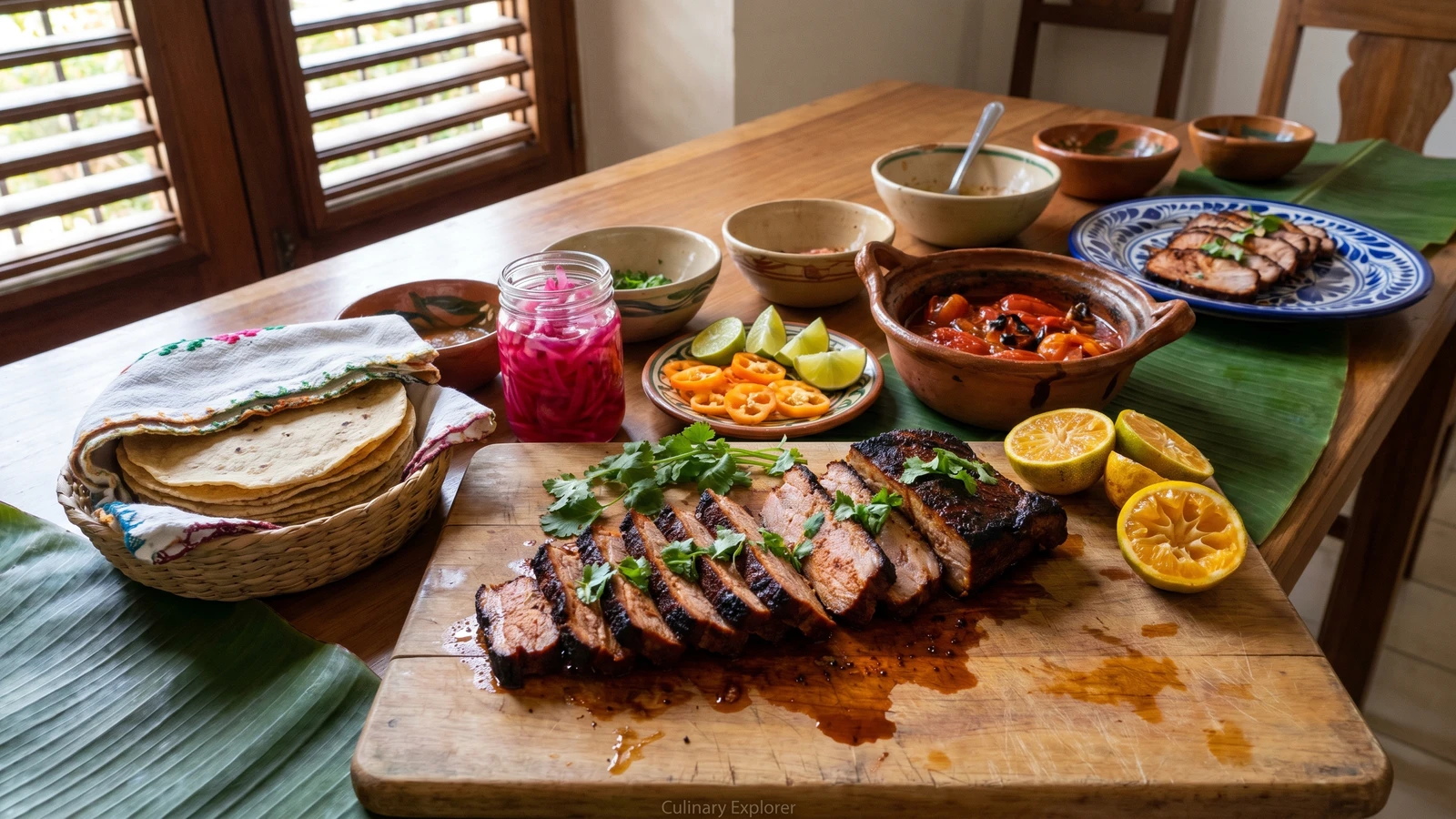
Yucatán's quick-grilled pork taco: thin pork steaks marinated in naranja agria, charred over wood until the edges curl, then folded into warm corn tortillas with chiltomate and bright magenta pickled onion.
Poc chuc is from Yucatán. Not Mexico. Yucatán. The Peninsula has its own grammar, its own pantry, its own way of cooking, and if you treat it like generic Mexican food, you have already gotten it wrong. The recado is different. The chile is habanero, not jalapeño. The citrus is naranja agria, not lime. The oregano is oregano yucateco, more floral and sharper than the Mexican oregano you find on the central plateau. Cada estado, su propia cocina, and the Peninsula has its own.
The name itself is Maya. Poc chuc means slow-burned charcoal, and the technique is exactly that: thin slices of pork pounded down to a quarter inch, marinated in naranja agria with garlic and a whisper of pimienta gorda, then thrown onto glowing embers for less than two minutes a side. The fire is the recipe. If you do not have wood or charcoal, you can use a screaming hot cast iron pan, but you are making a translation, not the dish. I have eaten poc chuc at the roadside stands outside Maní and at the cocinas economicas of Mérida, and I have watched the cocineras work the fire with palm fans, never letting the embers cool. That image is the dish.
The accompaniments are not negotiable. Cebolla morada en escabeche, the pickled red onion that turns magenta in naranja agria. Chiltomate, the roasted tomato salsa with charred habanero. Warm corn tortillas pressed by hand. A few drops of lime if you want. That is the table. No cheese. No sour cream. No flour tortillas. The Peninsula does not need any of that.
My mother did not cook Yucatecan food. She was from Jalisco and the Peninsula was as foreign to her as France. But the first time I ate poc chuc, at a tiny fonda in Ticul during my fieldwork year, I understood why the cooks in the south guard their tradition the way they do. The flavors do not exist anywhere else in the world. Saber cocinar es saber vivir, and to know the Peninsula is to know a kitchen that owes nothing to anyone.
Poc chuc descends from Maya techniques of cooking thin cuts of game and later domesticated pork directly over coals, distinct from the buried pit method (pib) used for cochinita and other ceremonial dishes. The combination of naranja agria with garlic and pimienta gorda reflects the Peninsula's specific colonial encounter: Seville orange trees were planted by the Spanish in the 16th century and flourished in Yucatán's limestone soil, becoming as essential to the regional cuisine as the indigenous achiote. The dish as it is served today, with chiltomate and cebolla morada in escabeche on the side, was codified in the 20th century in the small towns of the Mérida-Maní corridor, where roadside fondas built their reputations on a single perfect plate.
Quantity
2 pounds
sliced into 1/4-inch thick steaks
Quantity
1 cup
or 1/2 cup fresh orange juice mixed with 1/4 cup lime juice and 1/4 cup white vinegar
Quantity
6
crushed
Quantity
1 teaspoon
preferably oregano yucateco
Quantity
1/2 teaspoon
Quantity
1/2 teaspoon
Quantity
1 tablespoon
Quantity
2 tablespoons
melted
Quantity
1
sliced into thin half-moons
Quantity
1/2 cup
Quantity
1 teaspoon
Quantity
1/2 teaspoon
Quantity
4
Quantity
1
halved
Quantity
2
unpeeled
Quantity
1
whole
Quantity
1 teaspoon
Quantity
16
warmed
Quantity
1
finely sliced
Quantity
for serving
Quantity
for serving
| Ingredient | Quantity |
|---|---|
| boneless pork leg or pork shouldersliced into 1/4-inch thick steaks | 2 pounds |
| fresh naranja agria juiceor 1/2 cup fresh orange juice mixed with 1/4 cup lime juice and 1/4 cup white vinegar | 1 cup |
| garlic clovescrushed | 6 |
| dried Mexican oreganopreferably oregano yucateco | 1 teaspoon |
| ground allspice (pimienta gorda) | 1/2 teaspoon |
| ground black pepper | 1/2 teaspoon |
| kosher salt | 1 tablespoon |
| manteca de cerdo (pork lard)melted | 2 tablespoons |
| large red onionsliced into thin half-moons | 1 |
| fresh naranja agria juice (for the pickled onion) | 1/2 cup |
| kosher salt (for the pickled onion) | 1 teaspoon |
| dried Mexican oregano (for the pickled onion) | 1/2 teaspoon |
| medium ripe tomatoes | 4 |
| small white onionhalved | 1 |
| garlic clovesunpeeled | 2 |
| chile habanero (for the chiltomate)whole | 1 |
| kosher salt (for the chiltomate) | 1 teaspoon |
| hand-pressed corn tortillaswarmed | 16 |
| chile habanero (for serving) (optional)finely sliced | 1 |
| lime wedges (optional) | for serving |
| fresh cilantro leaves (optional) | for serving |
Lay each piece of pork between two sheets of plastic wrap and pound lightly with the flat side of a heavy knife or a meat mallet until each slice is about a quarter inch thick. Thin and even. The poc chuc cooks fast over hot fire, and uneven slices will be raw in the middle and dry at the edges. This is a quick-grill dish, not a slow-roast dish. The thinness is the technique.
In a bowl, combine the cup of naranja agria juice with the crushed garlic, oregano yucateco, ground allspice, black pepper, and salt. Whisk together. The naranja agria is the soul of this marinade. It is not orange juice and it is not lime juice. It is the bitter orange that grows in Yucatecan patios, and its perfume is what makes poc chuc taste like poc chuc. If you cannot find it, the orange-lime-vinegar mix gets you close, but tell yourself the truth: it is a compromise, not an upgrade.
Lay the pounded pork in a shallow dish or a heavy zip-top bag. Pour the marinade over the meat and turn each piece so it is fully bathed. Refrigerate for at least four hours, and up to overnight. Less than four hours and the naranja agria has not done its work. More than twelve and the acid starts to break down the proteins past the point you want. Four to eight hours is the window the Yucatecan cooks I trust hold to.
While the pork marinates, place the sliced red onion in a heatproof bowl. Pour boiling water over the slices, let them sit for 30 seconds, then drain. This blanching takes the raw bite off without cooking the onion. Return to the bowl and add the half cup of naranja agria, salt, and oregano. Toss well and let sit at room temperature for at least one hour. The onions will turn bright magenta. This is the cebolla morada en escabeche that goes on top of every taco in Mérida.
Heat a dry comal over medium-high. Char the tomatoes, white onion halves, garlic cloves, and the whole habanero on the comal, turning often. The tomato skins should blister and blacken in patches. The onion should be marked dark on the cut sides. The habanero should be marked but not collapsed. About eight to ten minutes total. Pull each item off as it is ready. Peel the garlic. Pull the stem off the habanero. Transfer everything to a molcajete or a blender and grind or pulse to a chunky salsa with the salt. This is chiltomate. Tomato and chile and char. That is all. Yucatecan salsas do not need ten ingredients.
Light a charcoal grill or a wood fire and let it burn down to glowing embers with a fine layer of white ash. You want a hot fire, not a flaming one. Poc chuc literally means slow-burned charcoal in Maya, and the dish takes its name from the technique. The pork should kiss the embers and char in seconds, not roast slowly over indirect heat. If you must use gas, set it as hot as it will go. If you can cook over wood, do.
Lift the pork slices out of the marinade and let the excess drip off. Brush each piece lightly with the melted manteca de cerdo. Lay the slices directly on the hot grate. They should hiss and sear instantly. Grill for about 90 seconds per side. The edges should char and curl. The meat should still be juicy at the center. Total cooking time per slice is two to three minutes. If you cook poc chuc longer than that, you have made a different, sadder dish. La manteca es el sabor and the char is the technique.
Move the grilled pork to a wooden cutting board and let it rest for three minutes. Then slice across the grain into thin strips. Pour any juices that have pooled on the cutting board back over the meat. Those juices are not garbage. They are the dressing.
On the same hot comal you used for the chiltomate, warm the corn tortillas in batches. Twenty seconds per side. They should puff slightly and pick up a few brown spots. Wrap them in a clean cotton servilleta as they come off the comal so they steam each other warm and pliable. Use hand-pressed corn tortillas. Flour tortillas have no place at this table.
Set the sliced poc chuc, the chiltomate, the pickled red onion, the sliced habanero, the lime wedges, and the cilantro out at the table in small dishes. Each person builds their own taco: a warm tortilla, a few strips of pork, a spoonful of chiltomate, a tangle of pickled onion, and habanero if they dare. Squeeze of lime at the end. Eat immediately. Poc chuc waits for nobody. Así se hace y punto.
1 serving (about 220g)
Culinary guides, cultural storytelling, and the editorial depth that makes cooking meaningful.
Discover Culinary ExplorerChef Lupita
Jalisco's goat birria, born around Cocula and carried into Guadalajara's markets, slow-braised in ancho, guajillo, cascabel, and chile de arbol, then tucked into corn tortillas crisped in its own red fat.

Chef Lupita
Sonora's working morning burrito: chicharrón de cáscara stewed in chile colorado with diced potato, rolled tight in a paper-thin tortilla sobaquera and eaten standing up at the carreta.

Chef Lupita
Mocorito's pork chilorio, shredded and confited in lard with chile ancho and pasilla, rolled into a thin handmade flour tortilla. The burrito Sinaloa sends out into the world.

Chef Lupita
Sonora's morning burrito of mashed pinto frijoles puercos and melted queso asadero, wrapped in a paper-thin sobaquera and seared on the comal until the cheese pulls in long strings.