
Chef Lupita
Burrito de Chicharrón Sonorense
Sonora's working morning burrito: chicharrón de cáscara stewed in chile colorado with diced potato, rolled tight in a paper-thin tortilla sobaquera and eaten standing up at the carreta.
A cooking platform built around craft, culture, and the stories behind what we eat.
Created by
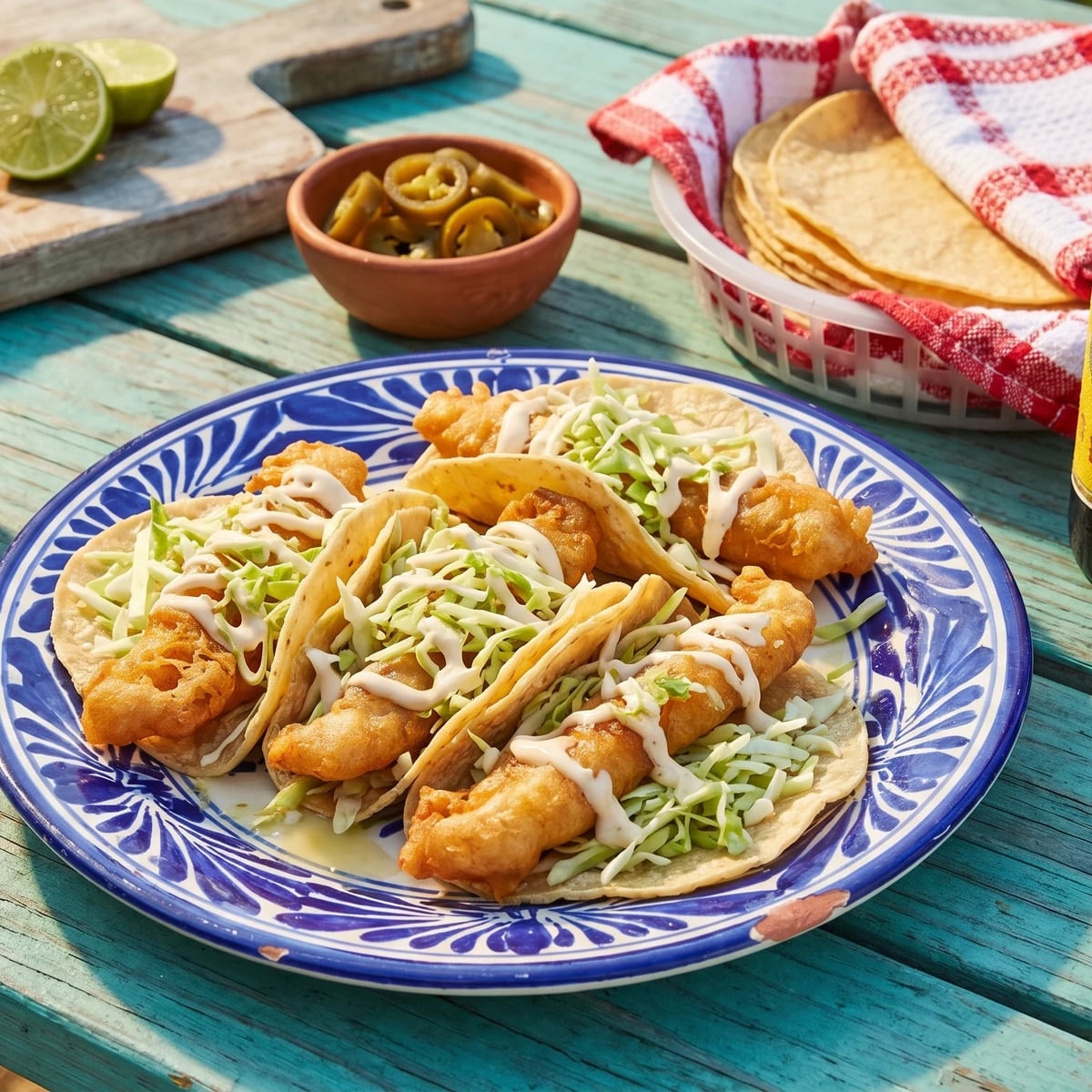
Baja California's Ensenada fish taco: Pacific cod fried in a cold-beer batter, piled with shredded cabbage, crema-mayo, and lime on a warm corn tortilla. The taco that built a port city's reputation.
This taco is from Ensenada, Baja California. Not San Diego, not Los Angeles, not the Mexican-inspired food trucks that built careers off this dish without ever crossing the border to learn it. Ensenada. The carretas on Avenida Lopez Mateos and the stalls inside the Mercado Negro near the harbor are where this taco was born and where it is still made best.
The fish is Pacific cod or rock cod or halibut, whatever the boats bring in that morning. The batter is light, lacy, blistered, made with cold Mexican lager and a hand that does not overwork the flour. The tortilla is corn, small, warmed on a comal, never flour. The cabbage is shredded thin, never lettuce. The sauce is crema thinned with mayonnaise and lime, drizzled across the top. Lime wedges on the side. Salsa de chile de arbol if you want heat. That is the taco. Anything more is a costume.
I traveled to Ensenada in 2014 for a chapter of the Baja California cookbook, and I spent four days at the Mercado Negro and the carretas talking to the cooks who have been doing this for thirty years. Every one of them said the same thing: the fish has to be fresh, the oil has to be hot, the batter has to be cold, the tortilla has to be warm. Get those four right and the taco makes itself. Get any one of them wrong and you will know. Saber cocinar es saber vivir.
The Ensenada-style fish taco is generally traced to the carretas and market stalls of the port city's Mercado Negro in the 1950s and 1960s, where Japanese fishing influence, Asian tempura technique met Pacific cod, and Mexican home cooking, the warm corn tortilla and the shredded cabbage, fused into a single taco. The dish was popularized outside Baja in the 1980s when surfer-traveler Ralph Rubio brought a version to San Diego and built a chain around it, but the original carretas of Ensenada predate that commercialization by at least three decades. Baja Californians firmly distinguish their pescado capeado from later California iterations: the ratio of light batter to fresh-caught white fish, the corn tortilla, and the crema-mayo are the markers of the Ensenada original, not the heavy beer-battered halibut and flour tortilla served north of the border.
Quantity
1 1/2 pounds
cut into strips about 3 inches long and 3/4 inch thick
Quantity
1 cup, plus 1/4 cup for dredging
Quantity
2 tablespoons
Quantity
1 teaspoon
Quantity
1 teaspoon
crumbled
Quantity
1/2 teaspoon
Quantity
1/2 teaspoon
Quantity
1/2 teaspoon
Quantity
1
lightly beaten
Quantity
1 cup
Quantity
4 cups
Quantity
1/2 cup
Quantity
1/2 cup
Quantity
1 tablespoon
Quantity
1/2 teaspoon
Quantity
3 cups
Quantity
12
warmed on a comal
Quantity
2
cut into wedges
Quantity
for serving
Quantity
for serving
| Ingredient | Quantity |
|---|---|
| firm white fish fillets (Pacific cod, halibut, or rock cod)cut into strips about 3 inches long and 3/4 inch thick | 1 1/2 pounds |
| all-purpose flour | 1 cup, plus 1/4 cup for dredging |
| cornstarch | 2 tablespoons |
| kosher salt | 1 teaspoon |
| dried Mexican oreganocrumbled | 1 teaspoon |
| ground chile de arbol or cayenne | 1/2 teaspoon |
| garlic powder | 1/2 teaspoon |
| freshly ground black pepper | 1/2 teaspoon |
| large egglightly beaten | 1 |
| ice-cold Mexican lager (Pacifico or Tecate) | 1 cup |
| vegetable oil or lard, for frying | 4 cups |
| Mexican crema | 1/2 cup |
| mayonnaise | 1/2 cup |
| fresh lime juice | 1 tablespoon |
| kosher salt | 1/2 teaspoon |
| very thinly shredded green cabbage | 3 cups |
| small corn tortillas (4 to 5 inches)warmed on a comal | 12 |
| limescut into wedges | 2 |
| salsa de chile de arbol or salsa bandera (optional) | for serving |
| pickled jalapenos en escabeche (optional) | for serving |
Pat the fish strips dry with paper towels and lay them on a plate in a single layer. Wet fish does not batter. The flour will slide off and you will end up with greasy strips and bare fish. Refrigerate the strips while you build the rest of the dish.
In a small bowl, whisk together the crema, mayonnaise, lime juice, and salt until smooth. Taste it. It should be tangy and loose enough to drizzle off a spoon. If it is too thick, thin it with a teaspoon of cold water. This sauce is non-negotiable on an Ensenada fish taco. Without it the cabbage is dry and the fish has nothing to lean on. Refrigerate until you are ready to assemble.
In a medium bowl, whisk together 1 cup flour, the cornstarch, salt, oregano, ground chile de arbol, garlic powder, and black pepper. Make a well in the center. Pour in the beaten egg and the ice-cold beer. Whisk just until smooth. The batter should coat the back of a spoon and slowly drip off in a thick ribbon. Do not overwork it. The cold beer and the gentle hand are what give the batter its lightness. No me vengas con atajos.
Pour the oil into a heavy 4-quart pot or wide cast iron skillet to a depth of at least 2 inches. Heat over medium-high until it reaches 360F. If you do not have a thermometer, drop a small piece of bread in. It should brown in 30 seconds. Too cool and the batter absorbs oil and turns greasy. Too hot and the outside burns before the fish cooks. La temperatura es la receta.
Spread the remaining 1/4 cup flour on a plate. Working with a few pieces at a time, dredge a fish strip lightly in the flour, shake off the excess, then dip it fully into the batter, letting the excess drip off for a second. The flour gives the batter something to grip. Skip it and the batter slides off in the oil.
Lower the battered fish into the hot oil one piece at a time, away from you. Fry 4 or 5 strips at once, do not crowd the pot, the oil temperature drops and the batter goes soggy. Cook for 3 to 4 minutes total, turning once, until the crust is deep gold and the fish flakes when poked with a fork. Lift them out with a spider and drain on a wire rack set over a sheet pan. Never on paper towels. Paper towels trap steam under the crust and ruin it. Salt the fish lightly the moment it comes out of the oil.
Heat a comal or heavy skillet over medium-high. Warm the corn tortillas one or two at a time, about 20 seconds per side, until they are pliable and lightly toasted in spots. Stack them in a clean cloth servilleta as you go to keep them soft and warm. Cold tortillas crack and fight the taco. Warm tortillas hold the fish.
Lay a warm tortilla flat on a plate. Place a piece of fried fish across the center. Top with a generous handful of shredded cabbage. Drizzle with the crema-mayo. Squeeze a lime wedge over the top. Add a spoon of salsa de chile de arbol if you want heat, and a few rings of pickled jalapeno on the side. Eat it standing up, the way they do at the carretas on Avenida Lopez Mateos. Asi se hace y punto.
1 serving (about 425g)
Culinary guides, cultural storytelling, and the editorial depth that makes cooking meaningful.
Discover Culinary Explorer
Chef Lupita
Sonora's working morning burrito: chicharrón de cáscara stewed in chile colorado with diced potato, rolled tight in a paper-thin tortilla sobaquera and eaten standing up at the carreta.

Chef Lupita
Mocorito's pork chilorio, shredded and confited in lard with chile ancho and pasilla, rolled into a thin handmade flour tortilla. The burrito Sinaloa sends out into the world.

Chef Lupita
Sonora's morning burrito of mashed pinto frijoles puercos and melted queso asadero, wrapped in a paper-thin sobaquera and seared on the comal until the cheese pulls in long strings.

Chef Lupita
Baja California Sur's smoked marlin burrito, sauteed with white onion, tomato, green olives, and capers, then rolled in a paper-thin flour tortilla. The beach lunch of La Paz and Cabo, served on the sand with a cold Pacifico.