
Chef Lupita
Birria Tacos with Consome
Jalisco's goat birria, born around Cocula and carried into Guadalajara's markets, slow-braised in ancho, guajillo, cascabel, and chile de arbol, then tucked into corn tortillas crisped in its own red fat.
A cooking platform built around craft, culture, and the stories behind what we eat.
Created by
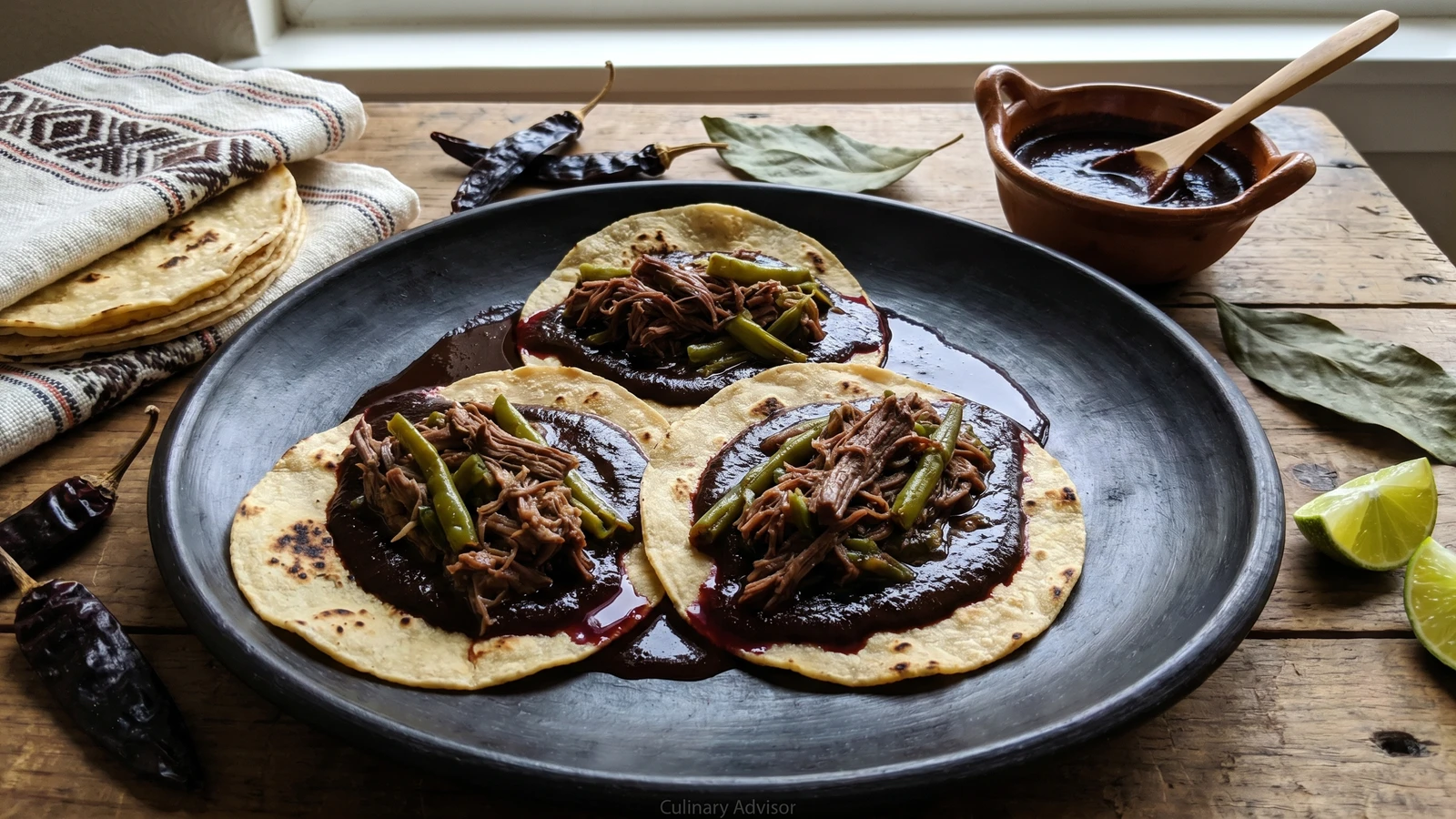
Oaxaca's darkest mole, the chichilo, built on charred tortillas and burned chile seeds, spooned over beef braised with hoja de aguacate and served in warm corn tortillas with ejotes cooked in the broth.
Oaxaca claims seven moles. Chichilo is the one nobody talks about outside the state. That should tell you something about how poorly this cuisine is understood.
Chichilo is the burned mole. Not smoky, not charred for drama. Burned. You take corn tortillas and cook them on a comal until they are black, crumbling, and past the point where any other recipe would tell you to throw them away. You do the same with the seeds from the chiles. The tortillas and the seeds go into the blender with everything else and they give the mole a bitter, ashy depth that no other sauce in Mexican cooking can replicate. It sounds wrong. It tastes like Oaxaca.
The chile that makes this work is the chilhuacle negro. It grows in the Canada region of Oaxaca and almost nowhere else. Without it, you are making a different sauce. The hoja de aguacate, avocado leaf, is the second signature. You toast it on a dry comal until it curls and the kitchen smells like anise. That perfume runs through the whole dish. In the Valles Centrales, senoras add the toasted leaf to the broth and grind more into the mole itself. Double the dose, because the flavor needs to hold against the bitterness of the char.
I collected three versions of chichilo from cooks in the Central de Abastos in Oaxaca city. One used beef shank with the bone. One used a mix of beef and pork. The third, the oldest woman at the stall, used only beef ribs and told me the bone marrow was half the flavor of the broth. I believed her. My version here uses bone-in beef shank because it gives you the collagen, the marrow, and the meat all in one cut. The ejotes cooked in the chichilo broth at the end are not a garnish. They are part of the dish. Cada estado, su propia cocina.
Chichilo occupies a singular position among Oaxaca's seven moles (negro, rojo, coloradito, amarillo, verde, chichilo, and manchamanteles) as the only one defined by deliberate carbonization of its components. The technique of burning tortillas and chile seeds into the sauce base likely predates the colonial period, reflecting pre-Columbian Zapotec practices of using ash and char as flavoring and thickening agents in ritual foods. The chilhuacle negro chile, essential to chichilo's near-black color, is an heirloom cultivar grown almost exclusively in the Canada Chica region of northern Oaxaca, where annual production has declined sharply since the 1990s, making it one of the most endangered commercially available chiles in Mexico. Chichilo is traditionally associated with funeral meals and Dia de Muertos observances in the Valles Centrales, where its dark color and bitter depth carry symbolic weight that the lighter, sweeter moles do not.
Quantity
2 pounds
cut into 2-inch thick rounds
Quantity
1/2 medium
Quantity
4
unpeeled
Quantity
2
Quantity
1 tablespoon, plus more to taste
Quantity
6
stemmed, seeds reserved
Quantity
4
stemmed, seeds reserved
Quantity
2
stemmed, seeds reserved
Quantity
3
Quantity
4 medium
husked and rinsed
Quantity
1/2 medium
Quantity
4
unpeeled
Quantity
4
Quantity
4
Quantity
6
Quantity
1/2 teaspoon
Quantity
1 small stick
Quantity
1 teaspoon
Quantity
2 tablespoons
Quantity
1/2 pound
trimmed and cut into 2-inch pieces
Quantity
for serving
Quantity
for serving
| Ingredient | Quantity |
|---|---|
| bone-in beef shankcut into 2-inch thick rounds | 2 pounds |
| white onion (for broth) | 1/2 medium |
| garlic cloves (for broth)unpeeled | 4 |
| dried avocado leaves, hoja de aguacate (for broth) | 2 |
| kosher salt | 1 tablespoon, plus more to taste |
| dried chile chilhuacle negrostemmed, seeds reserved | 6 |
| dried chile mulatostemmed, seeds reserved | 4 |
| dried chile pasilla mexicanostemmed, seeds reserved | 2 |
| corn tortillas | 3 |
| tomatilloshusked and rinsed | 4 medium |
| white onion (for mole) | 1/2 medium |
| garlic cloves (for mole)unpeeled | 4 |
| dried avocado leaves, hoja de aguacate (for mole) | 4 |
| whole cloves | 4 |
| black peppercorns | 6 |
| cumin seeds | 1/2 teaspoon |
| Mexican cinnamon (canela) | 1 small stick |
| dried Mexican oregano | 1 teaspoon |
| pork lard (manteca de cerdo) | 2 tablespoons |
| ejotes (green beans)trimmed and cut into 2-inch pieces | 1/2 pound |
| warm hand-pressed corn tortillas | for serving |
| lime wedges (optional) | for serving |
Place the beef shank rounds in a heavy stockpot and cover with cold water by two inches. Add the half onion, four unpeeled garlic cloves, two avocado leaves, and the salt. Bring to a gentle simmer over medium heat. Skim the gray foam that rises in the first ten minutes. Reduce to a lazy bubble, cover partially, and cook for two to two and a half hours, until the meat is fork-tender and pulling away from the bone. The marrow should be soft and loose in the center of the shank. That marrow is going to enrich the broth. Do not rush this.
While the beef simmers, heat a dry comal or cast iron skillet over medium-high. Place the three corn tortillas directly on the comal and cook them past golden, past dark, until they are black on both sides and brittle enough to snap. This takes four to five minutes per side. They should look ruined. They are not. Set them aside. On the same comal, spread the reserved chile seeds in a single layer and toast them, stirring constantly, until they are blackened and smoking. This takes two to three minutes. They will smell acrid and sharp. That is the flavor you are building. Transfer to a small bowl.
Lower the comal to medium heat. Toast the chilhuacle negro, mulato, and pasilla mexicano separately, pressing each one flat with a spatula for about 20 to 30 seconds per side. They should puff, blister, and release a deep, earthy fragrance. Do not blacken the chiles themselves. The char comes from the tortillas and seeds, not the chile skin. A burned chile turns bitter in the wrong way, sharp and acrid instead of deep and ashy. Place the toasted chiles in a heatproof bowl, cover with hot tap water, and soak for 20 minutes.
On the same hot comal, place the husked tomatillos, the half onion (cut side down), and the four unpeeled garlic cloves. Let them char without moving them. The tomatillos need five to seven minutes, turning once, until they are soft and blackened in spots. The onion needs about eight minutes, cut side down, until deeply charred. The garlic cloves need four minutes, turning occasionally, until the papery skin is spotted dark and the cloves inside feel soft when pressed. Set everything aside. Peel the garlic once cool enough to handle.
On the comal over low heat, toast the cloves, peppercorns, cumin seeds, cinnamon stick, and oregano for about one minute, shaking the pan, until fragrant. Transfer to a spice grinder or molcajete and grind to a fine powder. On the same comal, toast the four avocado leaves one at a time for about ten seconds per side, until they curl and release a strong anise perfume. Crumble two of the leaves into the ground spices. Reserve the other two whole.
Drain the soaked chiles, reserving half a cup of the soaking liquid. Break the burned tortillas into rough pieces. Working in batches, blend the soaked chiles, burned tortilla pieces, blackened chile seeds, charred tomatillos, charred onion, peeled garlic, ground spice mixture with crumbled avocado leaf, and one cup of the beef broth. Add the reserved soaking liquid only if the blender struggles. Blend until completely smooth. This takes three to four minutes of blending in a standard machine. The paste should be very dark, almost black, and thick enough to coat the back of a spoon. Strain through a medium-mesh sieve, pressing hard on the solids. You want a smooth, dark puree. Discard the skins.
In a heavy cazuela or Dutch oven, melt the lard over medium heat. When the lard shimmers, pour in the strained chichilo paste. It will sputter and darken immediately. Stir constantly for seven to eight minutes. The paste will thicken, deepen in color, and the fat will start to separate at the edges. La manteca es el sabor. This frying step concentrates the flavors and removes the raw taste from the chiles. You will smell the burned tortilla and the anise of the avocado leaf coming together. That is the moment you know the chichilo is alive.
Ladle three cups of the beef broth through a strainer into the fried mole paste, stirring as you pour. Add the two reserved whole toasted avocado leaves. The sauce should be the consistency of a medium-bodied gravy, dark enough to stain the spoon, thin enough to pool on a plate. If it is too thick, add broth a half cup at a time. Taste for salt. The bitterness from the char should be present but balanced by the earthiness of the chiles and the sweetness of the tomatillo. Simmer on low for 20 minutes, stirring occasionally, so the flavors marry.
Remove the beef shanks from their broth. Pull the meat from the bones in rough shreds, discarding the bones, cartilage, and spent aromatics. Push any loose marrow into the broth. Add the ejotes to the simmering chichilo and cook for eight to ten minutes, until they are tender but still have a slight bite. Add the shredded beef to the pot and stir gently to coat everything in the dark sauce. Let it all simmer together for five more minutes. The beef absorbs the mole. The ejotes soften into the broth. Asi se hace y punto.
Warm your corn tortillas on a comal until they are pliable and lightly charred in spots. Spoon the shredded beef onto each tortilla, making sure to get a few ejotes and a generous pool of the dark chichilo sauce. Fish out and discard the whole avocado leaves from the pot before serving. Set lime wedges on the table for those who want them, but taste the taco first without. The chichilo should speak for itself. Recetas probadas y garantizadas.
1 serving (about 330g)
Culinary guides, cultural storytelling, and the editorial depth that makes cooking meaningful.
Discover Culinary ExplorerChef Lupita
Jalisco's goat birria, born around Cocula and carried into Guadalajara's markets, slow-braised in ancho, guajillo, cascabel, and chile de arbol, then tucked into corn tortillas crisped in its own red fat.

Chef Lupita
Sonora's working morning burrito: chicharrón de cáscara stewed in chile colorado with diced potato, rolled tight in a paper-thin tortilla sobaquera and eaten standing up at the carreta.

Chef Lupita
Mocorito's pork chilorio, shredded and confited in lard with chile ancho and pasilla, rolled into a thin handmade flour tortilla. The burrito Sinaloa sends out into the world.

Chef Lupita
Sonora's morning burrito of mashed pinto frijoles puercos and melted queso asadero, wrapped in a paper-thin sobaquera and seared on the comal until the cheese pulls in long strings.