
Chef Lupita
Birria Tacos with Consome
Jalisco's goat birria, born around Cocula and carried into Guadalajara's markets, slow-braised in ancho, guajillo, cascabel, and chile de arbol, then tucked into corn tortillas crisped in its own red fat.
A cooking platform built around craft, culture, and the stories behind what we eat.
Created by
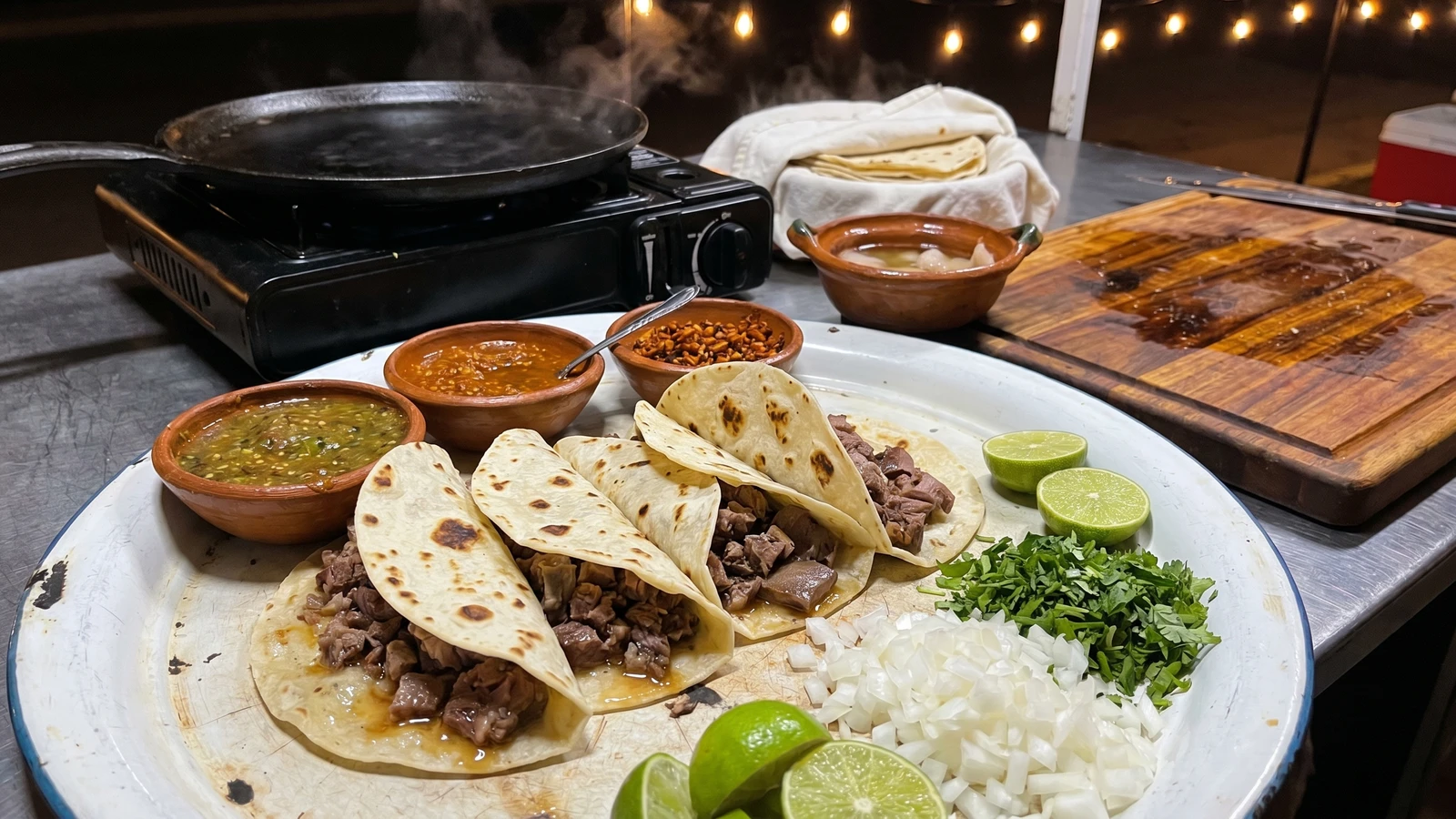
Hermosillo's weekend taco. Beef cheek and tongue steamed for hours, chopped fine, and folded into paper-thin Sonoran flour tortillas with salsa verde, raw onion, cilantro, and lime.
This is a Sonoran taco. Specifically from Hermosillo, where the carretas roll out late on Friday and Saturday nights and the line in front of the cabeza cart at dawn on Sunday is the line for breakfast. The Noroeste does not eat tacos the way the south does. Up here, the tortilla is flour, not corn, and that is not a deviation from Mexican tradition. It is its own tradition, a Sonoran birthright that runs from the wheat fields of the Yaqui Valley through every kitchen in the state.
The meat is beef-head, cooked the way Sonoran cooks have always cooked tough cuts: slow, moist, and patient. In the carretas they steam the whole head wrapped in maguey or cloth in a pit oven. At home you build the same logic with a tall stockpot and a steamer rack. Cheek for richness. Tongue for that dense, beefy bite. Maciza de cabeza if your butcher will sell it to you. Four hours of steam and the meat falls off the bone with no resistance, ready to be chopped fine and folded into a tortilla so thin you can see your hand through it.
The flour tortilla is the test. Lard, flour, salt, hot water. That is the recipe. La manteca es el sabor. The Sonorense tortilla is paper-thin, blistered with brown spots from a hot comal, big enough to wrap a generous fist of meat, and soft enough to fold without cracking. The senoras who sell them outside the Hermosillo airport do not use a press. They stretch each one by hand and the dough remembers their fingers. Cada estado, su propia cocina, and Sonora is flour country. Asi se hace y punto.
Tacos de cabeza belong to a broader tradition of barbacoa de cabeza practiced across northern Mexico, where pit-cooked or steamed beef head emerged in the 19th century as ranch and butcher-shop economy: nothing of the slaughtered animal was wasted, and the head, wrapped in maguey or cloth, was buried with hot stones overnight. Sonora's version diverged from the central-Mexican lamb barbacoa tradition by using beef, reflecting the state's identity as Mexico's leading cattle-ranching region since the colonial encomiendas of the 17th century. The flour tortilla itself is a direct legacy of Spanish wheat cultivation introduced to the Noroeste by Jesuit missionaries in the 17th and 18th centuries, particularly along the Yaqui and Mayo river valleys, where wheat thrived in conditions where corn struggled.
Quantity
4 pounds
trimmed of silverskin
Quantity
2 pounds
rinsed
Quantity
1 pound
if your butcher will sell it
Quantity
1 medium
halved
Quantity
1
halved crosswise
Quantity
3
Quantity
1 tablespoon
Quantity
2 tablespoons, plus more to taste
Quantity
1 pound
husked and rinsed
Quantity
4
stemmed
Quantity
2
stemmed
Quantity
4
Quantity
1 cup, packed
Quantity
1/2 medium
roughly chopped
Quantity
1 teaspoon
Quantity
3 cups, plus more for dusting
Quantity
1 teaspoon
Quantity
1/3 cup
at room temperature
Quantity
1 cup, plus more as needed
Quantity
for serving
Quantity
for serving
Quantity
for serving
Quantity
for serving
| Ingredient | Quantity |
|---|---|
| bone-in beef cheek (cachete)trimmed of silverskin | 4 pounds |
| beef tongue (lengua)rinsed | 2 pounds |
| beef cabeza meat from the jowl (maciza de cabeza)if your butcher will sell it | 1 pound |
| white onionhalved | 1 medium |
| head of garlichalved crosswise | 1 |
| bay leaves | 3 |
| whole black peppercorns | 1 tablespoon |
| kosher salt (for the steam) | 2 tablespoons, plus more to taste |
| fresh tomatilloshusked and rinsed | 1 pound |
| fresh chile serranostemmed | 4 |
| fresh chile jalapenostemmed | 2 |
| garlic cloves (for the salsa) | 4 |
| fresh cilantro leaves and tender stems | 1 cup, packed |
| white onion (for the salsa)roughly chopped | 1/2 medium |
| kosher salt (for the salsa) | 1 teaspoon |
| all-purpose flour | 3 cups, plus more for dusting |
| kosher salt (for the tortillas) | 1 teaspoon |
| pork lard (manteca de cerdo)at room temperature | 1/3 cup |
| very warm water | 1 cup, plus more as needed |
| finely diced raw white onion (optional) | for serving |
| chopped fresh cilantro (optional) | for serving |
| lime wedges (optional) | for serving |
| salsa de chiltepin (optional) | for serving |
Fit a wide stockpot with a tall steamer rack or insert. Pour in enough water to come just below the rack, about three inches. Add the halved onion, halved head of garlic, bay leaves, peppercorns, and the two tablespoons of salt to the water. This is what perfumes the meat from below. Bring to a hard simmer over medium-high heat while you arrange the meat.
Place the beef cheek, tongue, and any cabeza meat on the steamer rack. Stack heavier cuts on the bottom, lighter on top. Do not crowd. The meat needs the steam to circulate around every piece. Cover tightly. If the lid does not seal, lay a sheet of foil over the pot first and press the lid down on top.
Reduce the heat to medium-low. The water should bubble steadily, not violently. Steam for three and a half to four hours. Check the water level every hour and add boiling water from a kettle as needed. Never add cold water to a hot pot. The cheek is ready when a fork slides in with no resistance and the tongue is ready when the rough outer skin pulls off easily. The meat should be fork-tender, not falling apart. There is a difference.
Place the tomatillos, serranos, jalapenos, and the four garlic cloves in a dry comal or heavy skillet over medium-high heat. Char them. Turn them as they blacken in patches, about eight to ten minutes total. The tomatillos should soften and split. Transfer everything to a blender with the cilantro, the half onion, the teaspoon of salt, and a splash of water. Blend to a slightly chunky sauce. Taste. The salsa should be tart, hot, and green-tasting. If it is shy, add salt. If it is flat, add another raw serrano. Asi se hace y punto.
While the meat finishes, make the flour tortillas. In a wide bowl, whisk the three cups of flour with the teaspoon of salt. Add the lard and rub it into the flour with your fingertips until the mixture looks like coarse crumbs and there are no visible clumps of fat. Pour in the warm water in a steady stream while you mix with your other hand. The dough should come together into a soft, slightly tacky ball. If it is dry, add water by the tablespoon. If it is sticky, add flour by the tablespoon.
Knead the dough on the counter for two or three minutes until smooth and supple. Cover with a damp cloth and rest for thirty minutes. The gluten needs to relax or the tortillas will fight you when you stretch them. Divide the rested dough into twelve equal balls, each about the size of a small lime. Cover with the damp cloth again.
Heat a large dry comal or heavy skillet over medium-high heat. On a lightly floured counter, roll each ball into a thin round, then pick it up and stretch it gently with your hands the rest of the way. You want them thin enough to read a market receipt through. They do not need to be perfectly round. The Sonorense flour tortilla is a Noroeste birthright, not a Tex-Mex shortcut, and the woman who makes them outside the Hermosillo airport does not use a tortilla press. Her hands are the press.
Lay one tortilla on the hot comal. After about thirty seconds, brown spots will form on the underside and small bubbles will rise across the surface. Flip. Cook the second side for another twenty to thirty seconds, until lightly speckled. Stack the cooked tortillas inside a thick cloth servilleta to keep them soft and warm. Do not stack them naked on a plate. They will dry out and turn into crackers.
Lift the steamed meat onto a cutting board. Peel the rough outer skin off the tongue while it is still warm and discard it. Trim any heavy fat from the cheek. Chop everything finely with a heavy knife, mixing the cheek and tongue and any cabeza meat together as you go. Season with salt to taste. The mix should be rich, soft, and a little glossy from the natural fat. This is the cabeza filling and you do not need anything else in it.
Pile the chopped meat on a warm platter. Set out the salsa verde, the diced raw onion, the chopped cilantro, the lime wedges, and the chiltepin salsa if you are using it. Each person takes a warm flour tortilla, fills it with a generous spoonful of meat, tops with onion, cilantro, salsa, and a hard squeeze of lime, and folds. Eat immediately. Recetas probadas y garantizadas.
1 serving (about 360g)
Culinary guides, cultural storytelling, and the editorial depth that makes cooking meaningful.
Discover Culinary ExplorerChef Lupita
Jalisco's goat birria, born around Cocula and carried into Guadalajara's markets, slow-braised in ancho, guajillo, cascabel, and chile de arbol, then tucked into corn tortillas crisped in its own red fat.

Chef Lupita
Sonora's working morning burrito: chicharrón de cáscara stewed in chile colorado with diced potato, rolled tight in a paper-thin tortilla sobaquera and eaten standing up at the carreta.

Chef Lupita
Mocorito's pork chilorio, shredded and confited in lard with chile ancho and pasilla, rolled into a thin handmade flour tortilla. The burrito Sinaloa sends out into the world.

Chef Lupita
Sonora's morning burrito of mashed pinto frijoles puercos and melted queso asadero, wrapped in a paper-thin sobaquera and seared on the comal until the cheese pulls in long strings.