
Chef Lupita
Birria Tacos with Consome
Jalisco's goat birria, born around Cocula and carried into Guadalajara's markets, slow-braised in ancho, guajillo, cascabel, and chile de arbol, then tucked into corn tortillas crisped in its own red fat.
A cooking platform built around craft, culture, and the stories behind what we eat.
Created by
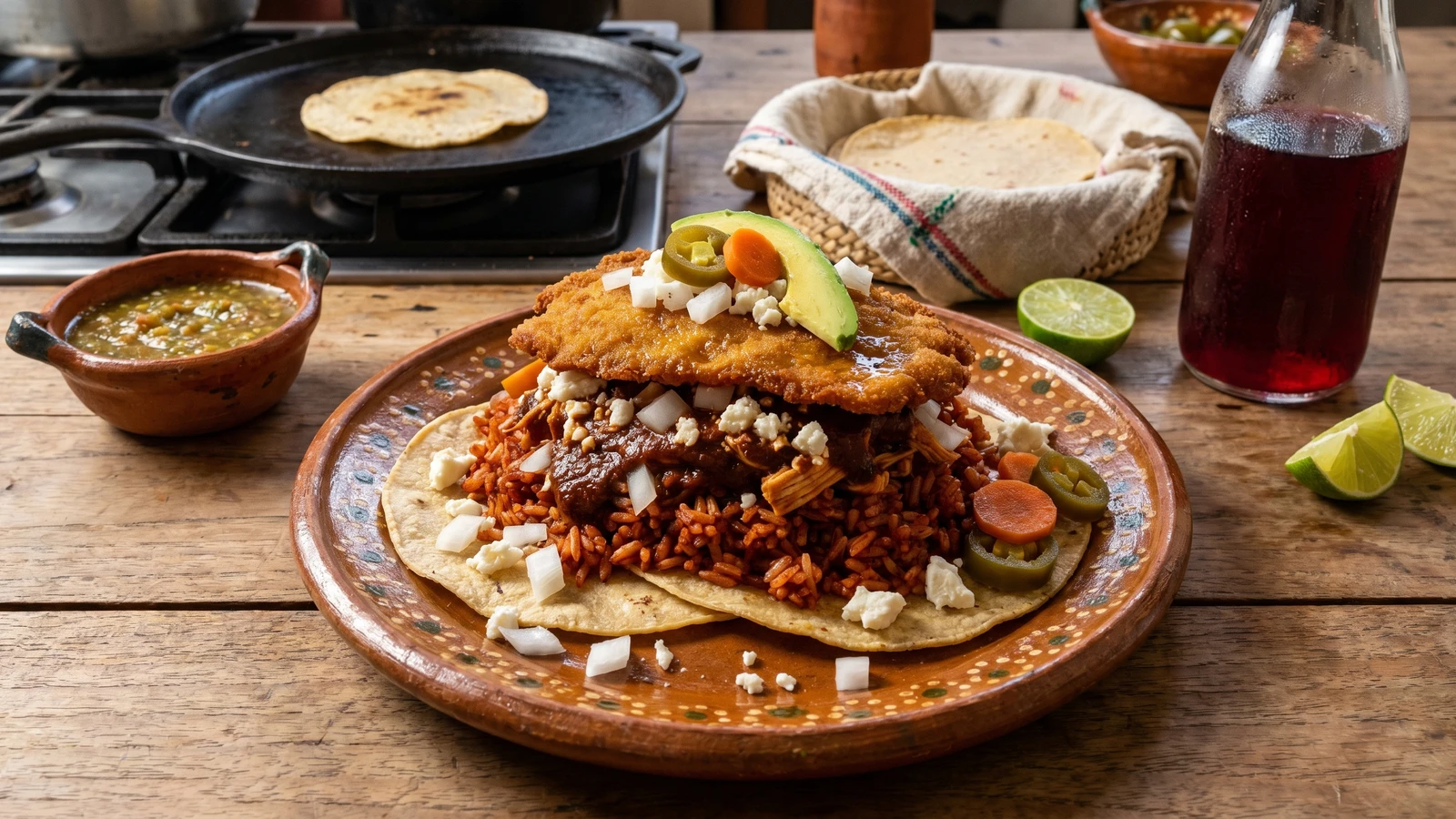
Cuautla's market taco from Morelos, doubled corn tortillas armored with red rice and chicken tinga, crowned with crisp milanesa or a fried egg. A full meal that costs what a snack costs and feeds you like dinner.
This taco is from Morelos. Specifically from Cuautla, the city east of Cuernavaca where market stands have been building acorazados the same way for decades. Acorazado means battleship, and the name is literal: two tortillas stacked as armor, a heap of red rice across them, a spoonful of guisado on top of the rice, and the whole thing crowned with crisp milanesa or a fried egg. One taco is a meal. Two is dinner for the next day.
The acorazado was born from market economics. The cooks who fed laborers and travelers in Cuautla needed a taco that was filling enough to count as a real meal and cheap enough to sell at market prices. The answer was rice. Arroz rojo morelense, fried in lard with toasted guajillo and tomato until every grain is stained red, then loaded onto doubled tortillas to give the rest of the toppings somewhere to sit. The guisado on top changes by the cook and the day: tinga, picadillo, chicharron en salsa verde, mole verde, rajas con crema. The crown of milanesa or huevo is what makes it an acorazado and not just a taco de guisado.
This is street food the way Mexico actually eats street food, not the fashionable version. You eat it standing up at a market stall, off a paper plate, with salsa from a squeeze bottle and a wedge of lime in your other hand. The second tortilla catches what spills out of the first. That is engineering, not accident.
My mother never made acorazados. She was from Jalisco and Jalisco does not eat this taco. I learned it in Cuautla, standing at a corner stand on a Tuesday morning, watching a señora named Doña Carmen layer the rice with a long-handled spoon while her daughter pressed tortillas behind her. Doña Carmen told me the rule: dos tortillas, siempre. Cada estado, su propia cocina, and this one belongs to Morelos.
The acorazado emerged in the early-to-mid 20th century in Cuautla, Morelos, a city whose central market and bus terminal made it a stop for sugar-cane workers, travelers, and traders moving between Mexico City and the Tierra Caliente. The taco's defining structure, two stacked tortillas plus a base of arroz rojo plus a guisado plus a fried crown, was an economic solution: rice was cheap, doubled tortillas held the weight, and a piece of milanesa or an egg transformed a snack into a working person's meal. While arroz rojo as a side dish appears across central Mexico, its use as the structural base of a taco is a morelense specificity, and Cuautla's market vendors continue to debate the precise origin of the format, with several family stalls claiming to have built the first one.
Quantity
12
fresh and pliable
Quantity
2 (about 4 ounces each)
pounded thin
Quantity
2
Quantity
1/2 cup
for dredging
Quantity
1 cup
Quantity
1
beaten, for breading
Quantity
1/2 teaspoon
Quantity
1/4 cup
Quantity
1 cup
Quantity
2 medium
cored
Quantity
1/4 medium, plus 2 tablespoons finely chopped
Quantity
1
Quantity
1
stemmed and seeded
Quantity
2 tablespoons
Quantity
2 cups
warm
Quantity
1/2 cup
Quantity
1 teaspoon
Quantity
1 pound
for the tinga guisado
Quantity
2, plus 1 tablespoon adobo sauce
Quantity
3
Quantity
1/2 medium
sliced thin
Quantity
2
Quantity
1 tablespoon
Quantity
1 sprig
Quantity
1/2 teaspoon
Quantity
for serving
Quantity
for serving
Quantity
for the table
Quantity
for serving
Quantity
for serving
| Ingredient | Quantity |
|---|---|
| hand-pressed corn tortillasfresh and pliable | 12 |
| thin beef milanesaspounded thin | 2 (about 4 ounces each) |
| large eggs (for frying on top) | 2 |
| all-purpose flourfor dredging | 1/2 cup |
| fine dry breadcrumbs | 1 cup |
| large eggbeaten, for breading | 1 |
| kosher salt (for milanesa) | 1/2 teaspoon |
| lard (manteca de cerdo) for frying | 1/4 cup |
| long-grain white rice | 1 cup |
| roma tomatoes (for rice)cored | 2 medium |
| white onion (for rice) | 1/4 medium, plus 2 tablespoons finely chopped |
| garlic clove (for rice) | 1 |
| dried chile guajillostemmed and seeded | 1 |
| lard (for rice) | 2 tablespoons |
| chicken brothwarm | 2 cups |
| frozen peas and diced carrots | 1/2 cup |
| kosher salt (for rice) | 1 teaspoon |
| bone-in skin-on chicken thighsfor the tinga guisado | 1 pound |
| chile chipotle in adobo | 2, plus 1 tablespoon adobo sauce |
| roma tomatoes (for tinga) | 3 |
| white onion (for tinga)sliced thin | 1/2 medium |
| garlic cloves (for tinga) | 2 |
| lard (for tinga) | 1 tablespoon |
| fresh epazote | 1 sprig |
| kosher salt (for tinga) | 1/2 teaspoon |
| sliced avocado (optional) | for serving |
| pickled jalapeños and carrots (en escabeche) (optional) | for serving |
| salsa verde or salsa roja (optional) | for the table |
| lime wedges (optional) | for serving |
| crumbled queso fresco (optional) | for serving |
Place the chicken thighs in a small pot. Cover with cold water by an inch. Add half an onion, one peeled garlic clove, and a pinch of salt. Bring to a low simmer and cook for 25 minutes, until the chicken pulls apart easily. Lift the thighs out, let them cool enough to handle, then shred the meat off the bone with your fingers. Save one cup of the poaching liquid. Discard the rest of the broth solids.
Heat a dry comal over medium. Toast the guajillo for the rice for about 20 seconds per side, until it puffs and smells warm. Do not blacken it. Drop it in a heatproof bowl with the two cored tomatoes for the rice, the quarter onion, and one garlic clove. Cover with hot tap water and let everything soften for 10 minutes. Transfer to a blender with 1/2 cup of the soaking water and blend until smooth. Strain. You want about one cup of red puree.
Rinse the rice in cold water until the water runs clear. Drain well. In a medium pot with a tight lid, melt 2 tablespoons of lard over medium heat. Add the drained rice and stir constantly for 4 to 5 minutes, until the grains turn opaque white and smell toasty. La manteca es el sabor. This is the step that gives morelense rice its character. Skip it and you have rice pudding.
Pour the red puree into the toasted rice. It will sputter. Cook for 2 minutes, stirring, until the puree darkens and coats every grain. Add the warm chicken broth, the peas and carrots, and the teaspoon of salt. Stir once. Bring to a boil, then drop to the lowest heat, cover tight, and cook for 18 minutes. Do not lift the lid. Pull off the heat and let it rest covered for 10 minutes. Fluff with a fork. The rice should be loose, deeply red, and tender. This is the armor of the taco.
Char the three tinga tomatoes and two garlic cloves on a dry comal until blackened in spots and soft, about 8 minutes. Transfer to a blender with the chile chipotle, the adobo sauce, and a splash of the reserved poaching liquid. Blend smooth. Melt the tablespoon of lard in a wide skillet over medium heat. Add the sliced onion and cook until soft and translucent, about 5 minutes. Pour in the chipotle puree. It will sputter and darken. Cook for 4 minutes, stirring, until the sauce thickens and the fat starts to break. Add the shredded chicken, the epazote sprig, half a cup of the reserved poaching liquid, and the half teaspoon of salt. Simmer for 10 minutes, until the chicken drinks up the sauce and the mixture is moist but not soupy. Pull out the epazote stem. Taste for salt.
Pound the milanesas thin between two sheets of plastic if your butcher has not done it already. Season with the half teaspoon of salt. Set up three shallow plates: flour, beaten egg, breadcrumbs. Dredge each milanesa in flour, then egg, then press firmly into the breadcrumbs. Melt the quarter cup of lard in a wide skillet over medium-high heat. When it shimmers, lay in the milanesa and fry for 90 seconds per side, until the breading is deep gold and crackling. Drain on a wire rack. Cut each milanesa in half so you have four pieces.
Wipe the milanesa skillet and add a tablespoon more lard. Fry the eggs over medium heat, sunny side up, until the whites are set but the yolks still tremble. Salt them lightly. The egg-topped acorazados need that runny yolk to bind everything together when you bite in.
Heat the comal over medium. Warm each tortilla for about 20 seconds per side, until soft and lightly speckled. Stack them in a hand-woven servilleta to hold the heat. The acorazado uses two tortillas stacked, not one. That double base is the armor that gives the taco its name. A single tortilla collapses under the weight of rice plus guisado plus protein. Two tortillas hold the line.
Lay two warm tortillas overlapping slightly on each plate. Spoon a generous heap of red rice across the center, edge to edge. Spoon the tinga guisado over the rice. Crown with a piece of milanesa or a fried egg. Scatter the chopped raw onion across the top. Add a slice or two of avocado and a few pieces of jalapeño en escabeche. Serve with salsa and lime at the table. Eat it standing up, the way they do in the markets of Cuautla, with the second tortilla catching what falls from the first. Así se hace y punto.
1 serving (about 340g)
Culinary guides, cultural storytelling, and the editorial depth that makes cooking meaningful.
Discover Culinary ExplorerChef Lupita
Jalisco's goat birria, born around Cocula and carried into Guadalajara's markets, slow-braised in ancho, guajillo, cascabel, and chile de arbol, then tucked into corn tortillas crisped in its own red fat.

Chef Lupita
Sonora's working morning burrito: chicharrón de cáscara stewed in chile colorado with diced potato, rolled tight in a paper-thin tortilla sobaquera and eaten standing up at the carreta.

Chef Lupita
Mocorito's pork chilorio, shredded and confited in lard with chile ancho and pasilla, rolled into a thin handmade flour tortilla. The burrito Sinaloa sends out into the world.

Chef Lupita
Sonora's morning burrito of mashed pinto frijoles puercos and melted queso asadero, wrapped in a paper-thin sobaquera and seared on the comal until the cheese pulls in long strings.