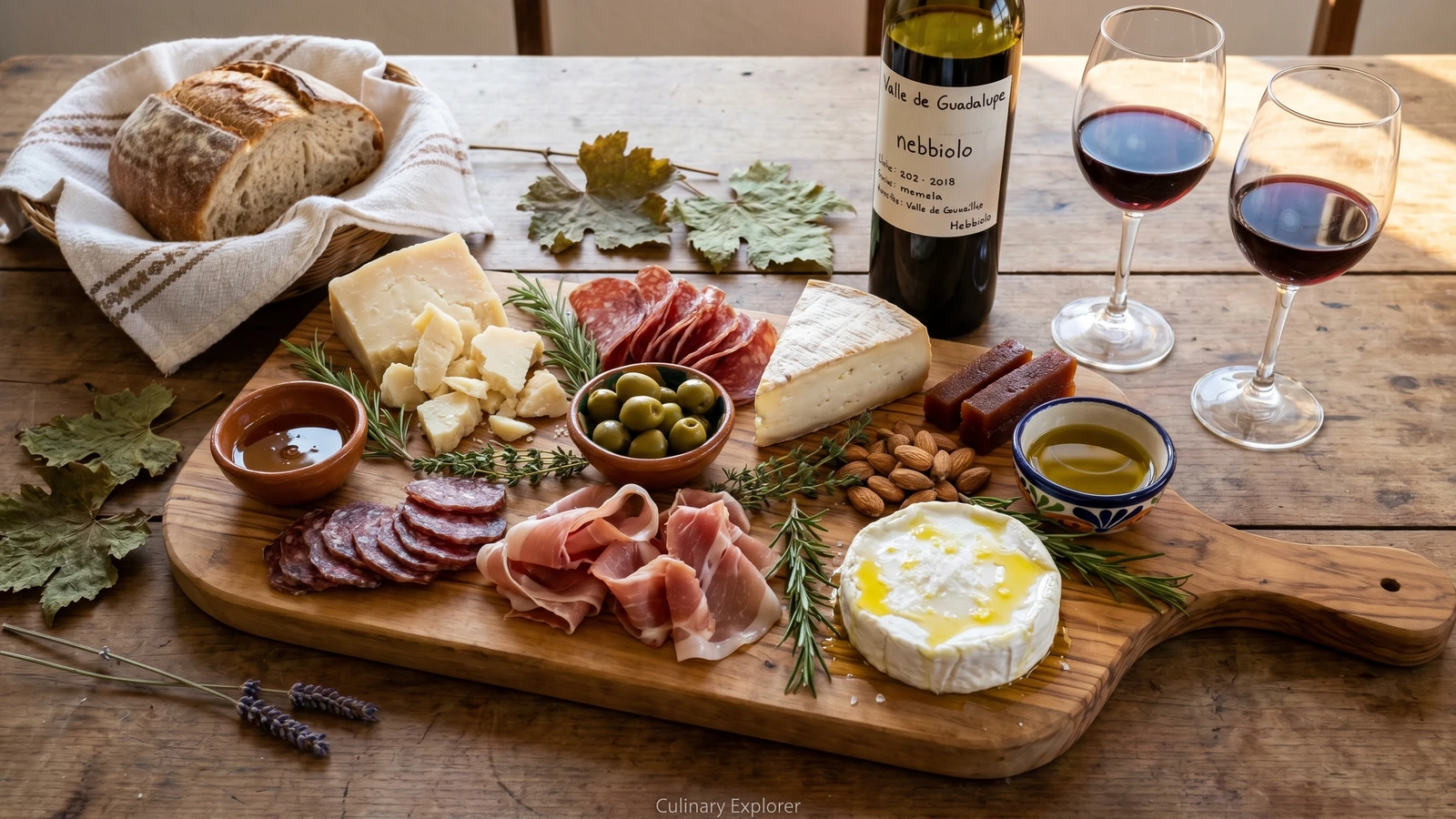
Baja California's wine-country tabla, built from Real del Castillo cheeses, Ramonetti's washed rind, regional cured pork, Valle olive oil, and rustic bread. Saturday afternoon food in vineyard country, eaten slow.
Appetizers & Snacks
Mexican
Dinner Party
Special Occasion
Date Night
45 min
Active Time
5 min cook•50 min total
Yield6 to 8 servings
This is not central Mexican food. This is Baja California, specifically the Valle de Guadalupe, the narrow wine valley east of Ensenada where Russian Molokans, French, Italian, and Lebanese settlers built a Mediterranean food culture in the dry hills of the peninsula at the turn of the twentieth century. If you came here looking for chiles and tortillas, you are in the wrong state. Not all Mexican food is spicy. Not all Mexican food is built on corn. This is a 32-state cuisine, and Baja California is one of those states.
The tabla is what you eat at lunch on a Saturday at one of the boutique wineries between Francisco Zarco and El Porvenir, with a glass of nebbiolo or chenin blanc grown on the same hill that pastures the cows. It is built from what the region produces: aged cow milk cheese from Real del Castillo, the small cheesemaking village in the sierra above the valley; semi-aged Ramonetti, made by the same family since 1911; fresh goat cheese from one of the small dairies that ring the valley; cured pork from regional charcuterie houses; olive oil pressed from trees the Dominican missionaries planted in 1834; rustic bread from wood-fired ovens that came with the Mediterranean settlers.
I traveled the Valle for the first time in 2009 with my notebook and a tape recorder. I did not expect what I found. The vineyards stretched between hills the color of pale earth and dry grass. The cheesemakers knew their cows by name. The bakers used the same starter their grandmothers had brought up from Puebla or down from Saratov. Cada estado, su propia cocina. Baja California is not the rest of Mexico. It is its own thing, and it is honest, and it deserves its place at the table.
The tabla is not a recipe in the way mole is a recipe. It is a curation, a sourcing exercise, an act of trust in the people who make the cheese and cure the pork and press the oil. Saber cocinar es saber vivir, and sometimes saber cocinar means knowing when to step out of the way. Buy well. Temper everything. Arrange with intention. Pour the wine. That is the recipe.
The Valle de Guadalupe's distinct culinary identity traces to two waves of settlement that diverge sharply from the rest of Mexican food history. The Misión de Nuestra Señora de Guadalupe del Norte, founded by Dominican friars in 1834 as the last of the California missions, planted the first olive trees and grapevines in the valley and established the Mediterranean agricultural template the region still follows. The second wave came in 1905, when a community of approximately 100 Russian Molokan families fleeing religious persecution under Tsar Nicholas II purchased land in the Valle and established the dairies, bakeries, and the early commercial wine trade that defined the region for the next half century. The Ramonetti family, who emigrated from Switzerland to Real del Castillo in the 1910s, founded the cheese tradition that today anchors the regional tabla, and Valle de Guadalupe now produces approximately 70 percent of all Mexican wine, making it the country's most important wine region and the cultural counterweight to the corn-and-chile narrative of central Mexican cuisine.
The technique, the tradition, and the story behind every dish.
aged cow milk cheese from Baja's cheesemaking village
queso Ramonetti
Quantity
5 ounces
semi-aged with washed rind
fresh queso de cabra
Quantity
4 ounces
from a regional dairy
dry-cured salami or chorizo curado
Quantity
4 ounces
from a Valle producer, thinly sliced
local jamón serrano-style ham or regional prosciutto
Quantity
4 ounces
sliced paper-thin
rustic country loaf (pan rústico)
Quantity
1
pulled the same morning
whole raw almonds
Quantity
1/3 cup
flaky sea salt from Guerrero Negro
Quantity
1 teaspoon, plus more for finishing
Valle de Guadalupe extra-virgin olive oil
Quantity
3 tablespoons, divided
mixed olives
Quantity
1/2 cup
Manzanilla verde and Kalamata-style
membrillo (quince paste)
Quantity
4 ounces
cut into batons
wild honey from the valley
Quantity
3 tablespoons
fresh rosemary
Quantity
4 sprigs
fresh thyme
Quantity
4 sprigs
freshly cracked black pepper
Quantity
for finishing
Ingredient
Quantity
queso Real del Castillo añejoaged cow milk cheese from Baja's cheesemaking village
6 ounces
queso Ramonettisemi-aged with washed rind
5 ounces
fresh queso de cabrafrom a regional dairy
4 ounces
dry-cured salami or chorizo curadofrom a Valle producer, thinly sliced
4 ounces
local jamón serrano-style ham or regional prosciuttosliced paper-thin
4 ounces
rustic country loaf (pan rústico)pulled the same morning
1
whole raw almonds
1/3 cup
flaky sea salt from Guerrero Negro
1 teaspoon, plus more for finishing
Valle de Guadalupe extra-virgin olive oil
3 tablespoons, divided
mixed olivesManzanilla verde and Kalamata-style
1/2 cup
membrillo (quince paste)cut into batons
4 ounces
wild honey from the valley
3 tablespoons
fresh rosemary
4 sprigs
fresh thyme
4 sprigs
freshly cracked black pepper
for finishing
Equipment Needed
•Large hand-hewn wooden board (olive wood or oak, at least 18 inches across)
•Three small cheese knives (a hard cheese knife, a soft cheese knife, and a spreading knife for the goat cheese)
•Small clay or talavera bowls for olives, honey, and olive oil
•Cast iron comal or skillet for the almonds and bread
•Hand-woven cotton servilleta for the bread basket
Instructions
1
Temper the cheese and meat
Pull every cheese and every package of cured meat out of the refrigerator a full hour before you plan to serve. Unwrap the cheeses and set them on a wooden board, covered loosely with a clean cotton servilleta. Cold cheese is muted cheese. Cold salami is greasy. The aromatics in Real del Castillo and Ramonetti only open up at room temperature, and the fat in the cured pork softens into something that coats the bread instead of slicking it. This is not a step you skip. The tabla begins here.
If your kitchen runs warm, 45 minutes is enough. If it runs cool, give it the full hour. Press the goat cheese gently with your thumb. When it gives without resistance, it is ready.
2
Toast the almonds
Heat a dry cast iron skillet over medium-low. Add the almonds and toast them for 4 to 5 minutes, shaking the pan every 30 seconds. They are ready when the skin darkens a shade and the kitchen smells nutty and slightly sweet. Tip them onto a plate, drizzle with a teaspoon of olive oil, and toss with a pinch of flaky sea salt while they are still hot. Let them cool. The Valle has been growing almonds since the missionaries planted the first trees in the 1830s. Use them with respect.
3
Slice the bread
Cut the country loaf into half-inch thick slices on a slight bias. Brush one side of each slice with olive oil and char them on a comal or a hot grill pan for 30 to 45 seconds per side, until the edges turn dark and the surface develops a few amber blisters. You are not making toast. You are making the structural element of the tabla. The bread should still have some give in the center, not the brittleness of a cracker. Stack the slices in a basket lined with a hand-woven servilleta.
4
Arrange the cheeses
Set out a large wooden board, hand-hewn olive wood or oak if you have it. Place the three cheeses in a triangle across the surface, each given its own territory with space around it. Cut the Real del Castillo into uneven shards using the back of a small knife to break it along its natural grain. Carve a thick wedge from the Ramonetti and lay it on its side so the rind is visible. Leave the goat cheese in a generous round, scoring the top lightly with a knife so guests can serve themselves without wrestling it. Cada cheese, its own space. They should not touch.
If you cannot find Real del Castillo añejo outside Baja, a well-aged Manchego is a compromise, not an upgrade. The Real del Castillo has a sharper, drier finish from the dry hills the cows graze on. Tell your guests what they are missing.
5
Lay out the charcuterie
Fold each slice of salami in half, then in half again, so the slices stand up in small folded fans across one section of the board. Drape the prosciutto-style ham in loose ribbons in another section, never flat, never stacked. The cured pork should look generous, not measured. La cocina no es decoracion, es trabajo, but the work shows when the meat catches the light.
6
Add the accompaniments
Pile the toasted almonds in one corner of the board. Set the membrillo batons next to the Real del Castillo, because aged cow cheese and quince is a pairing the Spanish brought over the Atlantic and the Valle inherited honestly. Place the olives in a small clay bowl rather than directly on the wood, with a smaller empty bowl beside it for the pits. Drizzle the honey into a shallow ceramic dish with a small wooden spoon. Pour the remaining olive oil into a third small dish, finished with a few cracks of black pepper and a pinch of flaky salt.
7
Finish and serve
Tuck the rosemary and thyme sprigs into the empty spaces on the board. Drizzle a thin thread of olive oil across the goat cheese only. Add a final pinch of flaky sea salt across the goat cheese and a turn of black pepper across the Ramonetti. Set the bread basket alongside the board. Pour a glass of Valle nebbiolo or chenin blanc, the same wine grown in the hills the cheese came from. The tabla is not finished until the wine is poured. This is how Saturdays are eaten in the valley. Asi se hace y punto.
Chef Tips
•Source the cheeses with intent. If you can travel to the Valle, buy directly from La Cava de Marcelo in Ojos Negros or from one of the small queserías along the wine route. If you cannot, ask your cheesemonger for aged Mexican queso añejo from Baja, semi-aged sheep or cow cheese with a washed rind, and a fresh goat cheese from a small producer. Three cheeses is the minimum for a real tabla. Five is generous. Seven is showing off.
•The bread is not a vehicle. It is an ingredient. Find a country loaf with a real crust and an open crumb, baked the same day. Sliced sandwich bread does not belong on this board, and neither do crackers from a box. If you cannot find good bread, make tostadas from corn tortillas instead. That is a cross-regional compromise, but it is honest.
•Pair the wine to the valley. Valle de Guadalupe produces serious nebbiolo, tempranillo, and chenin blanc, along with Bordeaux blends from L.A. Cetto, Monte Xanic, and the smaller producers around El Porvenir. If you cannot find Mexican wine, a dry Provençal rosé or a Spanish tempranillo holds the same Mediterranean structure. Sweet wine on this board is a mistake.
•Do not put grapes, strawberries, blueberries, or other fruit on this tabla. The membrillo and the wild honey are the sweet elements. Adding berries turns it into a brunch board for a hotel buffet. No me vengas con atajos.
Advance Preparation
•Cheeses can be portioned and wrapped in parchment one day ahead, refrigerated, then tempered for an hour before serving. Do not wrap cheese in plastic. It suffocates.
•Almonds can be toasted up to three days ahead and stored in a sealed jar at room temperature.
•Membrillo can be cut into batons one day ahead and held in the refrigerator wrapped in parchment.
•The bread should be baked or purchased the same morning. Day-old bread on a tabla is a sign that the cook did not respect the moment.
Frequently Asked Questions
Nutrition Information
1 serving (about 228g)
Calories
715 calories
Total Fat
38 g
Saturated Fat
15 g
Trans Fat
0 g
Unsaturated Fat
22 g
Cholesterol
70 mg
Sodium
1945 mg
Total Carbohydrates
65 g
Dietary Fiber
4 g
Sugars
20 g
Protein
31 g
Where cooking meets culture.
Culinary guides, cultural storytelling, and the editorial depth that makes cooking meaningful.