
Chef Freja
Danablu Mad med Rå Æggeblomme
Danish blue cheese layered on dark rye with a raw egg yolk nestled on top, red onion rings, and chives. The last piece at a Danish lunch, and the one that stays with you longest.
A cooking platform built around craft, culture, and the stories behind what we eat.
Created by Chef Freja
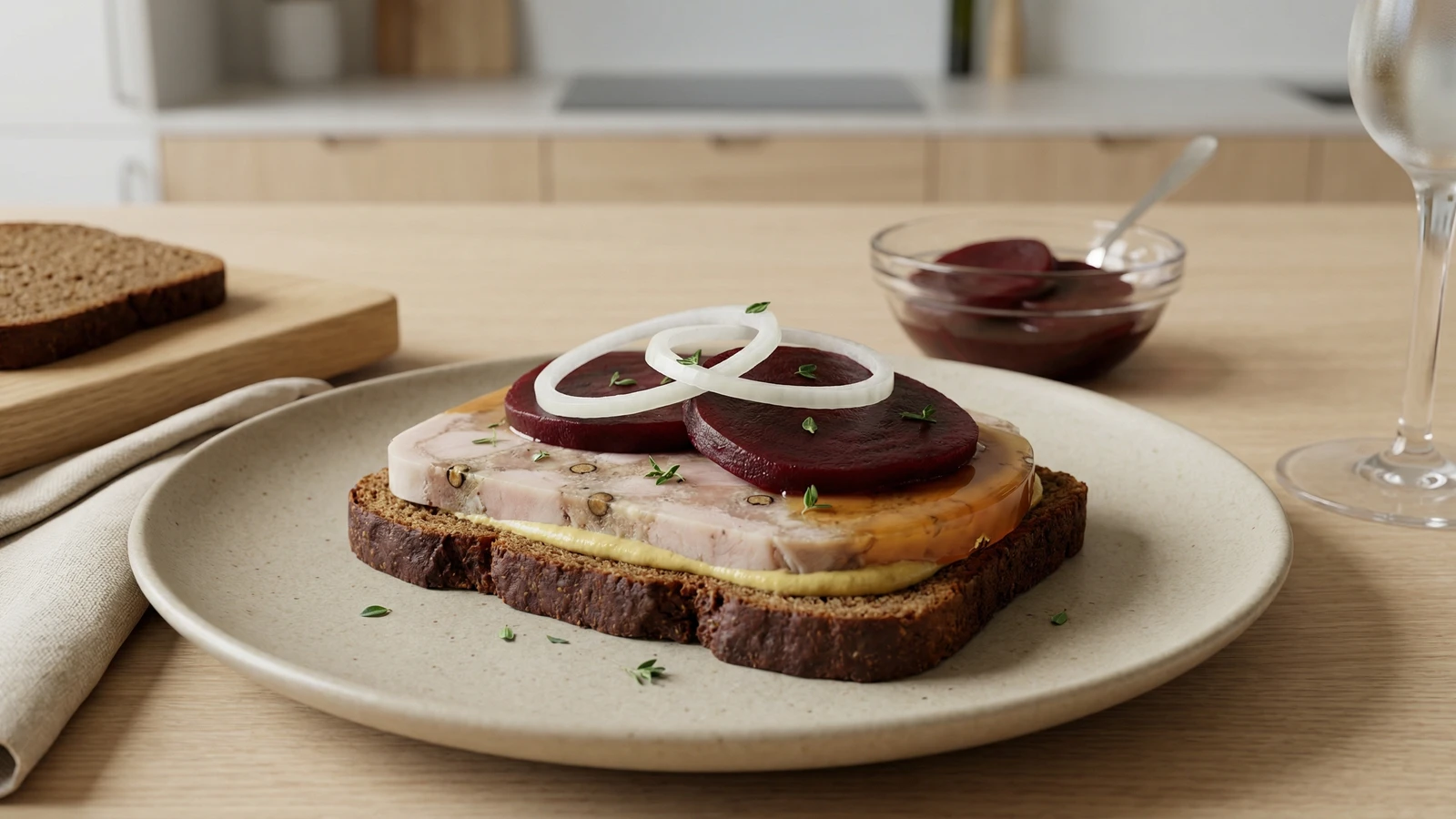
Danish head cheese set firm in its own clear stock, sliced thin on dark rugbrod with sharp mustard, pickled beets, and raw onion rings. The julefrokost cold cut that deserves its place.
There's a moment in mid-December when the Danish kitchen turns serious about Christmas. Not the shops and the lights. The kitchen. The rugbrod comes out of the oven, the herring goes into the brine, and somewhere on a cold shelf there's a terrine of sylte setting quietly in its own clear stock.
Syltemad is what you make with that sylte, and it belongs to the julefrokost, the long Danish Christmas lunch that can run four hours and twelve kinds of smorrebrod. Sylte is head cheese, pork cooked slowly with bay and allspice until it falls from the bone, then pressed into a terrine with its own gelatin-rich stock and chilled until firm. You slice it thin, lay it on dark rugbrod, and top it with sharp mustard, pickled beets, and raw onion rings. The dish has been nearly forgotten outside Danish homes, and that's a loss I'd like to correct at your table.
What matters most is the setting. The stock needs enough body to hold the meat together when you slice it, and I'll show you how to tell whether your pot has enough natural gelatin without guessing. Every step has a reason, and I'll carry the why alongside the how, so you never feel like you're working blind. You'll know when it's right because the terrine holds a clean edge under the knife and the first slice looks exactly like it should.
Sylte belongs to the tradition of the autumn slaughter, slagtning, when Danish farms once butchered a pig in November to carry the household through the winter. Nothing was wasted. The head, trotters, and tougher cuts went into the sylte pot, where long simmering with bay, clove, and allspice drew out the gelatin and turned rough meat into something that could be sliced cold for weeks. By the late 1800s, sylte had become a fixture of the Copenhagen julefrokost, the ritual Christmas lunch, where it still holds a quiet place on the table beside the herring, the liver pate, and the roast pork. The move from peasant preservation to Christmas ceremony happened without anyone writing it down. The dish simply stayed.
Quantity
1 kg
skin on if possible
Quantity
500g, or 2 trotters
Quantity
1 large
peeled and halved
Quantity
2
Quantity
10
Quantity
6
Quantity
12
Quantity
2 teaspoons, plus more to taste
Quantity
1 teaspoon
Quantity
1/2 teaspoon
Quantity
about 2 litres, to cover
Quantity
2 sheets
Quantity
8 thick slices, to serve
Quantity
4 tablespoons
Quantity
8 slices
Quantity
1 small
sliced into thin rings
Quantity
to finish
| Ingredient | Quantity |
|---|---|
| boneless pork shoulderskin on if possible | 1 kg |
| smoked ham hock or pork trotters | 500g, or 2 trotters |
| yellow onionpeeled and halved | 1 large |
| bay leaves | 2 |
| whole allspice berries | 10 |
| whole cloves | 6 |
| black peppercorns | 12 |
| fine sea salt | 2 teaspoons, plus more to taste |
| ground white pepper | 1 teaspoon |
| ground allspice | 1/2 teaspoon |
| cold water | about 2 litres, to cover |
| leaf gelatin (optional) | 2 sheets |
| dark rugbrod | 8 thick slices, to serve |
| strong Danish mustard | 4 tablespoons |
| pickled beetroot (rodbeder) | 8 slices |
| white onionsliced into thin rings | 1 small |
| fresh thyme leaves (optional) | to finish |
Place the pork shoulder and the ham hock in your largest pot. Add the halved onion, bay leaves, allspice berries, cloves, peppercorns, and the two teaspoons of salt. Pour over enough cold water to just cover the meat. Starting in cold water matters. It lets the stock draw slowly out of the bones and stay clear, instead of clouding the way it does when you drop meat into boiling water.
Bring the pot to a bare simmer over medium heat, then turn it down until the surface barely trembles. Skim any grey foam that rises in the first ten minutes. Let it cook like this, uncovered, for two to two and a half hours, until the shoulder gives no resistance when you push a fork into it and the hock meat is falling from the bone. Never a rolling boil. Boiling breaks the meat fibers and turns the stock cloudy, and you want both the meat and the stock to stay clean.
Lift the meat out onto a board with a slotted spoon. Strain the stock through a fine sieve lined with a piece of muslin or a clean tea towel into a clean pot. Discard the onion and spent spices. Put the strained stock back on a low heat and let it reduce gently by about a quarter while you deal with the meat. Reduction concentrates the flavor and the gelatin, and both matter for what comes next.
While the meat is still warm enough to handle, pull it into rough pieces with your fingers. Pull the hock meat from its bone. Keep a little of the softer fat but discard any heavy rind you don't want to eat. Now chop the meat with a knife to a rough, even dice, about the size of a pea. Not a paste, not a shred. Sylte has texture. You should be able to see what the meat is when you slice a piece.
Spoon a tablespoon of the reduced stock onto a cold saucer and put it in the freezer for five minutes. When you take it out, push it with your finger. If it wobbles and holds a clean edge, your stock has enough natural gelatin and you're finished reducing. If it runs like water, soak the gelatin sheets in cold water, squeeze them out, and stir them into the warm stock until dissolved. This is not cheating. It's the honest fix when your cut didn't give up enough gelatin.
Tip the chopped meat into a large bowl. Season with the ground white pepper, the ground allspice, and more fine sea salt to taste. Taste it warm. Sylte eaten cold loses about a third of its salt impression, so season a little more assertively than you think you need. Line a loaf tin or small terrine with cling film, leaving plenty overhanging the sides. Pack the seasoned meat in firmly, pressing the corners so there are no air pockets.
Ladle the warm stock slowly over the meat until it just covers the top. Tap the terrine gently on the counter so the stock works its way into every gap. Fold the cling film over the top, place a second tin or a piece of cardboard cut to size directly on the surface, and weigh it down with a couple of tins from the cupboard. The weight is what makes the slices hold together later. Without it, the sylte will crumble under the knife.
Move the weighted terrine to the fridge and let it set for at least twelve hours, ideally overnight or a full day. The joy of waiting. This is not a dish you can hurry. The stock needs time to set completely around the meat, and the flavors need time to settle into each other. A sylte made yesterday is better than a sylte made this morning.
Unwrap the cling film from the top and invert the terrine onto a board. Lift away the tin and peel off the rest of the cling film. You should see a firm block of pale pork set in a thin glaze of clear amber aspic. With a very sharp knife, cut slices about five millimetres thick. Wipe the knife between slices. A clean knife gives a clean edge, and the clean edge is half the pleasure of looking at a plate of sylte.
Lay a thick slice of rugbrod in front of you. Spread a firm line of mustard across the surface, not the whole slice, just a stripe down the middle. Place a slice of sylte on top, trimmed to fit the bread so the rye still shows at the edges. Lay a slice or two of pickled beetroot on the sylte, scatter a small heap of raw onion rings on top, and finish with a few thyme leaves. Serve at once with a cold snaps if the moment calls for it. Smorrebrod is eaten with a knife and fork, and syltemad in particular demands it. This is how we greet each other at the Christmas table. Tak for mad.
1 serving (about 180g)
Culinary guides, cultural storytelling, and the editorial depth that makes cooking meaningful.
Discover Culinary ExplorerChef Freja
Danish blue cheese layered on dark rye with a raw egg yolk nestled on top, red onion rings, and chives. The last piece at a Danish lunch, and the one that stays with you longest.

Chef Freja
Thick-sliced Danbo on properly buttered rugbrod with sweet pepper rings and a crown of garden cress. The cheese smorrebrod that lives in every Danish lunchbox, from the first day of school to the last day at the office.

Chef Freja
Copenhagen's most storied smorrebrod: leverpostej, cold salt beef, trembling aspic, onion rings, and fresh cress on dark rugbrod. Invented at Oskar Davidsen's in the 1880s for a hungry veterinarian and still one of the great pieces of the Danish lunch table.

Chef Freja
Pungent Esrom from North Zealand on dark rye with paper-thin radish and fresh chives. The cheese course that closes a proper Danish smorrebrod spread, one of the quietest, most satisfying bites in the whole tradition.