
Chef Fai
Isan Beef Larb (Larb Nua)
No sugar. That's the rule. Isan larb strips Thai cuisine down to three pillars: nam pla for salt, manao for sour, prik for heat, bound by the smoky crunch of freshly pounded khao khua. The absence defines the dish.
A cooking platform built around craft, culture, and the stories behind what we eat.
Created by
No sugar. No paste. Just bamboo, lime, fish sauce, dried chili, and khao khua. Isan's sup tradition strips Thai food to its bones and proves the system still holds.
No sugar. That's the rule. Write it down. Tattoo it on your arm. The absence of sweet is what separates Isan from Central Thai, and sup nor mai is where that principle announces itself loudest.
Ajarn always said the four pillars of Thai cuisine are fish sauce for salt, palm sugar for sweet, tropical fruit acids for sour, and chili for heat. But in Isan, the second pillar gets thrown out the window. Deliberately. The northeastern palate runs on three cylinders: salty from nam pla, sour from fresh lime, and hot from prik pon (dried roasted chili). That's it. No sugar softening the edges, no sweetness rounding off the corners. Everything is sharper. Everything hits harder. If Central Thai is a handshake, Isan is a slap.
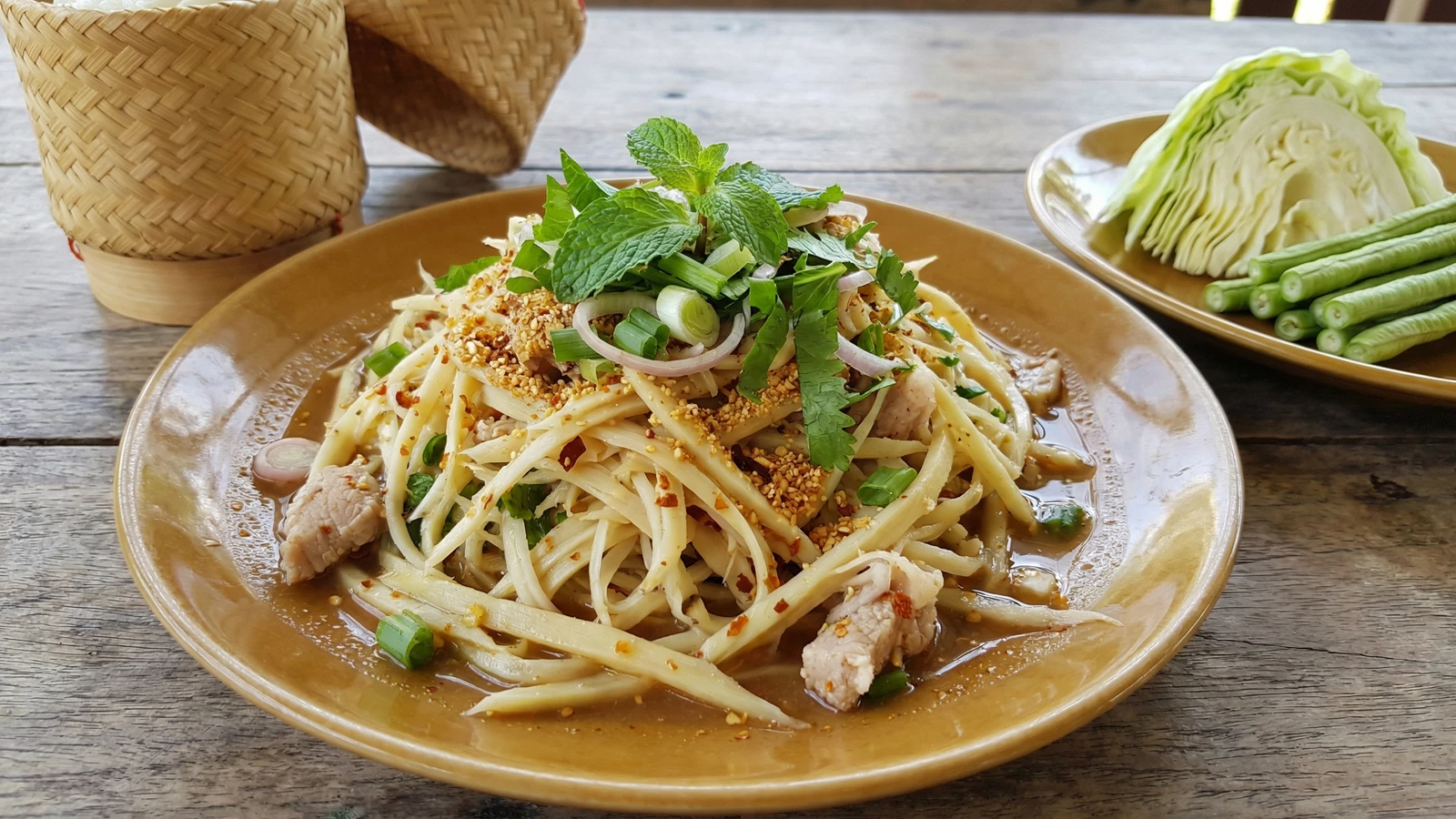
Sup nor mai is the dish that taught me this. My mother's side is from Isan, and bamboo shoot season was a big deal in our family. The young shoots come in during the rainy season, tender and pale, and the whole neighborhood knows because someone's boiling a massive pot of them on the street. The smell is earthy, vegetal, almost mushroomy. You boil the shoots to kill the bitterness, shred them, and then dress them while they're still warm so every fiber soaks up the lime and fish sauce. Then minced pork, cooked simply in water (not fried, not oiled), khao khua for that smoky crunch, dried chili for heat, and a storm of fresh herbs: mint, sawtooth coriander, green onion, cilantro, thinly sliced shallots.
This isn't a kreung tam dish. There's no paste. Sup is an Isan category of tossed, dressed preparations, a cousin to larb and nam tok. The technique is simpler than pounding a paste, but the principle is the same: balance governs everything. Sour leads. Salt supports. Heat follows. Herbs finish. Khao khua ties it all together. Principles, not recipes.
Sup nor mai belongs to the Isan 'sup' (ซุบ) category, a family of tossed preparations that includes sup hua pli (banana blossom) and sup no mai sot (fresh bamboo). The dish is tied to the rainy season (June through October) when young bamboo shoots push through the soil across the Khorat Plateau. In rural Isan, foraging bamboo is communal work, and sup nor mai is the first meal made from the harvest, eaten the same day. The preparation predates refrigeration and uses lime juice and salt as natural preservatives, a practical origin that became a flavor identity.
Quantity
400g
fresh or vacuum-packed, boiled and shredded
Quantity
150g
Quantity
3 tablespoons
Quantity
4 tablespoons (about 4 limes)
Quantity
1 tablespoon
freshly toasted and pounded
Quantity
1 tablespoon
Quantity
3
thinly sliced
Quantity
3
sliced into 1-inch pieces
Quantity
1 large handful
Quantity
1 small handful
cut into 1-inch pieces
Quantity
1 small handful
roughly torn
Quantity
1 tablespoon
for toasting into khao khua
| Ingredient | Quantity |
|---|---|
| young bamboo shoots (nor mai)fresh or vacuum-packed, boiled and shredded | 400g |
| minced pork | 150g |
| fish sauce (nam pla) | 3 tablespoons |
| fresh lime juice (nam manao) | 4 tablespoons (about 4 limes) |
| khao khua (toasted sticky rice powder)freshly toasted and pounded | 1 tablespoon |
| prik pon (dried roasted chili flakes) | 1 tablespoon |
| shallots (hom daeng)thinly sliced | 3 |
| green onions (ton hom)sliced into 1-inch pieces | 3 |
| fresh mint leaves (bai saranae) | 1 large handful |
| sawtooth coriander (pak chi farang)cut into 1-inch pieces | 1 small handful |
| fresh cilantro (pak chi)roughly torn | 1 small handful |
| uncooked sticky rice (khao niew)for toasting into khao khua | 1 tablespoon |
If using fresh bamboo shoots, peel them down to the tender pale core and cut into chunks. Boil in a large pot of water for 15 to 20 minutes until the bitterness is gone. Taste a piece. If it still bites the back of your tongue, keep boiling. Fresh shoots have hydrocyanic compounds that need to be cooked out. Don't skip this. If using vacuum-packed shoots, they're pre-boiled. Rinse them, drain, and you're good. Once cooked, let the shoots cool enough to handle, then shred them by hand along the grain into thin, fibrous strips. The texture matters. You want long, stringy shreds that catch the dressing in every crevice. A knife gives you uniform chunks. Your hands give you sup nor mai.
Put the sticky rice in a dry pan over medium heat. No oil. Shake the pan every few seconds. The rice will start to smell nutty and turn golden, then deepen to a toasty brown. This takes about 5 minutes. Don't walk away. The window between toasted and burnt is narrow. Pull it when the color is deep gold and the kitchen smells like roasted grain. Let it cool for a minute, then pound it in a mortar. Not a spice grinder. A mortar. You want a coarse powder with some irregular chunks, not dust. The texture is part of the dish.
Bring a small pot of water to a boil. Add the minced pork, breaking it apart with a spoon as it hits the water. Cook for 2 to 3 minutes until just cooked through, no pink remaining. Drain immediately. The pork should be tender, not rubbery. You're poaching, not frying. No oil touches this meat. The pork provides body and protein without any richness that would compete with the dressing. This is Isan discipline: clean flavors, nothing hidden.
In a large mixing bowl, combine the fish sauce, lime juice, and prik pon. Stir once. Taste. Sour should lead. Salty should support. Heat should follow. That's the order. If the lime isn't assertive enough, add more. If the salt is too forward, add another squeeze of lime to push it back. There is no sugar in this dressing. None. The absence is the point. This is Isan.
Add the shredded bamboo shoots and drained pork to the bowl. Toss with your hands or two spoons to coat everything. The bamboo should be warm or at room temperature, not cold. Warm fibers absorb dressing. Cold fibers repel it. Add the sliced shallots, green onions, sawtooth coriander, cilantro, and mint. Toss again gently. You're folding, not crushing. The herbs are structural. They're not decoration. Sprinkle the khao khua over the top and give one final toss. Taste. Adjust. More lime? More fish sauce? More chili? This is your dish now. The principle is balance. The balance is yours.
Transfer to a plate or a shallow bowl. Don't pile it into a deep vessel. Sup nor mai is meant to be spread out so you can see the herbs and the shreds. Serve at room temperature with sticky rice (khao niew) from a kratip basket. Tear off a pinch of sticky rice, press some sup nor mai onto it, add a mint leaf. That's a bite. Cabbage leaves and raw long beans on the side for scooping and crunching. Never jasmine rice. Never cold from a fridge. This is Isan food. Eat it the Isan way.
1 serving (about 205g)
Culinary guides, cultural storytelling, and the editorial depth that makes cooking meaningful.
Discover Culinary ExplorerChef Fai
No sugar. That's the rule. Isan larb strips Thai cuisine down to three pillars: nam pla for salt, manao for sour, prik for heat, bound by the smoky crunch of freshly pounded khao khua. The absence defines the dish.

Chef Fai
No sugar. That's the line between Isan and Central Thai larb. Grilled catfish flaked while warm, dressed with nam pla, manao, khao khua, prik pon, and a storm of fresh herbs. The plateau on a plate.

Chef Fai
No sugar. That's the rule. Isan larb strips Thai cuisine down to three pillars: nam pla for salt, manao for sour, prik for heat, with khao khua tying it together in a way nothing else can.

Chef Fai
Duck brings gamey depth to the Isan larb formula. No sugar. Lime, fish sauce, khao khua, prik pon, and a wall of fresh herbs. This is the celebration table standard, and the governing rule is restraint.