
Chef Jeong-sun
Agwi-jjim (Braised Monkfish with Bean Sprouts)
Firm monkfish buried under crisp soybean sprouts, minari, and a red gochugaru sauce thickened at the end; Masan's market dish asks for heat, timing, and a steady hand.
A cooking platform built around craft, culture, and the stories behind what we eat.

Created by
A recorded late-Joseon dumpling wrapped in blanched cabbage instead of dough, filled with beef, tofu, sprouts, and mushroom, then steamed until the leaf turns translucent over the clean, savory center.
People hear mandu (dumpling) and reach for flour. Sungchae-mandu stops that hand. Here the wrapper is baechu (napa cabbage), blanched until it bends, shaved at the rib, dried, and wrapped around a small savory filling. The leaf turns almost translucent over the meat and tofu. It tastes cleaner than dough because there is nothing heavy between your tongue and the cabbage.
Master Seong-nyeo taught it in the cold months, when kimjang cabbages had done their first work and the outer leaves were broad enough to fold. She put one leaf in my palm and said, 'If it tears, your knife was lazy.' Dry humor? No. Instruction. The thick white rib has to be shaved thin, and the filling has to be squeezed dry, because cabbage is tender and it will not forgive wet, careless hands.
I won't tell you this is easy. It asks for patient wrapping and a test patty before you season the whole bowl. You may use a metal steamer instead of a bamboo one, and store-ground beef instead of hand-minced beef. Do not skip pressing the tofu, squeezing the sprouts, or tasting the cooked filling. This is how an old dish survives a modern kitchen without losing its hands.
Sungchae-mandu is recorded in Jeungbo Sallim Gyeongje (증보산림경제), the 1766 expanded household and agricultural manual compiled by Yu Jung-rim from Hong Man-seon's earlier Sallim Gyeongje. Sungchae was a cabbage term used in late-Joseon writing, and the dish shows that mandu in Korea did not always mean a wheat-flour skin; fish, buckwheat, and vegetables could all become wrappers. Wheat flour was costly for many households, so a tender cabbage leaf made a special-occasion dumpling through knife work and care rather than rare ingredients.
Quantity
1 large head (about 1.2 kg), 18 large leaves
separated and rinsed
Quantity
10 cups
for blanching
Quantity
2 tablespoons
for blanching
Quantity
1 large bowl
for cooling the leaves
Quantity
4 medium
soaked, stemmed, squeezed dry, and minced
Quantity
150g
pressed 20 minutes and crumbled
Quantity
120g
blanched, squeezed dry, and chopped
Quantity
200g
Quantity
3
finely minced
Quantity
2 cloves
minced
Quantity
1/2 teaspoon
grated
Quantity
1 large
beaten
Quantity
1 1/2 tablespoons
Quantity
1 tablespoon
Quantity
1 teaspoon
lightly crushed
Quantity
1/2 teaspoon
Quantity
1/4 teaspoon
Quantity
1 tablespoon
use only if the filling feels loose
Quantity
16 long stems
blanched 10 seconds for tying
Quantity
3 tablespoons
Quantity
1 tablespoon
Quantity
1 tablespoon
Quantity
1 teaspoon
finely minced
Quantity
1/2 teaspoon
lightly crushed
Quantity
1/4 teaspoon
| Ingredient | Quantity |
|---|---|
| napa cabbage (baechu)separated and rinsed | 1 large head (about 1.2 kg), 18 large leaves |
| waterfor blanching | 10 cups |
| coarse sea salt or kosher saltfor blanching | 2 tablespoons |
| cold waterfor cooling the leaves | 1 large bowl |
| dried shiitake mushrooms (pyogo)soaked, stemmed, squeezed dry, and minced | 4 medium |
| firm tofupressed 20 minutes and crumbled | 150g |
| mung bean sprouts (sukju)blanched, squeezed dry, and chopped | 120g |
| ground beef or finely minced beef | 200g |
| scallionsfinely minced | 3 |
| garlicminced | 2 cloves |
| gingergrated | 1/2 teaspoon |
| eggbeaten | 1 large |
| soy sauce, for the filling | 1 1/2 tablespoons |
| toasted sesame oil | 1 tablespoon |
| toasted sesame seedslightly crushed | 1 teaspoon |
| kosher salt | 1/2 teaspoon |
| freshly ground black pepper | 1/4 teaspoon |
| potato starch (gamja-jeonbun) (optional)use only if the filling feels loose | 1 tablespoon |
| minari stems or garlic chives (optional)blanched 10 seconds for tying | 16 long stems |
| soy sauce, for the dipping sauce | 3 tablespoons |
| rice vinegar | 1 tablespoon |
| water, for the dipping sauce | 1 tablespoon |
| scallion, for the dipping saucefinely minced | 1 teaspoon |
| toasted sesame seeds, for the dipping saucelightly crushed | 1/2 teaspoon |
| gochugaru (Korean chili flakes) (optional) | 1/4 teaspoon |
Cover the dried shiitakes with warm water and soak 20 minutes, until pliable. Wrap the tofu in a clean towel, set a plate on top, and press it for the same 20 minutes; it should give up at least 2 tablespoons of liquid. Blanch the mung bean sprouts in boiling water for 1 minute, cool them, squeeze them hard in your hands, and chop them into 1/4-inch pieces. These water weights matter because cabbage leaf cannot absorb moisture the way dough can.
Bring 10 cups water and 2 tablespoons salt to a boil in a wide pot. Working with 3 or 4 cabbage leaves at a time, hold the soft leafy end with tongs and lower the thick white ribs into the boiling water first for 60 seconds, then submerge the whole leaf for another 30 to 45 seconds. Move the leaves to cold water, drain, and pat them very dry. Lay each leaf veined side up and shave the thick rib with a paring knife until it bends like cloth, taking care not to cut through the leaf.
Put the beef, soy sauce, salt, pepper, and ginger in a bowl and stir firmly in one direction for 1 minute, until the meat looks sticky. That stickiness is the binder. Add the pressed tofu, chopped sprouts, minced shiitakes, scallions, garlic, beaten egg, sesame oil, and crushed sesame seeds. Mix until the vegetables are evenly held by the meat. If the filling slumps or looks wet, add 1 tablespoon potato starch.
Cook 1 teaspoon of the filling in a small pan until fully cooked, then taste it. Do not taste raw meat. The filling should be a little more seasoned than you want by itself, because the cabbage leaf softens the salt once it wraps around it. If it tastes flat, add another 1/4 teaspoon salt or 1/2 teaspoon soy sauce, then cook and taste a second tiny patty. 손맛 is real; I measure it anyway, so you can make the same dumpling twice.
Lay one cabbage leaf on the board, veined side up and stem end closest to you. Spoon about 2 tablespoons, or 30g, filling onto the lower third and shape it into a short log. Fold the stem end over the filling, fold in both sides, and roll snugly, but do not squeeze like a fist. Tie with a blanched minari stem or garlic chive if you want a neater parcel, or place the dumpling seam side down and let its own weight hold it. Use the two spare leaves to patch any tears.
Line a steamer with cabbage trimmings or perforated parchment. Bring water in the steamer base to a steady boil, then arrange the dumplings seam side down with a little space between them. Cover and steam 10 to 12 minutes, until the cabbage is glossy and nearly translucent and the filling reaches 160 F (71 C) in the center. Let them rest 2 minutes before moving them, because the leaf firms slightly as it settles.
Stir together the soy sauce, rice vinegar, water, minced scallion, sesame seeds, and gochugaru if using. Arrange the dumplings on a warm platter, seams tucked underneath, and serve them with the dipping sauce, rice, and a clear soup or a few quiet banchan. This is not a fiery mandu. The point is the cabbage, the clean filling, and the care of the wrapping.
1 serving (about 370g)
Culinary guides, cultural storytelling, and the editorial depth that makes cooking meaningful.
Discover Culinary ExplorerChef Jeong-sun
Firm monkfish buried under crisp soybean sprouts, minari, and a red gochugaru sauce thickened at the end; Masan's market dish asks for heat, timing, and a steady hand.

Chef Jeong-sun
A quick Korean rice bowl built on contrast: warm rice, cold popping flying-fish roe, chopped vegetables, gim, sesame oil, and the crisp rice bottom a hot stone bowl gives you.
Chef Jeong-sun
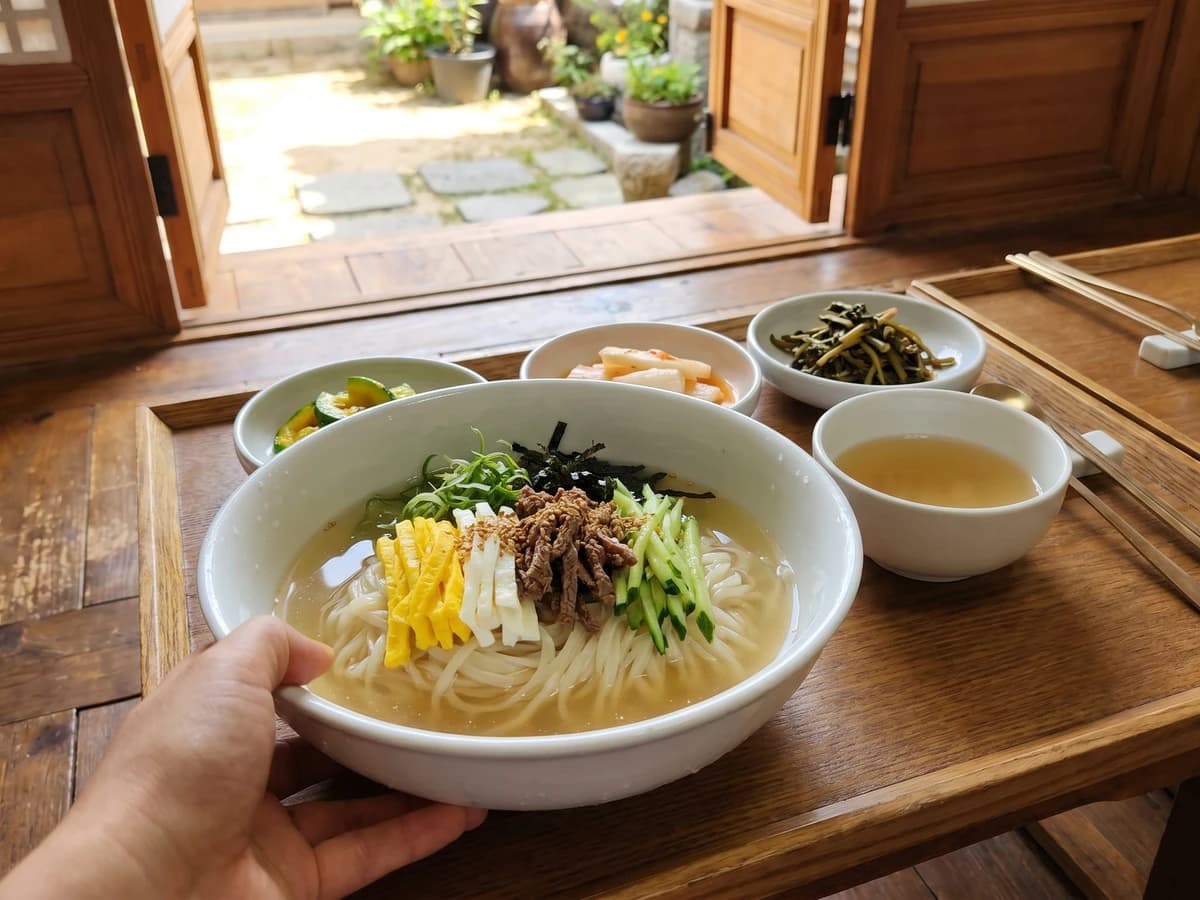
Andong's guest noodles, wheat and roasted soybean flour rolled thin, boiled and rinsed cold, then set in a clear chilled anchovy broth with careful strips of beef, egg, and cucumber.

Chef Jeong-sun
Andong's ritual-table rice served on an ordinary day: separate soy-sesame namul, warm rice, and clear radish soup, mixed without gochujang so every vegetable keeps its own voice.