Culinary Explorer
A cooking platform built around craft, culture, and the stories behind what we eat.
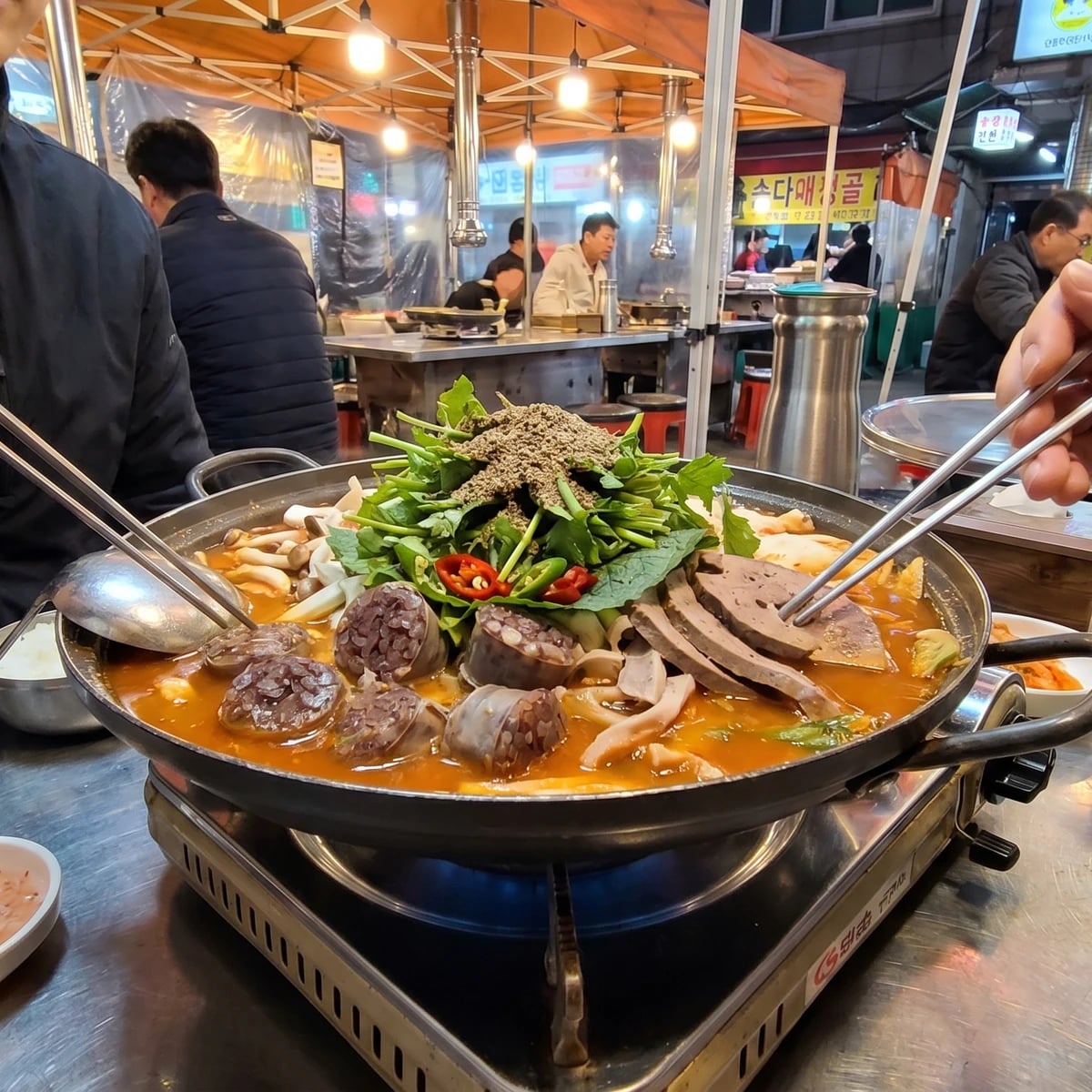
Sundae-jeongol (순대전골, Blood Sausage Hot Pot)
Created by Chef Jeong-sun
A market-stall jeongol of blood sausage, pork offal, cabbage, minari, and perilla seed, arranged in a shallow pan and simmered at the table until the broth leaves enough behind for fried rice.
Sundae-jeongol is not sundae-guk (blood sausage soup) in a wider pot. A jjigae (stew) usually points to one main ingredient; a jeongol (shared hot pot) gathers several, arranges them in a shallow pan, and cooks at the table where the eaters can see the order of things. The arrangement isn't decoration. Cabbage and onion go underneath to sweeten the broth, mushrooms and offal sit where they can give their flavor, and the sundae stays high enough to warm without splitting.
I learned to respect this dish at market tables, not in the old court kitchen people keep asking me about. Stainless bowls, a gas burner, a pot crowded with pork parts, and someone already asking whether rice can go in at the end. Master Seong-nyeo would still have made me line up the colors before the broth went in. Red chili, green minari, pale cabbage, brown mushroom, black-edged sundae. Order is how a busy pot stays readable.
Tonight this asks for shopping more than difficulty: good cooked sundae, clean cooked pork offal, a broth with body, and perilla seed powder that smells nutty, not stale. Don't bury it under gochujang. The broth should be red enough to warm the table, not so loud that every bite tastes the same. 손맛 is real; I measure it anyway, so the market-stall pot can be cooked properly in a home kitchen and then taught forward.
Ingredients
unsalted pork bone broth, low-sodium sagol broth, or anchovy-kelp broth
Quantity
6 cups
gochugaru (Korean chili flakes)
Quantity
3 tablespoons
gochujang (Korean chili paste)
Quantity
1 tablespoon
| Ingredient | Quantity |
|---|---|
| unsalted pork bone broth, low-sodium sagol broth, or anchovy-kelp broth | 6 cups |
| gochugaru (Korean chili flakes) | 3 tablespoons |
| gochujang (Korean chili paste) | 1 tablespoon |
Where cooking meets culture.
Culinary guides, cultural storytelling, and the editorial depth that makes cooking meaningful.
Discover Culinary Explorer