
Chef Klaus
Allgäuer Krautkrapfen
The Allgäu pan dish that makes a meal from noodle dough, winter kraut, onion, and fat: brown the cut sides first, then cook gently so the rolls hold.
A cooking platform built around craft, culture, and the stories behind what we eat.
Created by
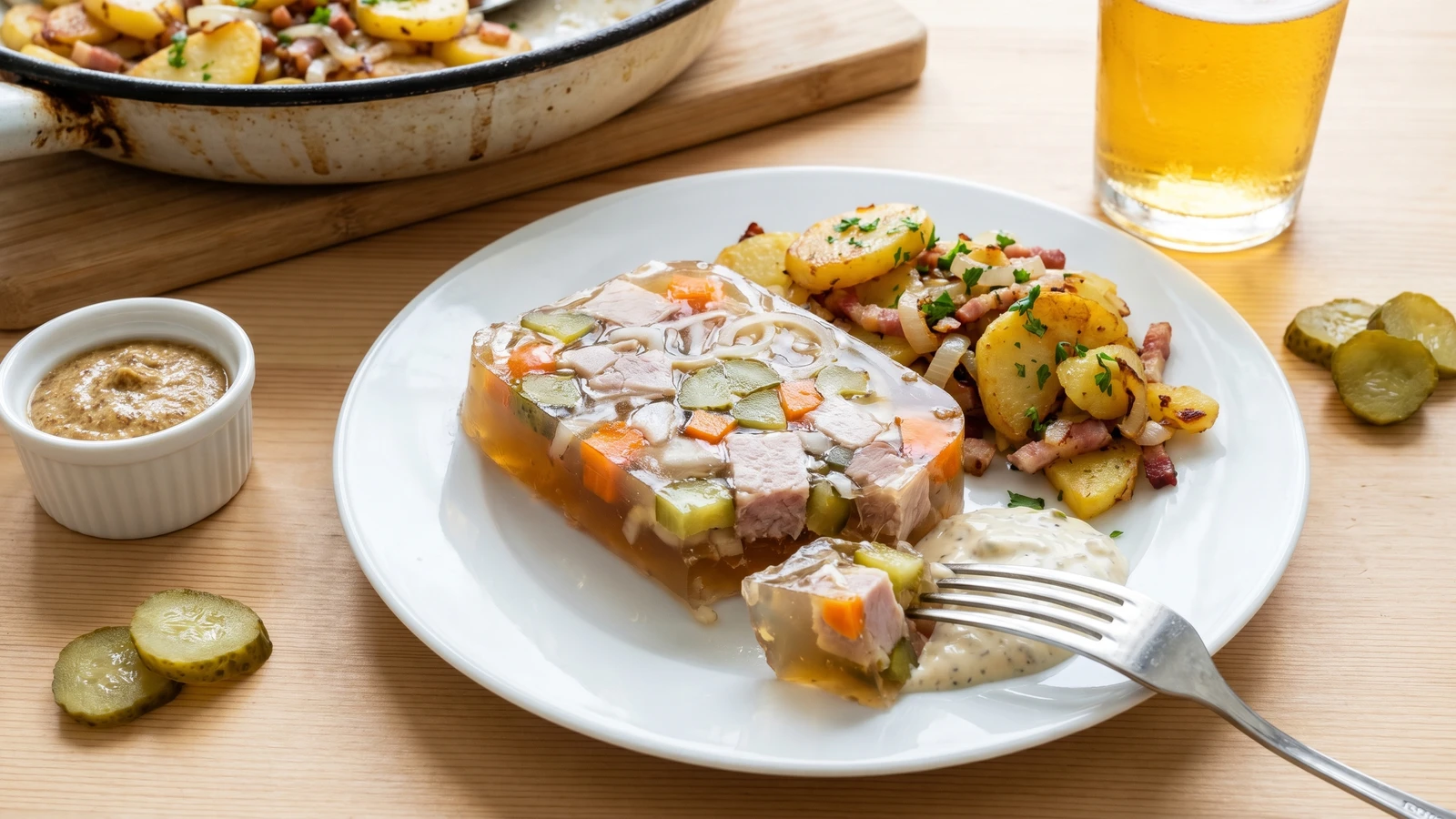
Sauer Sülze is the cold pork dish that proves the feet and rind were never scraps: clear sour jelly, good meat, pickles, and fried potatoes to make a meal.
Sauer Sülze sits in the German cold larder, the butcher's kitchen more than the feast table, but it earns its place on a Sunday as well as a weeknight. You make it ahead, slice it cold, and set it down with Bratkartoffeln, fried potatoes, and mustard or Remoulade. It belongs strongly to the north and east, from Schleswig-Holstein and Mecklenburg through Berlin and Saxony, where sour pork in jelly makes sense beside rye bread, pickles, and beer. Im Norden anders, im Süden anders: in the north you meet Sauerfleisch, sharper and often sliced clean; in Bavaria and Swabia it becomes Sulz, often more head meat, onion, and a softer sourness.
The whole dish stands on one piece of work: the broth must set itself. The pig's feet, rind, and knuckle go into cold water and climb slowly to a tremble because collagen loosens gently into the pot; a hard boil beats the fat and protein through the liquid and gives you a cloudy, greasy jelly. Runter mit der Temperatur. If the surface only shivers, you're cooking. If it rolls, you're making trouble.
I sour it after the broth is strong and reduced, because vinegar should cut clean through the cold fat, not boil for three hours and turn flat. Then the test decides everything: chill a spoonful of broth on a saucer. If it wrinkles and wobbles, the Sülze will slice. If it runs, reduce it longer. Nicht aus dem Glas, and not from the packet either. The feet have the gel in them.
Weggeworfen wird nichts. The knuckle gives meat, the feet give body, the rind gives strength, and the cooking liquor becomes the whole plate. Watch the pot, skim the fat, taste the sour against the salt, and let the cold finish the work. Das braucht seine Zeit.
The word Sülze comes from the old German Sulz, a salted or sour preserving liquid, and the dish belongs to the long butcher's practice of setting cooked meat in its own gelatin before refrigeration. Henriette Davidis's Praktisches Kochbuch, first published in 1845, included several meat and fish jellies, showing how ordinary these set dishes were in the German household kitchen by the nineteenth century. The regional line still shows: northern Sauerfleisch and Sülze run sharper with vinegar, while southern Sulz often leans on head meat, onion, and a milder set jelly.
Quantity
1.2kg
skin on, split if possible
Quantity
2
split lengthwise by the butcher
Quantity
500g
in one piece
Quantity
2.2 litres
or enough to just cover
Quantity
1 large
halved, unpeeled
Quantity
1
peeled
Quantity
100g
peeled and chopped
Quantity
1 small
cleaned and chopped
Quantity
2
Quantity
10
Quantity
6
lightly crushed
Quantity
4
Quantity
1 teaspoon
Quantity
18g
plus more to taste
Quantity
120ml
plus more to taste
Quantity
4
sliced thinly
Quantity
2 tablespoons
Quantity
1 small
sliced into fine rings
Quantity
2 tablespoons
roughly chopped
Quantity
800g
sliced for Bratkartoffeln
Quantity
2 tablespoons
for Bratkartoffeln
Quantity
to serve
| Ingredient | Quantity |
|---|---|
| fresh pork knuckle or hockskin on, split if possible | 1.2kg |
| pig's feetsplit lengthwise by the butcher | 2 |
| pork shoulderin one piece | 500g |
| cold wateror enough to just cover | 2.2 litres |
| onionhalved, unpeeled | 1 large |
| carrotpeeled | 1 |
| celeriacpeeled and chopped | 100g |
| leekcleaned and chopped | 1 small |
| bay leaves | 2 |
| black peppercorns | 10 |
| juniper berrieslightly crushed | 6 |
| allspice berries | 4 |
| yellow mustard seeds | 1 teaspoon |
| fine sea saltplus more to taste | 18g |
| white wine vinegar or mild German Branntweinessigplus more to taste | 120ml |
| Gewürzgurkensliced thinly | 4 |
| Gewürzgurken brine | 2 tablespoons |
| white onionsliced into fine rings | 1 small |
| flat-leaf parsley leavesroughly chopped | 2 tablespoons |
| cold cooked waxy potatoes (optional)sliced for Bratkartoffeln | 800g |
| lard or neutral oil (optional)for Bratkartoffeln | 2 tablespoons |
| German mustard or Remoulade (optional) | to serve |
Rinse the knuckle, feet, and shoulder under cold water, then soak them in a bowl of cold water for 30 minutes while you ready the vegetables. This pulls away loose blood and bone dust from the butcher's saw, and that gives you a cleaner broth before you have to do any clever work.
Put the drained pork into a large pot and cover it with the cold water by no more than 2cm. Start cold because the collagen and soluble proteins move into the water slowly; drop the meat into boiling water and the outside tightens before the broth has taken what it needs. Bring it up gently until the first grey foam gathers.
Skim the foam as it rises, then add the onion, carrot, celeriac, leek, bay, peppercorns, juniper, allspice, mustard seeds, and salt. Keep the heat low so the liquid only trembles. A rolling boil breaks fat into the broth and clouds the jelly; clear Sülze is made by patience, not violence.
Cook uncovered or half covered for 2 1/2 to 3 hours, topping up only if the meat is exposed. The shoulder is ready when a skewer slides through without a fight, and the knuckle is ready when the skin and rind feel soft between tongs. The feet will look spent and plain. Good. They gave the broth its backbone.
Lift the meat and bones onto a tray and let them cool just until your fingers can handle them. Pull the shoulder and knuckle meat into bite-size pieces, keeping a little soft rind if you like the old butcher's texture. Discard only clean bones and spent spice. Weggeworfen wird nichts until it has given its work to the pot.
Strain the broth through a fine sieve lined with cloth into a clean pot, pressing nothing through because pressed vegetables muddy the set. Skim off the fat from the surface, then boil the strained broth down to about 1 litre. Reducing before you season hard matters: salt and vinegar concentrate, and a timid broth makes a weak jelly.
Spoon a little broth onto a cold saucer and put it in the refrigerator for 10 minutes. It should wrinkle when pushed and hold a soft wobble. If it runs like soup, reduce the broth another 10 to 15 minutes and test again. The test is not decoration; it tells you whether the Sülze will slice tomorrow.
Stir in the vinegar and pickle brine, then taste with a cool spoon, not straight from the hot pot. Cold dulls salt and fat, so the warm broth should taste slightly too sharp and well salted. Würzen, Fett, Salz zum Schluss. The vinegar goes in now because its clean bite is the point of Sauer Sülze.
Rinse a 1.5 litre terrine mould or loaf tin with cold water, then lay in the pork, sliced Gewürzgurken, a few onion rings, pieces of cooked carrot, and parsley. Pour the hot sour broth over slowly so it fills the gaps instead of trapping air pockets. Tap the mould once on the counter, not like you're angry with it, just enough to settle the meat.
Cool the mould until it is no longer hot, then cover it and refrigerate at least 8 hours, preferably overnight. Do not leave it standing around the kitchen. This is old larder cooking, not shelf-stable magic, and the refrigerator is part of the recipe now.
Dip the mould briefly in warm water, turn the Sülze out, and slice it with a thin sharp knife. Fry the cold cooked potatoes in lard until the edges are crisp and brown, because Bratkartoffeln work best from yesterday's potatoes; fresh boiled potatoes break and smear in the pan. Serve the cold Sülze with the hot potatoes, mustard or Remoulade, and more pickles if the table asks for them. Schön ist, was schmeckt.
1 serving (about 440g)
Culinary guides, cultural storytelling, and the editorial depth that makes cooking meaningful.
Discover Culinary ExplorerChef Klaus
The Allgäu pan dish that makes a meal from noodle dough, winter kraut, onion, and fat: brown the cut sides first, then cook gently so the rolls hold.

Chef Klaus
Swabian egg pasta turned toward the apple cellar: fresh Spätzle tossed with browned butter, tart apples, cinnamon, and enough restraint to stay supper, not cake.

Chef Klaus
Hesse's pork goulash belongs to Apfelwein country: shoulder, onions, and tart cider cooked low until the cheap cut turns soft and the sauce lands sweet-sour, not sour-sweet.

Chef Klaus
The old sweet supper that saves yesterday's loaf: stale bread drinks eggy milk, the pan stays moderate, and butter browns the outside only after the centre has set.