
Chef Graziella
Mostaccioli Napoletani
The ancient spice cookies of Naples, shaped like diamonds and cloaked in dark chocolate. Every Neapolitan nonna makes these for Christmas, and now you will too.
A cooking platform built around craft, culture, and the stories behind what we eat.
Created by
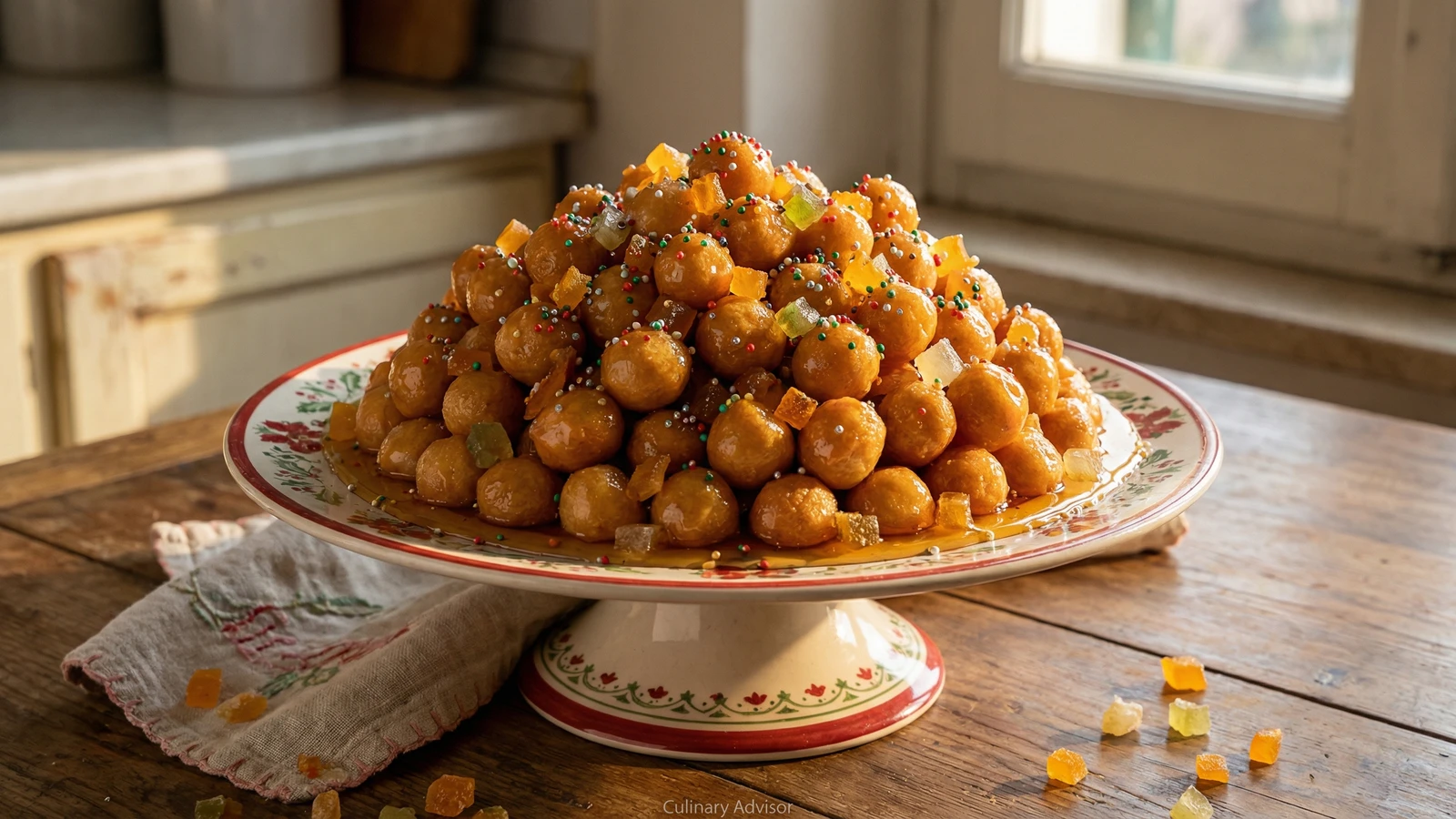
The golden honey-drenched dough balls of Naples, shaped by many hands around the table, piled high and scattered with jeweled candied fruit for Christmas.
In Naples at Christmastime, there is no dessert table without struffoli. These tiny fried balls of dough, bathed in warm honey and studded with candied fruit, are not difficult to make. They are time-consuming. This is the point. Struffoli exist to bring the family together around the table, each person rolling the little balls while the conversation flows and the children steal pieces of candied orange.
The dough is simple: flour, eggs, a little butter, citrus zest for fragrance. The technique requires patience. Each ball must be the same size, no larger than a chickpea, or they will not fry evenly. This is why Neapolitan grandmothers recruit every available hand. The work goes faster when shared, and faster still when accompanied by strong coffee and gossip.
Do not attempt to rush the frying. Do not let the honey boil. These are the only rules that matter. Everything else is tradition passed from mother to daughter: the shape of the mound, the particular candied fruits preferred by this family or that, whether to dust with confectioners' sugar (elegant) or not (traditional). Make them your own, but make them correctly.
Struffoli likely descended from ancient Greek honey pastries brought to Naples when it was part of Magna Graecia. The name may derive from the Greek 'strongoulos,' meaning round, though Neapolitans debate this with characteristic passion. By the 18th century, the nuns of San Gregorio Armeno convent were famous for their struffoli, and the tradition of making them at home for Christmas had spread to every kitchen in the city.
Quantity
3 cups (400g)
Quantity
4
Quantity
3 tablespoons
softened
Quantity
3 tablespoons
Quantity
1
zested
Quantity
1
zested
Quantity
2 tablespoons
Quantity
1/4 teaspoon
Quantity
about 4 cups
for frying
Quantity
1 1/2 cups
Quantity
1/2 cup
diced small
Quantity
1/2 cup
diced small
Quantity
3 tablespoons
Quantity
for dusting
| Ingredient | Quantity |
|---|---|
| all-purpose flour | 3 cups (400g) |
| large eggs | 4 |
| unsalted buttersoftened | 3 tablespoons |
| granulated sugar | 3 tablespoons |
| lemonzested | 1 |
| orangezested | 1 |
| limoncello or rum | 2 tablespoons |
| fine sea salt | 1/4 teaspoon |
| vegetable oilfor frying | about 4 cups |
| honey | 1 1/2 cups |
| candied orange peeldiced small | 1/2 cup |
| candied citron or lemon peeldiced small | 1/2 cup |
| colored nonpareils | 3 tablespoons |
| confectioners' sugar (optional) | for dusting |
Mound the flour on a wooden board or clean work surface. Create a well in the center, deep enough to hold the eggs without spilling. Crack the eggs into the well. Add the softened butter, sugar, lemon zest, orange zest, limoncello, and salt to the eggs. With a fork, beat the eggs and other ingredients together, gradually drawing flour from the inner walls of the well. When the mixture becomes too thick for the fork, use your hands.
Knead the dough with the heel of your hand, pushing it away from you, folding it back, and rotating it a quarter turn. Continue for 8 to 10 minutes until the dough is smooth, soft, and no longer sticky. It should feel like your earlobe when pressed. If the dough feels too dry, wet your hands slightly and continue. If too sticky, dust with the smallest amount of flour. Wrap in plastic and rest at room temperature for 30 minutes.
Divide the rested dough into eight pieces. Keep the pieces you are not working with covered. Roll each piece between your palms and the work surface into a rope about one-half inch thick. With a sharp knife, cut the rope into small pieces the size of chickpeas or hazelnuts. Roll each piece between your palms to form a smooth ball. Place the balls on a lightly floured tray, not touching. This takes time. Call the family to help.
Pour the oil into a deep heavy pot to a depth of at least three inches. Heat to 350°F (175°C). Use a thermometer. Guessing the temperature leads to greasy or burnt struffoli. Fry the balls in small batches, no more than two dozen at a time. They will sink, then rise. Stir them gently with a slotted spoon to fry evenly. When golden brown all over, about 2 to 3 minutes, remove to a tray lined with paper towels. Let the oil return to temperature between batches.
In a large wide pot or deep skillet, warm the honey over medium-low heat. Do not let it boil. The honey should be warm enough to flow easily but not so hot that it darkens or burns. Test a drop on your wrist: warm, not scalding. This is essential. Overheated honey becomes bitter and turns the struffoli an unpleasant dark color.
Add the fried struffoli to the warm honey. Stir gently with a wooden spoon, turning them over and over until each piece is coated and glistening. Work carefully. The balls are fragile. Add about three-quarters of the candied peels and stir again to distribute them throughout. Remove the pot from the heat.
Working quickly before the honey sets, turn the struffoli onto a serving plate. Wet your hands with cold water and shape them into a mound, a ring, or a wreath. The cold water prevents the honey from sticking to your skin. Scatter the remaining candied peels over the top. Shower with the colored nonpareils. Let cool completely at room temperature. Do not refrigerate.
1 serving (about 125g)
Culinary guides, cultural storytelling, and the editorial depth that makes cooking meaningful.
Discover Culinary ExplorerChef Graziella
The ancient spice cookies of Naples, shaped like diamonds and cloaked in dark chocolate. Every Neapolitan nonna makes these for Christmas, and now you will too.
Chef Graziella
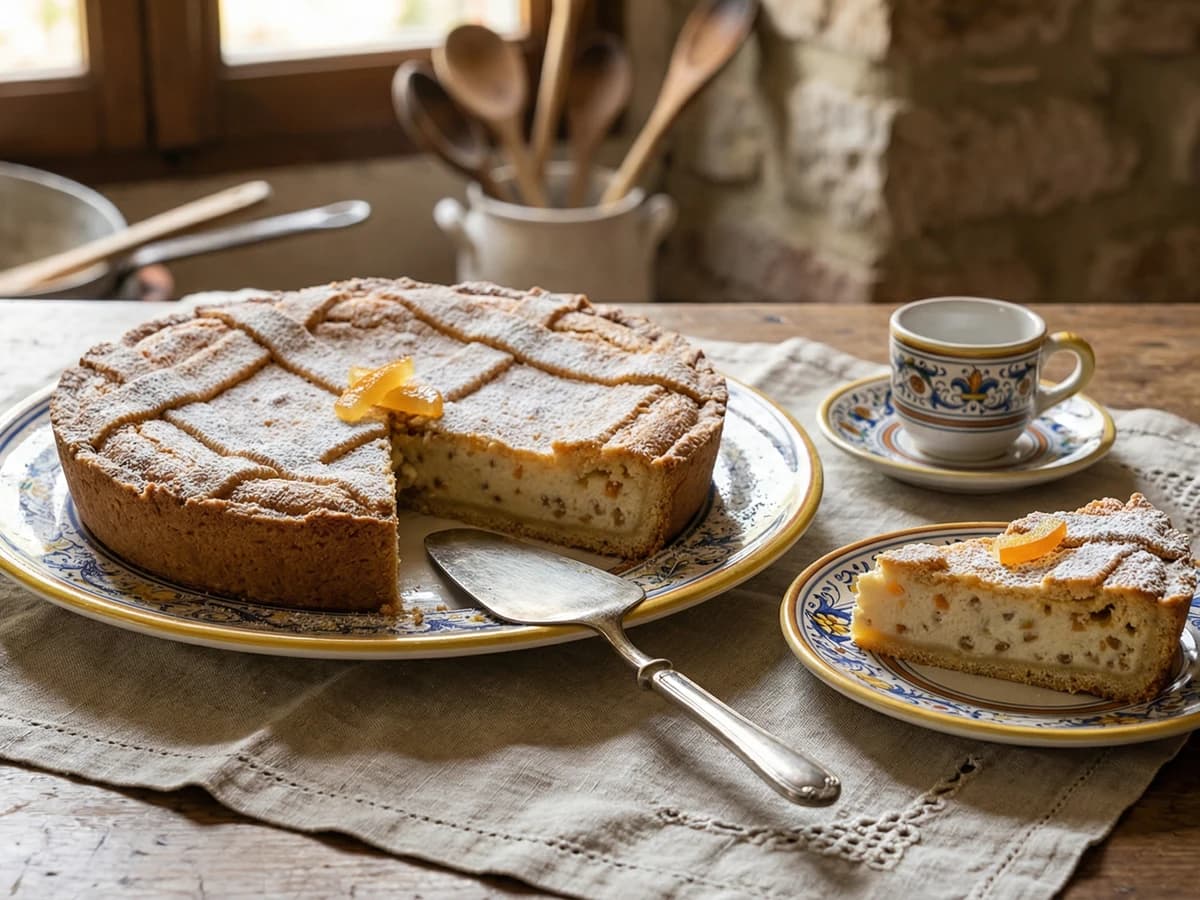
The ancient Easter tart of Naples, where cooked wheat, ricotta, candied citrus, and orange blossom water unite inside buttery pasta frolla. Made days ahead because patience is not optional.

Chef Graziella
The rock-hard almond rings of Naples, baked to withstand the Christmas season. Dunk them in vin santo or espresso, wait for the softening, and understand why Neapolitans have made these for three centuries.

Chef Graziella
The legendary ridged pastry of Naples, where paper-thin dough is stretched, laminated with lard, and shaped into shells that shatter at first bite. This is not a recipe for the impatient.