
Chef Elsa
Apfelkren
Freshly grated horseradish folded with tart apple and lemon, the cold, sharp sauce that belongs beside every plate of Tafelspitz in Vienna and has done for as long as anyone can remember.
A cooking platform built around craft, culture, and the stories behind what we eat.
Created by
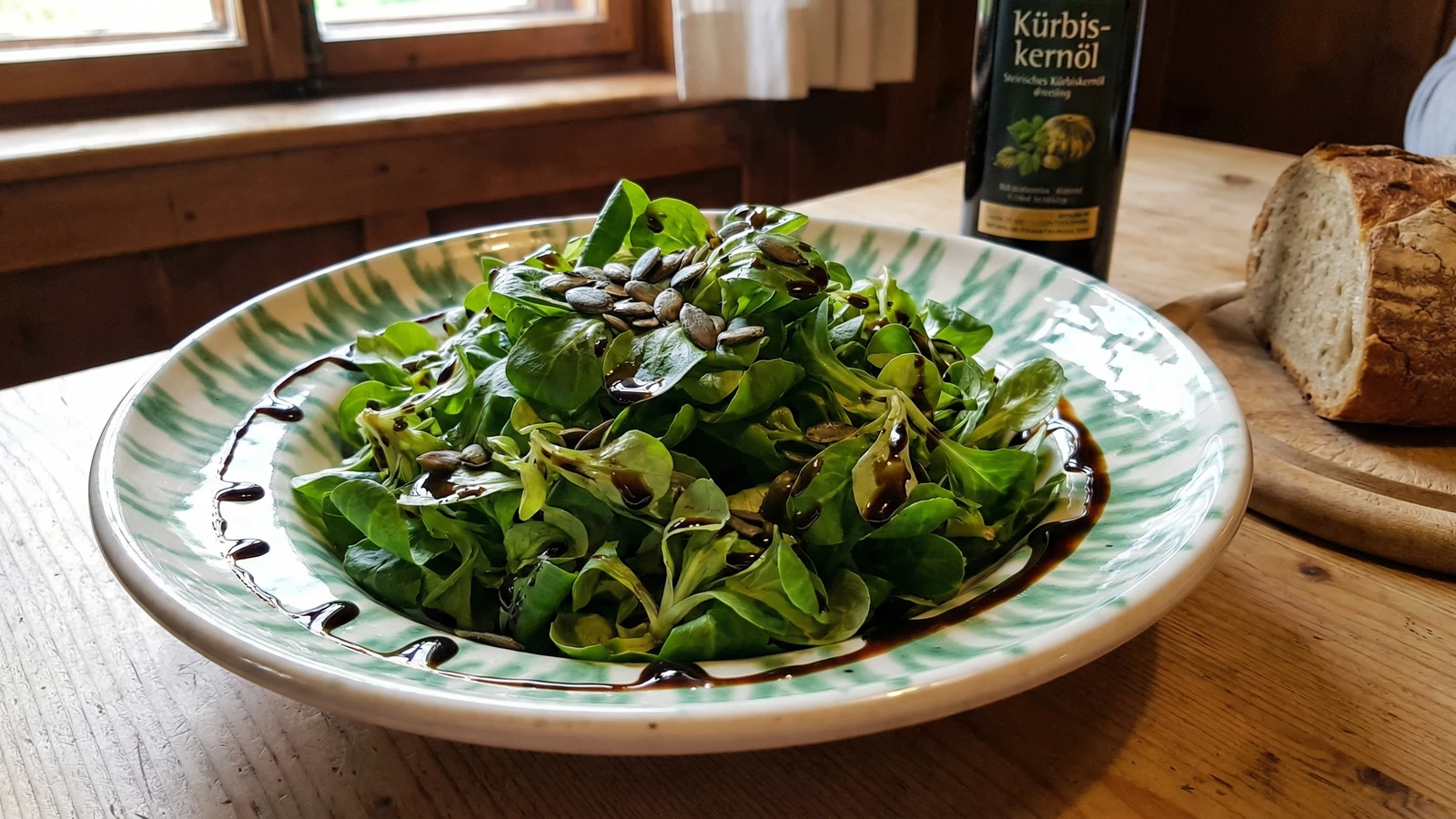
Styria's liquid black gold whisked with sharp cider vinegar and a pinch of salt, the three-ingredient dressing that turns a bowl of Vogerlsalat into something you'll dream about.
The first time I tasted real Steirisches Kürbiskernöl was on a childhood trip to Graz with Gretel and my grandmother Eva. We were at a Buschenschank, one of those vineyard taverns where the farmer's wife brings out what she has and you eat it. A bowl of Vogerlsalat arrived, small and dark green, dressed in something so deeply nutty and rich it stained the white plate black-green where the oil pooled. I was maybe eight. I ate the whole thing and asked for more.
Gretel explained it to me the way she explained everything: carefully, as though I deserved the full answer. This oil comes from a specific pumpkin, the Cucurbita pepo var. styriaca, a variety that grows only in southeastern Styria. The seeds are hulless, dark green, and when they're pressed, they produce an oil so thick and intensely flavored that a tablespoon is enough to dress an entire salad. You don't cook with it. You finish with it. Heat would destroy everything that makes it extraordinary.
This dressing is three ingredients. Oil, vinegar, salt. That's it. There is nowhere to hide. If your oil is mediocre, your dressing will be mediocre. If your vinegar is sharp and clean, and your Kernöl is the real thing from Styria, you will have something that makes a simple bowl of greens taste like a place. Good Austrian home cooking has always been this: simple food done well, built on ingredients that earned their reputation.
Styrian pumpkin seed oil holds PGI (Protected Geographical Indication) status from the European Union, meaning only oil produced in designated regions of Styria, southern Burgenland, and parts of Lower Austria from the indigenous hulless-seeded pumpkin can carry the name Steirisches Kürbiskernöl. The hulless mutation was first documented in Styria in the 19th century, though pumpkin cultivation in the region dates to the 17th century. What began as a regional farmhouse staple has become one of Austria's most recognized food products, with Styrians treating their Kernöl the way the French treat their olive oil: as a point of provincial pride not open for debate.
Quantity
3 tablespoons
Quantity
1.5 tablespoons
Quantity
1/4 teaspoon
Quantity
1 small
very finely minced
Quantity
pinch
| Ingredient | Quantity |
|---|---|
| Steirisches Kürbiskernöl (Styrian pumpkin seed oil) | 3 tablespoons |
| apple cider vinegar | 1.5 tablespoons |
| fine sea salt | 1/4 teaspoon |
| shallot (optional)very finely minced | 1 small |
| freshly ground black pepper | pinch |
Pour the apple cider vinegar into a small bowl. Add the salt and whisk until it dissolves completely. This matters. Salt won't dissolve in oil, so if you add it later, you'll get uneven seasoning and the occasional sharp, salty bite where a crystal hid. Vinegar first, salt dissolved, then oil. That's the order and the reason behind it.
If you're using shallot, stir it into the vinegar mixture now and let it sit for two minutes. The acid takes the raw edge off without cooking the shallot. Some Styrian cooks would consider a shallot an intrusion. Others wouldn't make it without one. I like it when I'm dressing heartier greens or sliced tomatoes. For Vogerlsalat, I usually leave it out and let the oil speak.
Pour the pumpkin seed oil into the vinegar in a steady stream, whisking as you go. The dressing won't emulsify into a thick vinaigrette the way a mustard-based dressing would. It will stay loose and glossy, dark green-black with a slightly viscous body. That's correct. You're not making a mayonnaise. You're making a dressing that wants to coat leaves lightly and pool at the bottom of the bowl for you to mop up with bread.
Add a grind of black pepper. Taste again. The dressing should be nutty, sharp, and clean, with the oil's roasted depth balanced by the vinegar's bite. Use it immediately or within the hour. Pumpkin seed oil oxidizes faster than olive oil, and the dressing tastes best when it's freshly made. Pour it over your salad at the table, toss gently, and serve. Mahlzeit!
1 serving (about 24g)
Culinary guides, cultural storytelling, and the editorial depth that makes cooking meaningful.
Discover Culinary ExplorerChef Elsa
Freshly grated horseradish folded with tart apple and lemon, the cold, sharp sauce that belongs beside every plate of Tafelspitz in Vienna and has done for as long as anyone can remember.

Chef Elsa
The clear, caraway-scented pan jus you pour over Schweinsbraten and Knödel, built from nothing but good pork drippings, honest stock, and the patience to let a roasting pan tell you everything it knows.

Chef Elsa
A silky butter roux sauce finished with beef broth, cream, and handfuls of fresh dill, the way every Viennese grandmother serves it alongside Tafelspitz on Sunday.

Chef Elsa
Crisp cauliflower, sweet carrots, and bright peppers in a spiced sweet-sour brine with mustard seeds, the jar you open first when the Brettljause comes out and the last one you put away.