Culinary Explorer

A cooking platform built around craft, culture, and the stories behind what we eat.
Discover Culinary Explorer
Stafidota Ierapetras (Σταφιδωτά Ιεράπετρας)

Stafidota Ierapetras (Σταφιδωτά Ιεράπετρας)

Created by

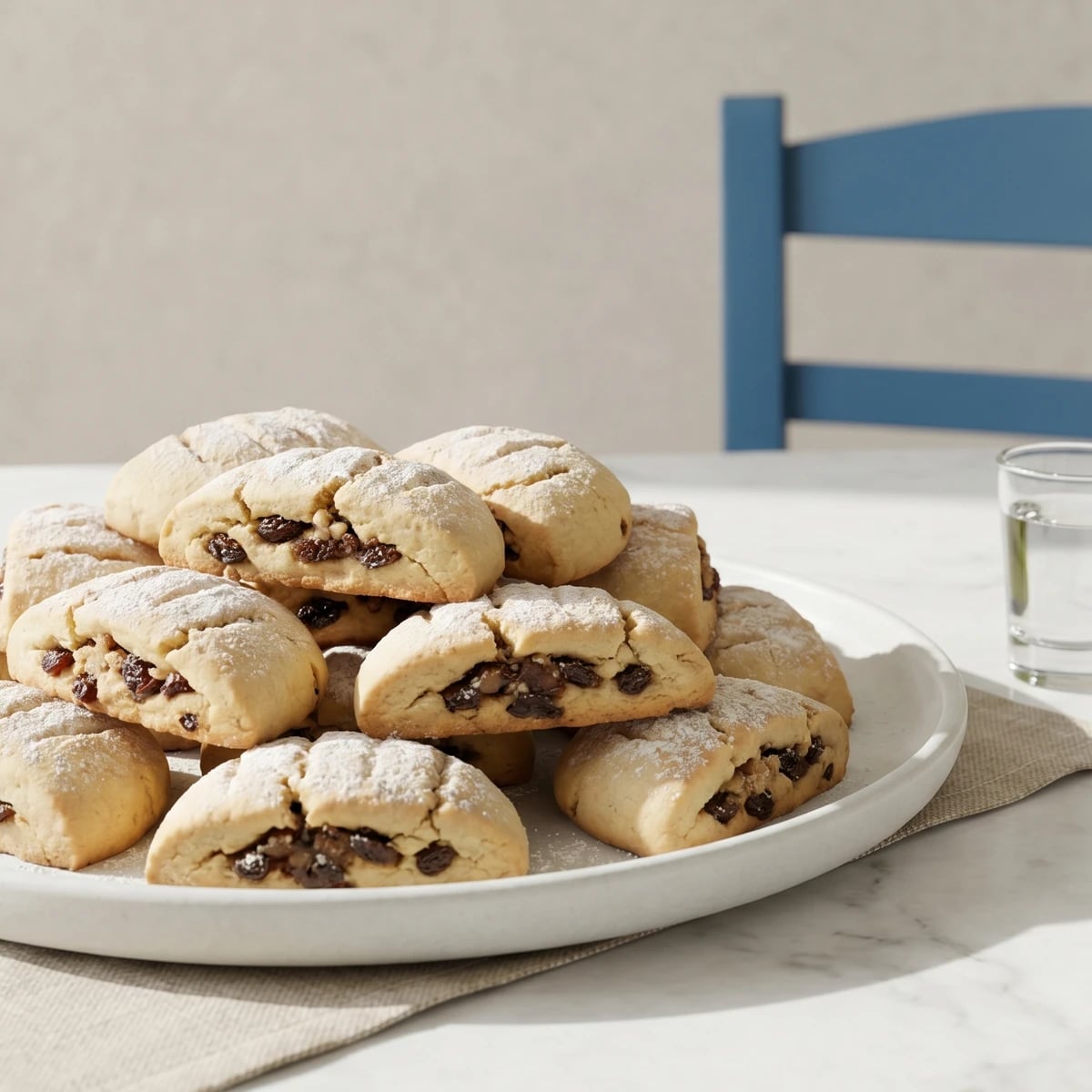
Ierapetra's stafidota are soft Cretan raisin cookies, olive-oil dough folded around walnuts, orange, and cinnamon, then sealed shut so the filling bakes plump instead of dry.

Pastries & Cookies
Greek
Make Ahead
Celebration
Comfort Food
45 min
Active Time
25 min cook1 hr 40 min total
Yield28 cookies

Stafidota Ierapetras are the raisin cookies of Ierapetra in Lasithi, Crete: soft olive-oil pastry folded over a dark filling of raisins, walnuts, sesame, orange, and cinnamon. They are not syrup sweets. They are not little cakes. They are the kind of cookie that waits on the tray and tastes even better after a day.

The whole cookie depends on the seal. The raisin filling must be chopped into a sticky paste, then the dough is folded thinly around it and pressed closed without flour in the seam. If the edge opens, the raisins dry. Seal it properly and the filling stays juicy, which is exactly what makes this Ierapetra sweet itself.

The dough is nistisimo, made with olive oil, orange juice, and a little tsikoudia, no butter and no eggs. I keep the sweetness modest because the raisin does the work. A recipe written down is a recipe saved, and this one deserves the plain numbers that let a first tray come out like it belongs on a Cretan table.

Stafidota take their name from stafida, raisin, and the Ierapetra version belongs to the household pastry tradition of Lasithi on Crete's southeastern coast. In Cretan village kitchens, dried grapes, walnuts, sesame, orange, and cinnamon made a filling that kept well before sweets depended on butter or cream. Because the pastry uses olive oil and no eggs or dairy, it also fits the Orthodox fasting table, though in Ierapetra it is just as much a celebration cookie.

The technique, the tradition, and the story behind every dish.

Discover Culinary Explorer

Ingredients

seedless raisins (stafides)

Quantity

350g

preferably Cretan sultanas or dark raisins

fresh orange juice

Quantity

80ml

warmed, for soaking

tsikoudia, Cretan raki

Quantity

30ml

for soaking

walnuts

Quantity

120g

finely chopped

sesame seeds

Quantity

30g

lightly toasted

fine barley rusk crumbs or dry breadcrumbs

Quantity

35g

petimezi (grape molasses) or Cretan thyme honey

Quantity

40g

orange zest

Quantity

1 tablespoon

finely grated, for the filling

ground cinnamon

Quantity

1 1/2 teaspoons

ground cloves

Quantity

1/4 teaspoon

all-purpose flour

Quantity

500g

plus a little for rolling

granulated sugar

Quantity

80g

baking powder

Quantity

10g

baking soda

Quantity

1/2 teaspoon

fine sea salt

Quantity

1/2 teaspoon

extra virgin olive oil

Quantity

120ml

preferably Cretan Koroneiki

fresh orange juice

Quantity

120ml

for the dough

tsikoudia or dry white wine

Quantity

60ml

for the dough

orange zest

Quantity

1 tablespoon

finely grated, for the dough

icing sugar (optional)

Quantity

25g

for dusting

Equipment Needed

  • 9cm round cutter or thin-rimmed glass
  • food processor or hand mincer for the raisin filling
  • two rimmed baking sheets
  • rolling pin

Instructions

  1. 1

    Plump the raisins

    Put the raisins in a bowl and pour over the warm orange juice and tsikoudia. Let them stand for 20 minutes, until they soften and shine. If the raisins are dry and stubborn, give them another 10 minutes. A good stafidoto starts with a raisin that still has life in it.

  2. 2

    Make the filling

    Drain the raisins only if liquid is pooling in the bowl, then pulse them in a food processor until they become a coarse, sticky paste, not a smooth puree. Scrape into a bowl and mix in the walnuts, sesame, rusk crumbs, petimezi or honey, orange zest, cinnamon, and cloves. The filling should hold together when pressed between your fingers. If it smears wet, add 1 tablespoon more crumbs. If it crumbles, add 1 teaspoon orange juice.

  3. 3

    Mix the dough

    Whisk the flour, sugar, baking powder, baking soda, and salt in a wide bowl. In another bowl whisk the olive oil, orange juice, tsikoudia, and orange zest, then pour the liquid into the flour. Mix with your hand until the dough comes together, then knead only 8 or 10 turns, just until smooth. Olive-oil dough gets tough if you bully it. Cover and rest for 30 minutes.

  4. 4

    Roll and cut

    Heat the oven to 180 C and line two baking sheets with parchment. Roll half the dough on a lightly floured surface to about 3mm thick. Cut rounds with a 9cm cutter or the rim of a glass, then gather the scraps gently. Keep the remaining dough covered so it stays pliable.

  5. 5

    Fill and seal

    Set 1 level tablespoon of filling, about 18g, just off center on each round. Fold the dough over into a half-moon and press the edge closed firmly with dry fingers, then crimp with a fork or pinch the rim. This is the step that decides the cookie. If flour sits on the edge, brush it away or touch the rim with a damp fingertip, because a dusty edge will open in the oven and the raisin filling will dry. Sealed well, the inside stays juicy.

  6. 6

    Bake pale gold

    Arrange the stafidota 3cm apart on the trays. Bake for 22 to 25 minutes, rotating the trays once, until the bottoms are lightly golden and the tops are set but still pale. Don't chase a dark color here. These are soft Cretan cookies, not hard rusks.

  7. 7

    Cool and dust

    Let the cookies cool on the tray for 10 minutes, then move them to a rack. Dust with icing sugar only when fully cool. They are good the same day, better the next, when the orange, cinnamon, and raisin settle into the pastry.

Chef Tips

  • Use raisins that are pliable and fragrant, not dusty and hard. If that's all the shop has, soak them longer in warm orange juice. The right method on a tired raisin still gives you a tired filling.
  • Keep flour away from the sealing edge. Roll with a light hand, brush off excess, and press the seam until it feels joined, not just folded. That small care is what keeps the center moist.
  • For a strict plant-based tray, use petimezi instead of honey. Serve stafidota with Greek coffee, mountain tea, or a small glass of tsikoudia. They keep their dignity for days, which is more than I can say for most fancy biscuits.

Advance Preparation

  • The filling can be made up to 2 days ahead and kept covered in the refrigerator. Bring it to room temperature before shaping.
  • The dough can rest at room temperature for 30 minutes, or be chilled up to 1 day. If chilled, let it soften before rolling or it will crack at the fold.
  • Bake the stafidota 1 to 2 days ahead for the best texture. Store airtight and dust with icing sugar shortly before serving.

Frequently Asked Questions

Nutrition Information

1 serving (about 50g)

Calories
205 calories
Total Fat
8 g
Saturated Fat
1 g
Trans Fat
0 g
Unsaturated Fat
7 g
Cholesterol
0 mg
Sodium
115 mg
Total Carbohydrates
32 g
Dietary Fiber
2 g
Sugars
13 g
Protein
3 g

Note: Chef personas and recipes are created with AI assistance. Cook with care: follow safe food-handling practices, check doneness with a thermometer when needed, and adapt for allergies and your kitchen.

Where cooking meets culture.

Culinary guides, cultural storytelling, and the editorial depth that makes cooking meaningful.

Discover Culinary Explorer

More from Greek Cookies

Browse the full collection