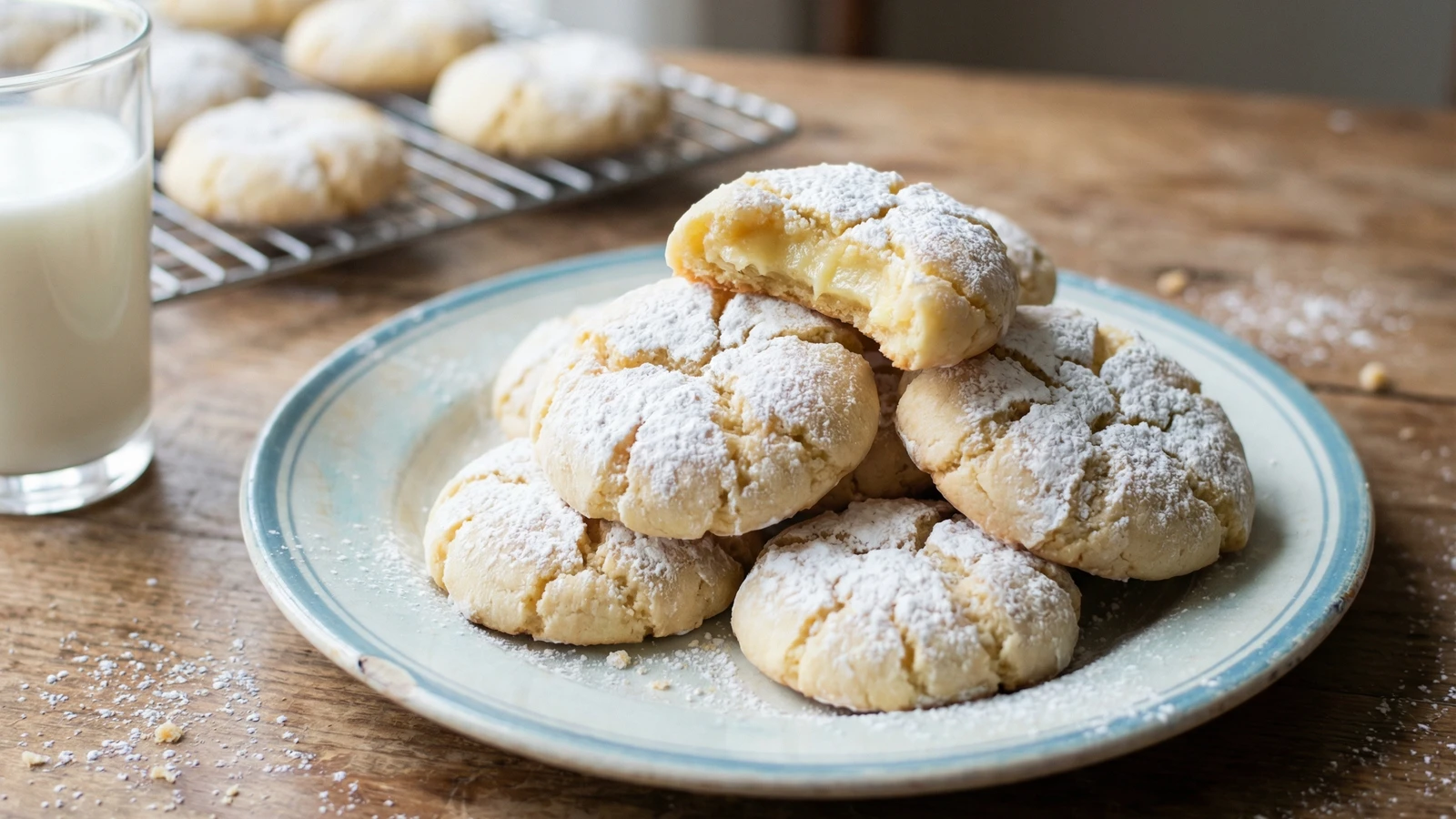
Cream cheese cookie dough rolled in powdered sugar, baked until the tops crackle and the centers stay impossibly soft. St. Louis gave us this gift, and we should honor it properly.
Pastries & Cookies
American
Make Ahead
Potluck
20 min
Active Time
12 min cook•2 hr 30 min total
Yield24 cookies
St. Louis has given American baking one of its most ingenious accidents. In the 1930s, a German-American baker reportedly reversed his ratios of butter and flour while making coffee cake. Instead of correcting the mistake, he served it anyway. The result was gooey butter cake, a confection so decadent it became the city's calling card.
These cookies translate that same spirit into portable form. The cream cheese does the heavy lifting here, creating a dough that bakes into something between a cookie and a cake. The exterior develops those signature cracks while the interior stays soft, almost custard-like when still warm. This is not a crispy cookie. If you want crunch, look elsewhere.
The powdered sugar coating serves two purposes. It creates the dramatic crackle pattern as the cookies spread and split in the oven's heat. It also adds another layer of sweetness that balances the tanginess from the cream cheese. Roll them generously. Don't be shy about it.
I've watched these cookies disappear from potluck tables faster than any chocolate chip variety. They travel well, they hold for days, and they convert skeptics who claim they don't care for butter cookies. The name alone sparks curiosity. The first bite seals the deal.
The technique, the tradition, and the story behind every dish.
In a large bowl, beat the cream cheese and butter together with an electric mixer on medium speed until completely smooth and unified, about 2 minutes. Scrape down the sides of the bowl. You want no lumps, no streaks. The mixture should look like pale, fluffy frosting. This is your foundation, so take the time to get it right.
Truly softened cream cheese matters here. Set it out 2 hours before baking, or microwave in 10-second bursts until it yields easily to a finger press.
2
Add sugar and egg
Add the granulated sugar and beat on medium speed until light and fluffy, another 2 minutes. The mixture will increase in volume and turn almost white. Add the egg and vanilla, beating until fully incorporated. Scrape the bowl again. Every ingredient needs to be evenly distributed for proper texture.
3
Mix dry ingredients
In a separate bowl, whisk together the flour, baking powder, and salt. Add this to the wet mixture in two additions, mixing on low speed just until the flour disappears each time. The dough will be soft, sticky, and slightly shiny. Do not overmix. We want tender cookies, not tough ones.
4
Chill the dough
Cover the bowl tightly with plastic wrap and refrigerate for at least 2 hours, or overnight. The dough must firm up completely. Skip this step and you'll have cookies that spread into flat puddles and lose their signature gooey centers. Patience rewards you here.
Overnight chilling produces even better results. The flavors meld and the texture improves. Plan ahead when you can.
5
Prepare for baking
When ready to bake, position racks in the upper and lower thirds of your oven and preheat to 350°F. Line two baking sheets with parchment paper. Place the powdered sugar in a shallow bowl. Work quickly once you start rolling. The dough softens fast in warm hands.
6
Shape and coat
Scoop tablespoon-sized portions of dough and roll into balls between your palms. Drop each ball into the powdered sugar and roll until thickly coated on all sides. Really bury them in the sugar. This generous coating creates those beautiful cracks as the cookies bake. Place the balls 2 inches apart on the prepared sheets. They will spread.
A cookie scoop ensures uniform size. Uniform size means uniform baking. Every cookie hits that perfect moment together.
7
Bake until just set
Bake for 10 to 12 minutes, rotating the pans halfway through. The cookies are done when the edges look set and matte but the centers still appear slightly underdone and shiny. They will look too soft. They will look like they need more time. They don't. Trust the process. The tops should have developed deep cracks revealing the pale dough beneath.
8
Cool completely
Let the cookies cool on the baking sheets for 10 minutes. They're fragile when hot and will break if you try to move them too soon. Transfer to a wire rack to cool completely. The centers will firm up as they cool but retain that characteristic gooey, almost fudgy texture. Resist the urge to eat them straight from the oven. They improve at room temperature.
Chef Tips
•Use full-fat cream cheese in the brick form, not the spreadable kind in tubs. The tub variety contains stabilizers and extra moisture that throw off the texture.
•These cookies are intentionally very sweet. The tanginess from cream cheese balances it, but if you prefer less sweetness, reduce the granulated sugar by 2 tablespoons.
•For deeper flavor, brown your butter first, then chill it until solid before creaming. It adds a nutty complexity that elevates the whole cookie.
•The dough freezes beautifully. Scoop into balls, freeze on a sheet pan, then transfer to a freezer bag. Bake from frozen, adding 2 to 3 minutes to the time.
•Store baked cookies in an airtight container at room temperature for up to 5 days. They actually taste better on day two, once the flavors have fully developed.
Advance Preparation
•Dough can be refrigerated for up to 3 days before shaping and baking.
•Unbaked dough balls can be frozen for up to 2 months. Roll in powdered sugar while still frozen, then bake directly from the freezer.
•Baked cookies freeze well for up to 3 months. Thaw at room temperature for 1 hour before serving.
Frequently Asked Questions
Nutrition Information
1 cookie (about 30g)
Calories
165 calories
Total Fat
7 g
Saturated Fat
4 g
Trans Fat
0 g
Unsaturated Fat
2 g
Cholesterol
20 mg
Sodium
125 mg
Total Carbohydrates
24 g
Dietary Fiber
0 g
Sugars
18 g
Protein
2 g
Where cooking meets culture.
Culinary guides, cultural storytelling, and the editorial depth that makes cooking meaningful.