
Chef Klaus
Aachener Printen
Aachen's Advent biscuit is dark, hard, and spiced, with beet syrup doing the deep work and a closed tin finishing what the oven only starts.
A cooking platform built around craft, culture, and the stories behind what we eat.
Created by
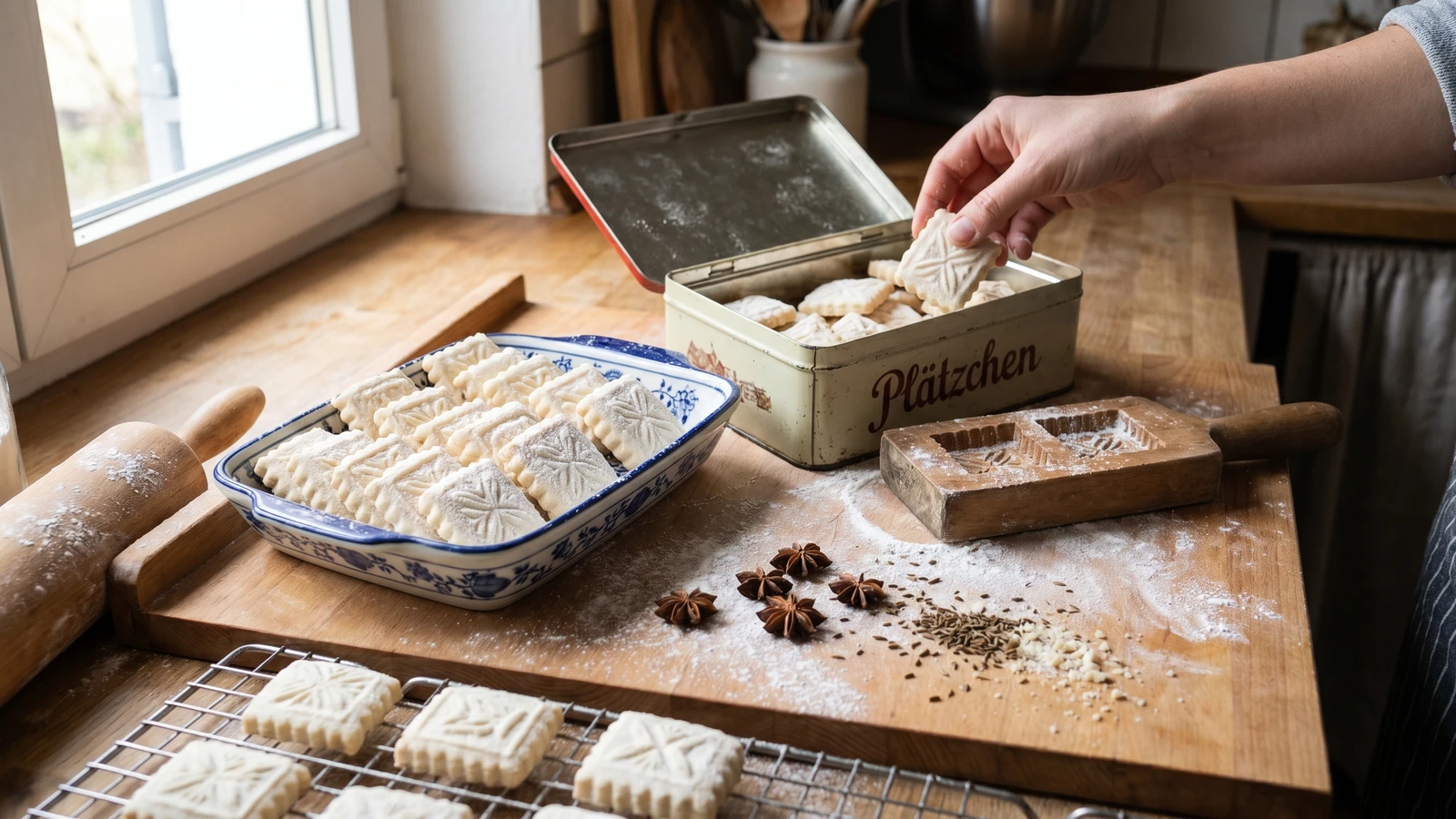
The old Swabian Christmas cookie lives or dies before it bakes: dry the stamped dough overnight, and the picture stays sharp while the pale foot lifts underneath.
Springerle sits deep in the Advent tin, especially in Swabia and Baden, where the carved mould matters almost as much as the dough. It is a white anise cookie, stamped with pictures, dried overnight, and baked pale. Not golden. Pale. If you want brown Christmas spice, bake Lebkuchen. This one is ivory, hard at first, and better after it rests.
The regions argue in the small ways that matter. Swabia keeps them thick and high, with whole anise underneath the dough. Baden and Alsace often go a little thinner, and some kitchens flavour the dough with ground anise or anise oil instead. I like the seed underneath. It perfumes the cookie from below and leaves the face clean, which is where the mould has done its work. Im Norden anders, im Süden anders, and here we are firmly in the south-west.
The step that decides everything is the drying. Stamp the dough sharply, cut it, then leave the cookies uncovered overnight. The surface skin sets around the picture, so when the heat comes from below, the bottom rises into a little foot and the carved face does not blur. Bake too hot and you brown the top before the foot forms. Skip the drying and you get a sweet biscuit with a smudged face. Das braucht seine Zeit.
These are not last-minute cookies. Make them before the feast, stack them in a tin with a piece of apple or bread for a day if they need softening, and let the anise settle. Nicht aus dem Glas, not from a packet mix. Eggs, sugar, flour, anise, patience. That is the whole cupboard.
Springerle moulds are documented in German-speaking regions from at least the 14th century, when carved wood and clay forms carried biblical scenes, coats of arms, animals, and feast-day images into holiday baking. The cookie became strongest in Swabia, Baden, Franconia, Alsace, and Switzerland, regions tied to the medieval spice trade that made anise a Christmas baking flavour rather than an everyday one. The name is commonly linked to the way the cookie springs up from the base during baking, forming the pale little foot under the dried stamped picture.
Quantity
4
at room temperature
Quantity
500g
sifted, plus more for dusting
Quantity
1 teaspoon
finely grated
Quantity
1 pinch
Quantity
1 tablespoon
Quantity
1/2 teaspoon
crushed fine
Quantity
500g
plus more for rolling
Quantity
2 tablespoons
| Ingredient | Quantity |
|---|---|
| large eggsat room temperature | 4 |
| icing sugarsifted, plus more for dusting | 500g |
| lemon zestfinely grated | 1 teaspoon |
| fine salt | 1 pinch |
| kirsch or milk | 1 tablespoon |
| baking ammoniacrushed fine | 1/2 teaspoon |
| plain flourplus more for rolling | 500g |
| whole anise seeds | 2 tablespoons |
Beat the eggs and sifted icing sugar for 10 to 12 minutes, until the mixture is thick, pale, and falls from the whisk in a slow ribbon. This long beating dissolves the sugar and builds the fine structure that lets the cookie rise cleanly instead of cracking at random.
Stir in the lemon zest and salt. Dissolve the baking ammonia in the kirsch or milk, then mix it in. Crush the baking ammonia fine before it goes near the bowl, because a hard grain leaves a bitter pocket in the cookie and nobody at the Advent table asked for that.
Add the flour in stages and mix until you have a firm, smooth dough that is no longer sticky but still rolls without cracking. Stop as soon as it comes together. Too much extra flour makes Springerle dry before they have had the decency to age.
Dust the board and mould lightly with flour, then roll the dough about 1cm thick. Press the Springerle mould straight down with steady pressure, lift it cleanly, and cut the shapes apart. Do not rock the mould. Rocking smears the carved lines, and those lines are the point of the cookie.
Scatter the anise seeds over parchment-lined trays and set the stamped cookies on top. Leave them uncovered at cool room temperature for 12 to 24 hours, until the surface feels dry and set. This skin locks the picture in place, so the bottom can lift into its foot while the face stays pale and sharp.
Bake at 150C for 15 to 18 minutes, one tray at a time, until the cookies have risen from the base and the bottoms are just faintly coloured. Runter mit der Temperatur. If the tops go golden, the oven is too hot and the old white cookie has turned into something else.
Cool the Springerle completely, then pack them in a tin and leave them at least one week before serving. They start hard, then the texture settles and the anise moves through the crumb. If they stay too hard, add a small piece of apple or bread to the tin for one day, then remove it before it brings mould with it.
1 serving (about 25g)
Culinary guides, cultural storytelling, and the editorial depth that makes cooking meaningful.
Discover Culinary ExplorerChef Klaus
Aachen's Advent biscuit is dark, hard, and spiced, with beet syrup doing the deep work and a closed tin finishing what the oven only starts.

Chef Klaus
The Baden-Wuerttemberg apple fritter that lives between weeknight dessert and Sunday coffee, built on tart rings, a light batter, and oil kept steady.

Chef Klaus
The Carnival doughnut lives by proofing and fat temperature: a light yeast round floats high, cooks through with one pale belt, then takes its jam without turning greasy.

Chef Klaus
A cold Mürbeteig ball, one clean hollow, and a spoon of tart jelly: Engelsaugen are Advent cookies that fail only when the dough gets warm.