
Chef Klaus
Apfelmus
The apple-harvest preserve of the German kitchen, cooked low until the fruit collapses, then kept smooth, tart, and ready for potato pancakes or warm Mehlspeisen.
A cooking platform built around craft, culture, and the stories behind what we eat.
Created by
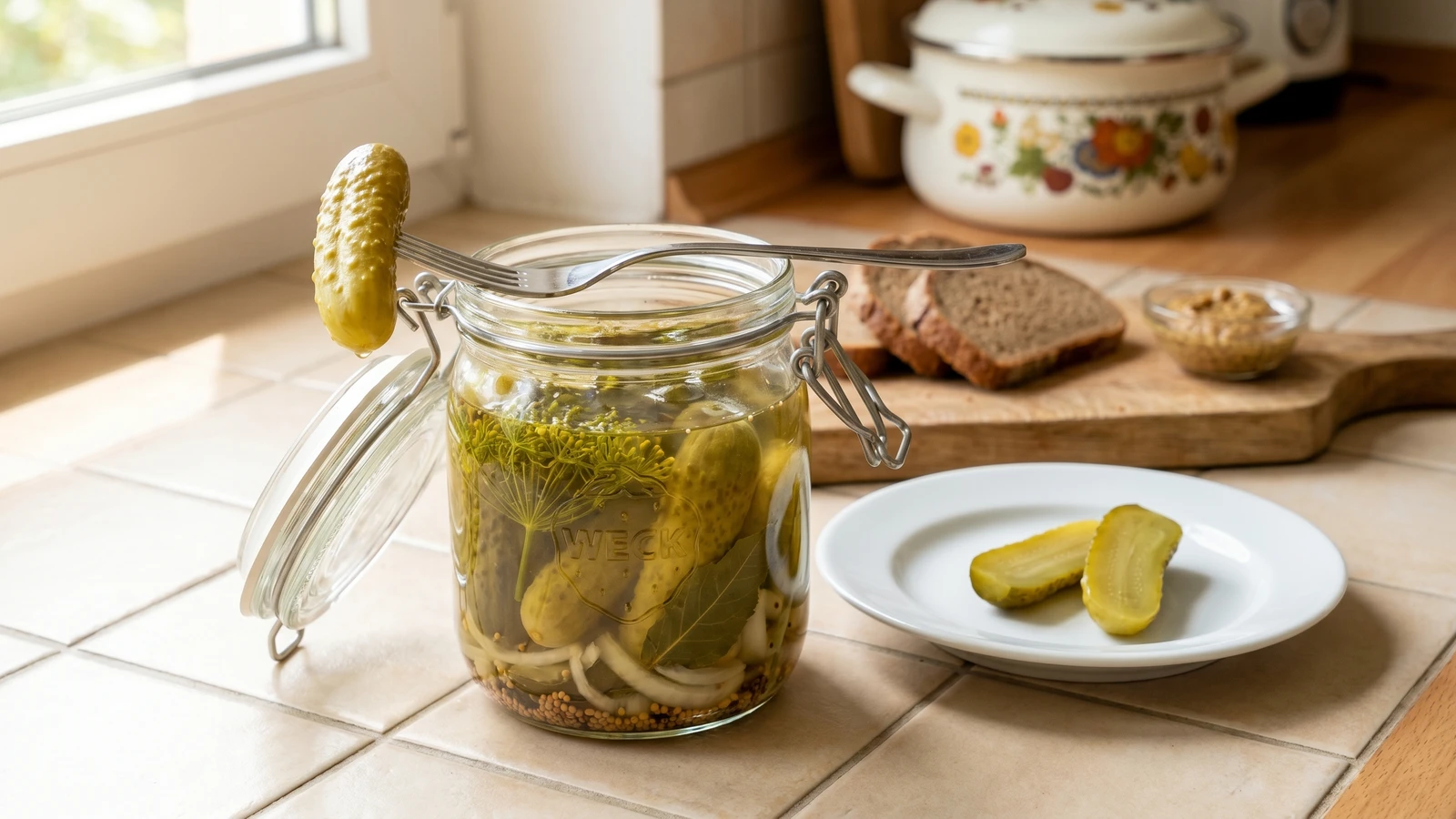
Brandenburg's cucumber jar for the winter shelf: small gherkins salted first, packed with dill and horseradish leaf, then sealed in vinegar brine so the snap stays where it belongs.
Spreewälder Gewürzgurken belong to Brandenburg's wet, green Spreewald and to the late-summer preserving day, when cucumbers come in faster than you can eat them. I put them up for the cold shelf, then open them beside Abendbrot, the evening bread table, with rye, cold cuts, potato salad, or a Sunday roast that needs something sharp. This is the larder doing its work. Weggeworfen wird nichts, and a cucumber glut becomes winter.
Germany disagrees over cucumbers as seriously as it disagrees over dumplings. In the north you meet Salzgurken, salt-brined cucumbers soured by fermentation; in the south the vinegar jar often runs sweeter. The Spreewald's Gewürzgurke sits in its own place: small firm cucumbers, dill, mustard seed, onion, horseradish leaf, and a clean sweet-sour brine. Das ist kein Bierzelt.
The deciding technique is firming before sealing: salt first, then controlled heat. Salt pulls water from the cucumber and tightens the flesh, so the vinegar brine doesn't get thin and the pickle doesn't go slack. Pasteurize at 82 to 85C, not a wild boil, because a hard boil may close the lid but it cooks the crunch out. Erst verstehen, dann kochen.
Spreewälder Gurken come from the Spreewald, the canal-cut lowland south of Berlin around Lübbenau, Lübben, and Burg, where cucumber growing was established by the 18th century and jars moved into Berlin by boat, cart, and rail. The name Spreewälder Gurken was registered by the EU as a protected geographical indication in 1999, tying the pickle to Brandenburg's regional growing and processing tradition. The local family splits into Gewürzgurken in vinegar spice brine, Salzgurken in lactic salt brine, and Senfgurken peeled and cut with mustard seed, so the argument is not whether to pickle, but which jar belongs on the table.
Quantity
1.5kg
6-9cm long
Quantity
1.5L
for salting
Quantity
45g
for salting
Quantity
750ml
5% acidity
Quantity
750ml
Quantity
90g
Quantity
30g
Quantity
4 flower heads or 8 sprigs
Quantity
4 small pieces
washed, or use unsprayed grape or sour cherry leaf
Quantity
40g
peeled and sliced
Quantity
1
thinly sliced
Quantity
4 teaspoons
Quantity
2 teaspoons
Quantity
8
Quantity
4
| Ingredient | Quantity |
|---|---|
| small unwaxed pickling cucumbers6-9cm long | 1.5kg |
| cold waterfor salting | 1.5L |
| fine sea saltfor salting | 45g |
| white wine vinegar or distilled vinegar5% acidity | 750ml |
| water | 750ml |
| sugar | 90g |
| fine sea salt | 30g |
| dill flower heads or dill sprigs | 4 flower heads or 8 sprigs |
| horseradish leafwashed, or use unsprayed grape or sour cherry leaf | 4 small pieces |
| fresh horseradish rootpeeled and sliced | 40g |
| medium onionthinly sliced | 1 |
| yellow mustard seed | 4 teaspoons |
| black peppercorns | 2 teaspoons |
| allspice berries | 8 |
| bay leaves | 4 |
Choose small, hard, unwaxed pickling cucumbers, all close to the same size so they cure at the same pace. Scrub them well and trim a thin slice from the blossom end, the end opposite the stem; that end carries enzymes that soften pickles, and the jar remembers lazy knife work.
Dissolve 45g salt in 1.5L cold water, cover the cucumbers completely, and keep them cold for 8 to 12 hours. Salt pulls loose water out of the flesh and seasons the cucumber before the vinegar arrives, so the finished brine doesn't turn weak around a soft pickle. Drain, rinse briefly, and pat them dry.
Wash four 500ml preserving jars and new lids, then keep the jars hot until packing so the hot brine does not crack cold glass. Put one dill head, one piece of horseradish leaf, a few slices of horseradish root and onion, 1 teaspoon mustard seed, a pinch of peppercorns, 2 allspice berries, and 1 bay leaf into each jar. The leaf is not decoration; its tannin helps the cucumber keep its bite.
Stand the cucumbers upright in the jars, tight enough that they stay under the brine but not so tight that you bruise them. Pack smaller cucumbers into the gaps. A loose jar floats and cures unevenly; a crushed cucumber gives up its crunch before the first week is over.
Bring the vinegar, 750ml water, sugar, and 30g salt to a full boil and stir until clear. Use vinegar marked 5% acidity and do not weaken it, because the acid is the preservation, not a flavour suggestion. Pour the hot brine over the cucumbers, leaving 1cm headspace, then tap out air bubbles, wipe the rims, and close the jars.
Set the jars on a rack in a preserving pot and cover them with water by 2.5cm. Hold the bath at 82 to 85C for 30 minutes, timing from when the water returns to that range. This controlled heat seals the jars and pasteurizes the acid brine without cooking the snap out of the cucumbers. If you cannot hold that temperature accurately, use a rolling boiling-water bath for 10 minutes and accept a softer pickle.
Lift the jars out and leave them undisturbed for 12 hours, then check that the lids have sealed. Store sealed jars in a cool, dark place for at least 2 weeks before opening, because the first days taste like vinegar and spices sitting beside a cucumber, not inside it. Das braucht seine Zeit. Refrigerate any unsealed jar and eat it within 4 weeks.
1 serving (about 500g)
Culinary guides, cultural storytelling, and the editorial depth that makes cooking meaningful.
Discover Culinary ExplorerChef Klaus
The apple-harvest preserve of the German kitchen, cooked low until the fruit collapses, then kept smooth, tart, and ready for potato pancakes or warm Mehlspeisen.

Chef Klaus
The northern marinated herring that belongs to the cold larder: salt fish, vinegar, onion, and time doing the work before bread or potatoes ever reach the table.

Chef Klaus
A proper Bratensoße begins with the brown bits in the pan, not a packet: bones roasted dark, wine scraped clean, stock reduced until it coats the spoon.

Chef Klaus
Plain mushrooms browned hard, then loosened with stock and cream. The sauce is mild, pale, quick, and honest, made for Schnitzel, Spätzle, or a weeknight pork cutlet.