
Chef Klaus
Aachener Printen
Aachen's Advent biscuit is dark, hard, and spiced, with beet syrup doing the deep work and a closed tin finishing what the oven only starts.
A cooking platform built around craft, culture, and the stories behind what we eat.
Created by
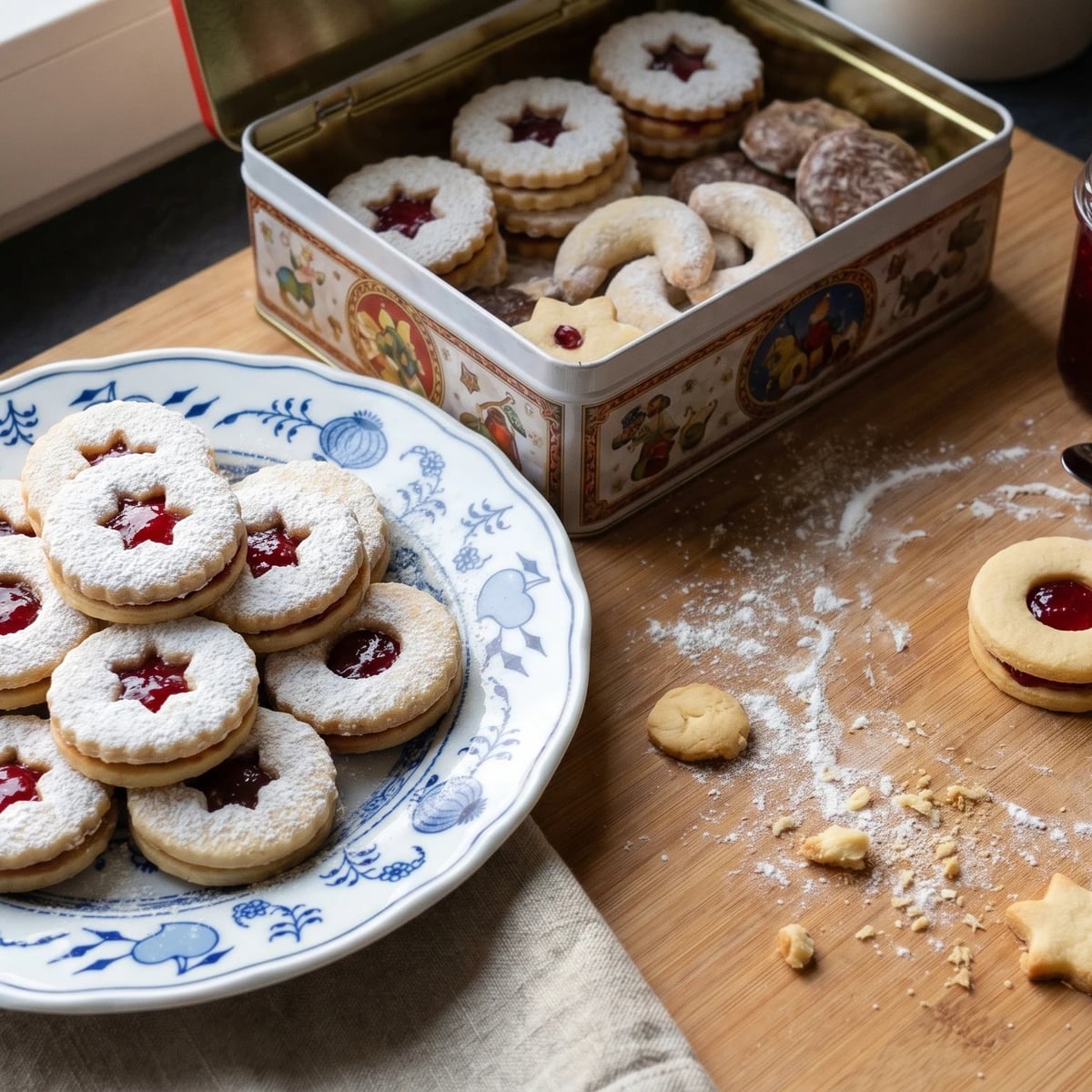
The Advent rascal from the southern Christmas tin: cold Mürbeteig rolled thin, baked pale, then sandwiched with sharp red currant jelly so the window shines ruby.
Spitzbuben belong to the Advent tin, the weeks when the German table fills with Plätzchen, Christmas cookies, and every household suddenly has an opinion about butter, jam, and thickness. They sit strongest in the south and south-west, in Swabia, Baden, Bavaria, Austria, and Switzerland, though the names start arguing before the dough is rolled. Spitzbuben here, Hildabrötchen in Baden, Linzer Augen across the Austrian line. Same family, different table.
I make them as Mürbeteig, short pastry, two thin discs with a hole cut from the top and red currant jelly between. The jelly matters. Strawberry is sweet and lazy here; red currant is sharp enough to wake up the butter and sugar. Nicht aus dem Glas is a fine rule for sauce, but a good clear currant jelly is exactly what the larder made for Advent.
The one technique is cold dough, rolled thin. Warm Mürbeteig smears under the cutter, loses its clean edge, and bakes tough because you keep adding flour to rescue it. Cold dough cuts sharp and stays crisp. If the tray feels soft before it goes in the oven, chill it again. Das braucht seine Zeit.
Bake them pale, not brown. The colour comes from the ruby window and the dusting of icing sugar, not from taking the butter too far. Let the cookies cool before the jelly goes in, or the filling runs and the top slides around like a drunk cousin at Christmas coffee. Schön ist, was schmeckt.
Filled cut-out Christmas cookies grew from the same central European baking line as Linzer pastry, whose named ancestor, Linzer Torte, appears in written recipes by the 17th century. In south-west Germany the cookies are often called Hildabrötchen, a name commonly linked to Grand Duchess Hilda of Baden in the late 19th and early 20th centuries, while Spitzbuben remains the wider southern name. The sharp red currant jelly shows the old Advent larder at work: summer fruit put up in glass so it could brighten the winter sweet table.
Quantity
300g
plus a little for rolling
Quantity
100g
Quantity
100g
Quantity
1 packet or 1 teaspoon
Quantity
1 pinch
Quantity
200g
cut into small cubes
Quantity
2
Quantity
1 teaspoon
finely grated
Quantity
250g
Quantity
2 tablespoons
for dusting
| Ingredient | Quantity |
|---|---|
| plain flourplus a little for rolling | 300g |
| ground almonds | 100g |
| fine sugar | 100g |
| vanilla sugar | 1 packet or 1 teaspoon |
| fine salt | 1 pinch |
| cold unsalted buttercut into small cubes | 200g |
| egg yolks | 2 |
| lemon zestfinely grated | 1 teaspoon |
| red currant jelly | 250g |
| icing sugarfor dusting | 2 tablespoons |
Mix the flour, ground almonds, sugar, vanilla sugar, and salt in a bowl. Rub in the cold butter until the mixture looks like coarse crumbs, then add the yolks and lemon zest and press it together quickly. Work fast because Mürbeteig, short pastry, wants cold fat in small pieces; warm butter melts into the flour and gives you a tough biscuit instead of a crisp one.
Divide the dough in two, press each half into a flat disc, wrap it, and chill for at least 1 hour. Flat dough chills evenly and rolls without cracking at the edge. A round lump stays cold outside and soft inside, and then you fight it with extra flour. That flour dulls the butter taste.
Roll one disc on a lightly floured board to about 3mm thick. Cut plain rounds from half the dough and window rounds from the other half, using the same cutter for the outside and a small cutter for the centre. Keep the tops and bottoms in equal numbers. If the dough softens, slide it onto a tray and chill it 10 minutes; cold edges bake clean, soft edges slump.
Set the cookies on lined baking sheets and chill the trays while the oven heats to 180C. Bake for 10 to 12 minutes, until the edges are only lightly golden and the centres still pale. Don't chase brown colour here. Brown butter notes belong in Heidesand, not in Spitzbuben. These need delicacy and snap.
Cool the cookies fully on a rack before you touch the jelly. Dust only the window tops with icing sugar while they are separate; dust after filling and you bury the red window, which is the whole little joke of the cookie.
Warm the red currant jelly gently until it loosens, then stir it smooth. Don't boil it hard, or it turns sticky and dull. Spoon a little onto each plain bottom, leaving a narrow bare rim, then set the sugared window tops on and press just enough to bring the jelly to the edge.
Leave the filled Spitzbuben uncovered for an hour so the jelly sets and the tops stop sliding. Then pack them in a tin with parchment between layers. They are crisp on day one and better on day two, when the butter and almond settle into the jelly. Weggeworfen wird nichts: the little cut-out centres bake as cook's biscuits.
1 serving (about 30g)
Culinary guides, cultural storytelling, and the editorial depth that makes cooking meaningful.
Discover Culinary Explorer
Chef Klaus
Aachen's Advent biscuit is dark, hard, and spiced, with beet syrup doing the deep work and a closed tin finishing what the oven only starts.

Chef Klaus
Frankfurt's Advent marzipan ball is small, pale gold, and exacting: real almond paste, rosewater, three almond halves pressed on firmly, then a short bake for gloss.

Chef Klaus
A cold Mürbeteig ball, one clean hollow, and a spoon of tart jelly: Engelsaugen are Advent cookies that fail only when the dough gets warm.

Chef Klaus
Florentiner are Advent tin work: almond lace held together by cream caramel, baked thin because thick turns chewy, then brushed with dark chocolate underneath.