Culinary Explorer

A cooking platform built around craft, culture, and the stories behind what we eat.
Discover Culinary Explorer
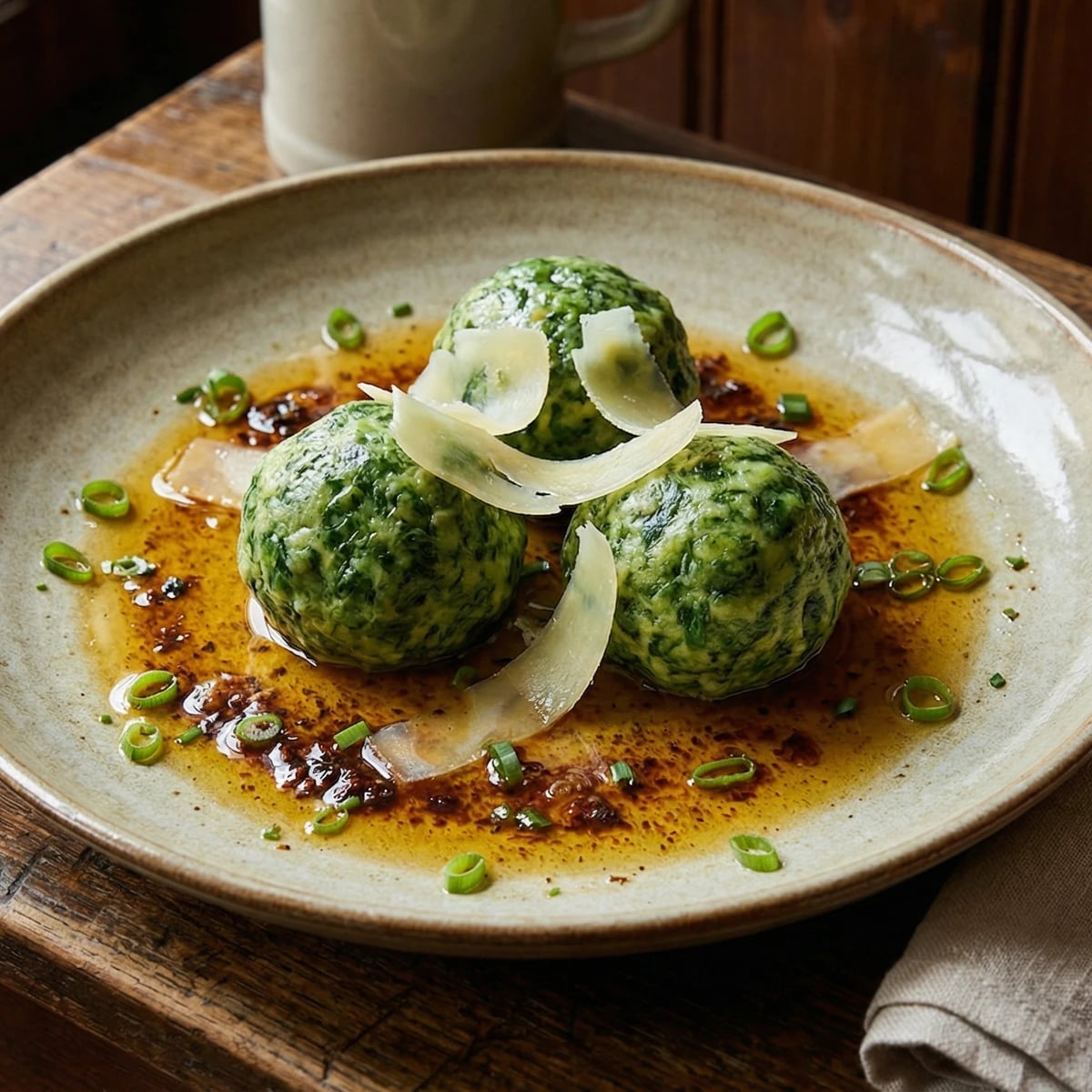
Spinatknödel mit Brauner Butter

Spinatknödel mit Brauner Butter

Created by

Tyrolean spinach bread dumplings poached until tender, then rolled through nutty Nussbutter and finished with curls of Parmesan. Alpine comfort food that proves the best Austrian cooking starts with stale bread and good butter.

Main Dishes
Austrian
Weeknight
Dinner Party
Comfort Food
40 min
Active Time
20 min cook1 hr total
Yield4 servings (12 dumplings)

The first time I ate Spinatknödel properly was on one of our childhood trips to Austria, at a Gasthaus above Innsbruck where the tablecloths were red-checked and the mountains filled the window. Three dumplings on a plate, vivid green, sitting in a pool of brown butter with shavings of cheese melting into the fat. I was maybe ten. I ate every bite and asked for more.

Knödel are the quiet backbone of Austrian and Tyrolean cooking. Where the Viennese built their reputation on pastry, the Tyroleans built theirs on dumplings. Bread Knödel, Speck Knödel, Kaspressknödel, and these: Spinatknödel, where yesterday's bread becomes today's dinner. The stale bread isn't a compromise. It's the point. Fresh bread has too much moisture and your dumplings will fall apart in the water. Stale bread absorbs the milk and egg, binds with the spinach, and holds its shape through a gentle poach.

The Braune Butter is the other half of this dish. Austrians call it Nussbutter because of its nutty fragrance, and making it is one of those kitchen skills that looks like nothing but changes everything. You cook butter past the foaming stage until the milk solids on the bottom of the pan turn deep gold and the whole kitchen smells like toasted hazelnuts. Pour it over the dumplings while it's still hot. Add Parmesan. Sit down. This is good Austrian home cooking at its most honest: simple ingredients, proper technique, a plate of food that makes you feel held.

Knödel culture runs deepest in Tyrol and South Tyrol (now Alto Adige in northern Italy), where bread dumplings have been a staple since the Middle Ages. The earliest written references to Tyrolean Knödel date to the 14th century, when they were peasant food made from stale bread that couldn't be wasted. Spinatknödel specifically reflect the Italian influence on South Tyrolean cooking, where spinach and Parmesan crossed the Alps through centuries of shared Habsburg territory. The dish sits exactly at the border where Austrian dumpling tradition meets Italian ingredients, which is why you'll find it on menus from Innsbruck to Bolzano.

The technique, the tradition, and the story behind every dish.

Discover Culinary Explorer

Ingredients

Knödelbrot (stale white bread cubes)

Quantity

300g

whole milk

Quantity

200ml

lukewarm

fresh spinach

Quantity

400g

onion

Quantity

1 medium

finely diced

unsalted butter (for sautéing)

Quantity

2 tablespoons

garlic

Quantity

1 small clove

finely minced

eggs

Quantity

3 large

plain flour

Quantity

60g

plus more for shaping

nutmeg

Quantity

generous pinch

freshly grated

salt and black pepper

Quantity

to taste

unsalted butter (for Nussbutter)

Quantity

120g

Parmesan

Quantity

60g

shaved with a vegetable peeler

fresh chives

Quantity

for garnish

finely cut

Equipment Needed

  • Large mixing bowl
  • Large pot for poaching (at least 5 liters)
  • Clean tea towel for squeezing spinach
  • Wide light-colored pan for Nussbutter
  • Slotted spoon
  • Vegetable peeler for Parmesan shavings

Instructions

  1. 1

    Soak the bread

    Place the Knödelbrot in a large mixing bowl. Pour the lukewarm milk over it evenly and toss gently so every cube gets some moisture. Let it sit for fifteen to twenty minutes. The bread should be soft and damp all the way through but not swimming in liquid. If you squeeze a handful, it should hold together without dripping. This is the foundation of every bread Knödel: stale bread brought back to life with just enough milk to bind.

    If you can't find Knödelbrot, cut a day-old white loaf (Semmel or a light farmhouse bread) into 1cm cubes and leave them uncovered overnight. Soft sandwich bread won't work. You need something with structure.
  2. 2

    Prepare the spinach

    Wash the fresh spinach thoroughly and wilt it in a large pan over high heat with just the water clinging to the leaves. This takes about two minutes. The pile will collapse to almost nothing. Transfer it to a colander and run cold water over it to stop the cooking and lock in that vivid green color. Once cool, squeeze it in a clean tea towel, wringing hard until no more liquid comes out. This step matters. Wet spinach will make your Knödel soggy and they'll fall apart when you poach them. Chop the squeezed spinach finely.

    If using frozen spinach, thaw it completely, then squeeze it dry in a tea towel exactly the same way. Frozen leaf spinach works well here. Avoid the chopped kind, it turns to mush.
  3. 3

    Sauté the onion

    Melt two tablespoons of butter in a small pan over medium-low heat. Add the diced onion and cook slowly until soft and translucent, about five minutes. You don't want any color on the onion. It should disappear into the dumpling, not announce itself. Add the garlic in the last thirty seconds, just enough to take the raw edge off. Let this cool slightly before adding it to the bread.

  4. 4

    Mix the Knödel mass

    Add the chopped spinach, softened onion and garlic, eggs, flour, nutmeg, a generous pinch of salt, and a few grinds of black pepper to the soaked bread. Mix everything together with your hands. This is not a job for a spoon. You need to feel the consistency. The mixture should be damp and cohesive, holding together when you press it. If it feels too wet, add flour a tablespoon at a time. If it's crumbly and won't hold, add a splash more milk. Let the mixture rest for ten minutes. The flour needs time to absorb the moisture and the bread needs time to bind.

    Grate the nutmeg fresh. Pre-ground nutmeg loses its fragrance within weeks. You want just enough to warm the spinach flavor from behind, not enough to taste it outright.
  5. 5

    Shape and test one Knödel

    Wet your hands or dust them lightly with flour. Take a portion of the mixture about the size of a tennis ball and roll it gently between your palms until smooth. Don't pack it too tightly or the dumpling will be dense and heavy. You want a firm ball that holds its shape but still has some give. Bring a large pot of salted water to a gentle simmer. Drop the test Knödel in. It should sink, then float to the surface after a minute or two. Let it cook for twelve minutes from when it floats. Cut it open. The inside should be tender and cooked through, holding together without crumbling. If it falls apart, your mixture needs a bit more flour. If it's heavy and dense, use a lighter touch when shaping.

    Gretel always said you test one first. Always. Better to adjust the mixture now than to lose twelve dumplings to a pot of green water.
  6. 6

    Poach the dumplings

    Shape the remaining mixture into dumplings, about twelve in total. Keep the water at a gentle simmer, never a rolling boil. Boiling water will tear the Knödel apart before they've had a chance to set. Lower them in carefully with a slotted spoon, working in batches if your pot isn't large enough to hold them all without crowding. They need room to float. Cook for twelve to fifteen minutes from when they rise to the surface. They're ready when they feel firm on the outside but give slightly when pressed, like a just-ripe peach.

  7. 7

    Make the Nussbutter

    While the last batch of Knödel poaches, cut the 120g butter into pieces and melt it in a wide pan over medium heat. It will foam vigorously. Don't touch it. Watch the color of the milk solids at the bottom of the pan through the foam. They'll go from white to pale gold to deep amber. The moment they turn the color of hazelnuts and the butter smells nutty and toasty, pull the pan off the heat. This happens fast. Ten seconds separates Nussbutter from burned butter, so stay at the stove.

    Use a light-colored pan so you can see the milk solids changing color. In a dark pan you're guessing, and guessing with brown butter usually ends in smoke.
  8. 8

    Serve the Spinatknödel

    Lift the dumplings out of the water with a slotted spoon and let them drain briefly. Arrange three per plate. Spoon the hot Nussbutter generously over the dumplings, letting it pool around the base. Scatter Parmesan shavings over the top so they begin to soften and curl in the heat. Finish with fresh chives. Serve immediately. The butter should still be warm and fragrant when it reaches the table. Mahlzeit!

Chef Tips

  • The breadmust be genuinely stale, at least a day old, preferably two. Fresh bread holds too much of its own moisture and throws off the balance of the entire mixture. If you forgot to leave bread out, cut it into cubes and dry them in a low oven (100°C) for fifteen minutes. It's not the same as a natural stale, but it works.
  • Squeeze the spinach until your hands ache, then squeeze it again. Every drop of water you leave in the spinach is a drop that weakens your Knödel. I cannot overstate this. Wrap it in a clean tea towel, twist the ends in opposite directions, and press until nothing comes out.
  • The water should barely tremble when you poach Knödel. If you see rolling bubbles, turn the heat down. Aggressive boiling tears dumplings apart. Gentle simmering lets them set slowly and hold their shape.
  • If you have leftover Spinatknödel, slice them in half the next day and pan-fry the cut sides in butter until golden. Tyrolean cooks call this Geröstete Knödel and it might be even better than the original.

Advance Preparation

  • The Knödel mixture can be made up to four hours ahead and refrigerated, covered. Let it come to room temperature for twenty minutes before shaping, or the cold mass will take longer to cook through.
  • Shaped, uncooked Knödel can be frozen on a lined tray, then transferred to a bag. Cook from frozen, adding three to four minutes to the poaching time.
  • Nussbutter must be made fresh. It takes three minutes. Don't try to reheat it; the milk solids keep cooking and it turns bitter.

Frequently Asked Questions

Nutrition Information

1 serving (about 300g)

Calories
705 calories
Total Fat
42 g
Saturated Fat
24 g
Trans Fat
1 g
Unsaturated Fat
17 g
Cholesterol
240 mg
Sodium
1100 mg
Total Carbohydrates
59 g
Dietary Fiber
5 g
Sugars
6 g
Protein
24 g

Note: Chef personas and recipes are created with AI assistance. Cook with care: follow safe food-handling practices, check doneness with a thermometer when needed, and adapt for allergies and your kitchen.

Where cooking meets culture.

Culinary guides, cultural storytelling, and the editorial depth that makes cooking meaningful.

Discover Culinary Explorer

More from Austrian Pasta, Dumpling & Grain Mains

Browse the full collection