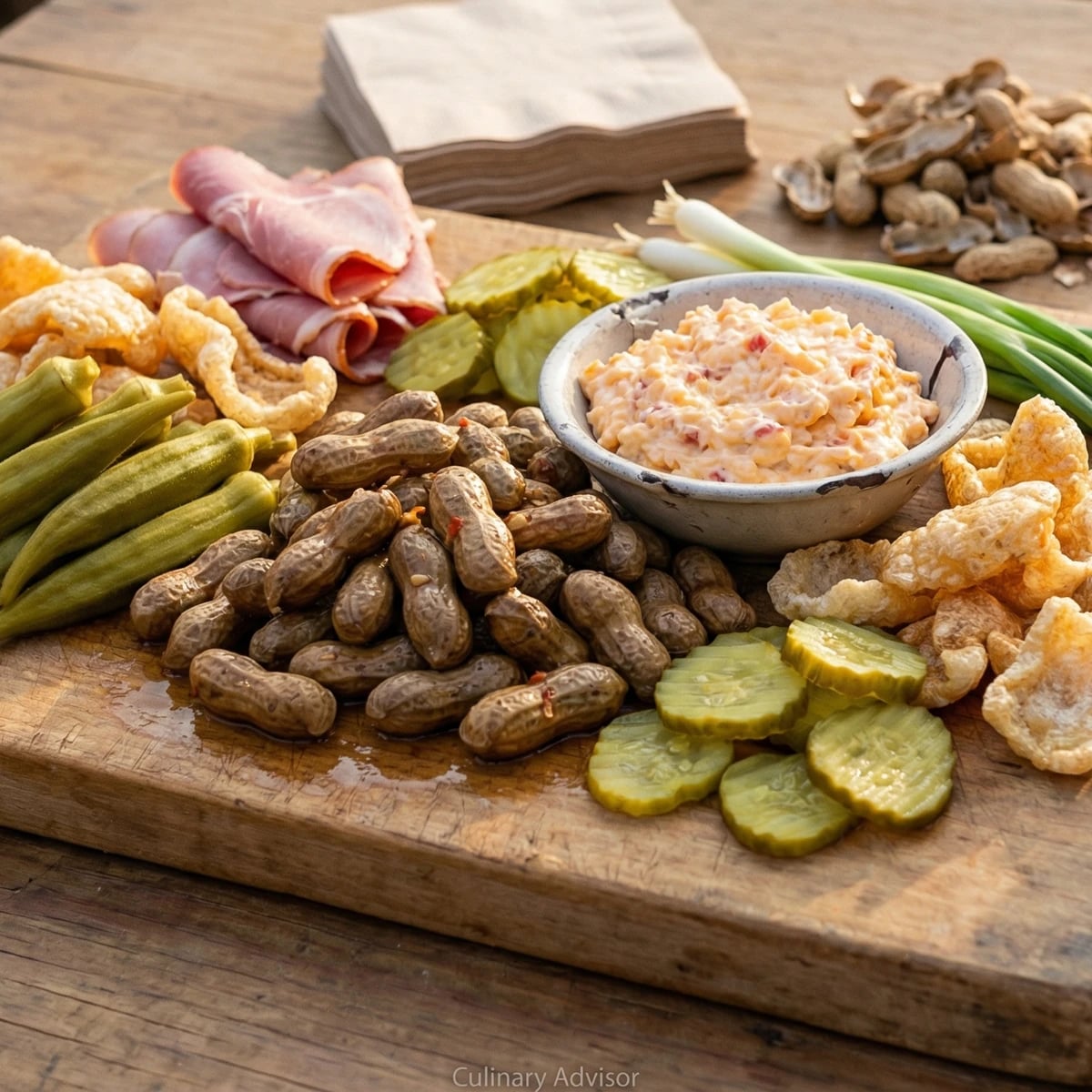
A generous spread of Cajun-spiced boiled peanuts, creamy pimento cheese, tangy pickled okra, crispy pork rinds, and salty country ham, all arranged on a board that invites every hand to reach in and grab another bite.
Appetizers & Snacks
Southern
Game Day
Potluck
Outdoor Dining
45 min
Active Time
4 hr cook•4 hr 45 min total
Yield12 servings
There's a reason folks gather around a board like this. It's not just about the food. It's about the reaching, the sharing, the conversation that happens when everyone's hands are busy and mouths are happy.
Boiled peanuts are the heart of this board. If you didn't grow up eating them warm from a roadside stand in the Deep South, you might need a moment to understand. They're soft, briny, and completely addictive. Not the crunchy roasted peanuts you're thinking of. These are tender, almost creamy, swimming in spiced brine that penetrates straight through the shell. My grandmother Evangeline used to make a pot every Sunday, and we'd sit on the porch cracking shells and tossing them into a bucket until the sun went down.
The pimento cheese is the soul of the South in spreadable form. Sharp cheddar, creamy base, those sweet pimentos, and just enough cayenne to remind you where you are. At Lagniappe, we go through gallons of the stuff. People spread it on crackers, dip their pork rinds in it, and I've seen more than a few guests eating it straight with a spoon when they think nobody's looking.
What makes this board work is the contrast: salty peanuts against tangy pickled okra, rich cheese against crispy pork rinds, soft against crunchy, spicy against sweet. Every bite is different from the last, and that's exactly the point. Set it down in front of your people and watch it disappear.
The technique, the tradition, and the story behind every dish.
raw peanuts in the shellgreen peanuts if available
2 pounds
kosher salt (for boiling)
1/2 cup
Cajun seasoning
3 tablespoons
cayenne pepper (for peanuts)
2 tablespoons
garlic powder (for peanuts)
1 tablespoon
onion powder
1 tablespoon
water
4 quarts
sharp cheddar cheesefinely shredded
16 ounces
cream cheesesoftened
8 ounces
mayonnaise
1 cup
diced pimentosdrained
1 jar (4 ounces)
cayenne pepper (for pimento cheese)
1/2 teaspoon
smoked paprika
1/2 teaspoon
garlic powder (for pimento cheese)
1/4 teaspoon
kosher salt and black pepper
to taste
pickled okra
1 jar (16 ounces)
pork rinds
8 ounces
bread and butter pickles
1 cup
pickled green tomatoes
1 cup
country ham or tassothinly sliced
8 ounces
saltine crackers
1 sleeve
green onionstrimmed
1 bunch
hot sauce (optional)
for serving
Equipment Needed
•Large stockpot (8-quart minimum)
•Slotted spoon
•Large wooden cutting board or rustic platter (18 inches or larger)
•Small serving bowl for pimento cheese
Instructions
1
Start the boiled peanuts
Rinse the raw peanuts under cold running water, agitating them to remove any dirt clinging to the shells. Place them in your largest stockpot and cover with four quarts of cold water. The peanuts will float at first. That's fine. They'll sink as they absorb liquid and soften.
Green peanuts (freshly harvested, not dried) are the gold standard for boiling. They cook faster and have a creamier texture. If you can only find dried raw peanuts, add two hours to your cooking time.
2
Season the boiling liquid
Add the half cup of kosher salt, Cajun seasoning, cayenne, garlic powder, and onion powder to the pot. Stir well to dissolve everything. This is your seasoning base, and the peanuts will drink it in over the next few hours. Taste the liquid. It should taste aggressively salty, almost too much. The peanuts will temper it as they absorb.
3
Boil low and slow
Bring the pot to a rolling boil, then reduce heat to maintain a steady simmer. Cover partially and let the peanuts cook for three to four hours, checking occasionally. Add water if the level drops below the peanuts. They should always be submerged. Start testing at the three hour mark.
4
Test for doneness
Fish out a peanut with a slotted spoon and let it cool enough to handle. Crack it open and taste. The texture should be soft and creamy, similar to a cooked bean. If it's still crunchy or starchy in the center, keep simmering. When they're done, turn off the heat and let the peanuts soak in the brine for at least thirty minutes. This is when the real flavor absorption happens.
Boiled peanuts actually improve after sitting overnight in their brine. If you have the time, make them a day ahead and refrigerate them in the liquid.
5
Make the pimento cheese
While the peanuts simmer, combine the softened cream cheese and mayonnaise in a large bowl. Beat with a wooden spoon or hand mixer until smooth and creamy, about two minutes. You want no lumps of cream cheese visible. This is your base, and it needs to be silky.
6
Build the cheese flavor
Add the shredded cheddar and fold it into the cream cheese mixture. Work it gently so you don't completely break down the cheese shreds. Some texture is good here. Fold in the drained pimentos, cayenne, smoked paprika, and garlic powder. Season with salt and pepper, then taste. Adjust until it makes you want to eat it straight from the bowl.
7
Let flavors marry
Cover the pimento cheese and refrigerate for at least one hour, preferably overnight. The flavors need time to get acquainted. Fresh pimento cheese is good. Day-old pimento cheese is better. The spices bloom, the cheese firms up, and everything comes together.
At Lagniappe, we always make our pimento cheese a day ahead. The difference is noticeable.
8
Assemble the board
Choose a large wooden cutting board or rustic platter, at least eighteen inches across. This isn't delicate food, and it shouldn't look precious. Drain the boiled peanuts and pile them generously on one section of the board. They should tumble over themselves, abundant and inviting.
9
Add the pimento cheese
Scoop the pimento cheese into a small bowl or directly onto the board in a generous mound. Use the back of a spoon to create a shallow well in the center, then drizzle with a little hot sauce if you like. Place saltine crackers nearby, fanned out or stacked casually.
10
Arrange the pickled elements
Drain the pickled okra and arrange the pods in a cluster on the board. Add the bread and butter pickles and pickled green tomatoes in separate areas. These tangy bites cut through the richness of the cheese and pork. They're essential for balance.
11
Complete the board
Pile the pork rinds in a generous heap. Don't be shy with them. Fold or roll the sliced country ham or tasso and arrange in loose bundles. Scatter the trimmed green onions across the board for color and crunch. Set a bottle of your favorite hot sauce alongside. Stand back and admire what you've built: a board that celebrates everything good about Southern hospitality.
Chef Tips
•If you're short on time, you can find decent boiled peanuts at roadside stands throughout the South or canned at some grocery stores. They're not the same as fresh-made, but they'll do in a pinch.
•Duke's mayonnaise is the only correct choice for pimento cheese. It's tangier and less sweet than other brands. This is not negotiable in my kitchen.
•Look for pork rinds without too much artificial seasoning. You want the pure pork flavor to come through. The good ones should be light, airy, and shatter when you bite them.
•Tasso is spiced Cajun smoked pork that adds serious flavor. If you can't find it, good country ham or even a spicy capicola works fine.
•This board feeds a crowd, but it scales down easily. For a smaller gathering, halve the peanuts and cheese, keep the pickled elements and pork rinds the same.
Advance Preparation
•Boiled peanuts can be made up to 5 days ahead and stored in their brine in the refrigerator. Reheat gently in the brine or serve at room temperature.
•Pimento cheese improves after 24 hours refrigerated and keeps for up to 1 week.
•Assemble the board no more than 1 hour before serving. Pork rinds lose their crunch if they sit too long in humid conditions.
Frequently Asked Questions
Nutrition Information
1 serving (about 250g)
Calories
735 calories
Total Fat
55 g
Saturated Fat
19 g
Trans Fat
0 g
Unsaturated Fat
32 g
Cholesterol
95 mg
Sodium
2165 mg
Total Carbohydrates
27 g
Dietary Fiber
4 g
Sugars
5 g
Protein
35 g
Where cooking meets culture.
Culinary guides, cultural storytelling, and the editorial depth that makes cooking meaningful.