
Chef Lupita
Aguascalientes Beef Tongue Pozole (Pozole de Lengua)
Aguascalientes' Bajio pozole de lengua, built with cacahuazintle hominy, tender beef tongue, chile ancho and guajillo, with xoconostle brightness and table garnishes.
A cooking platform built around craft, culture, and the stories behind what we eat.
Created by
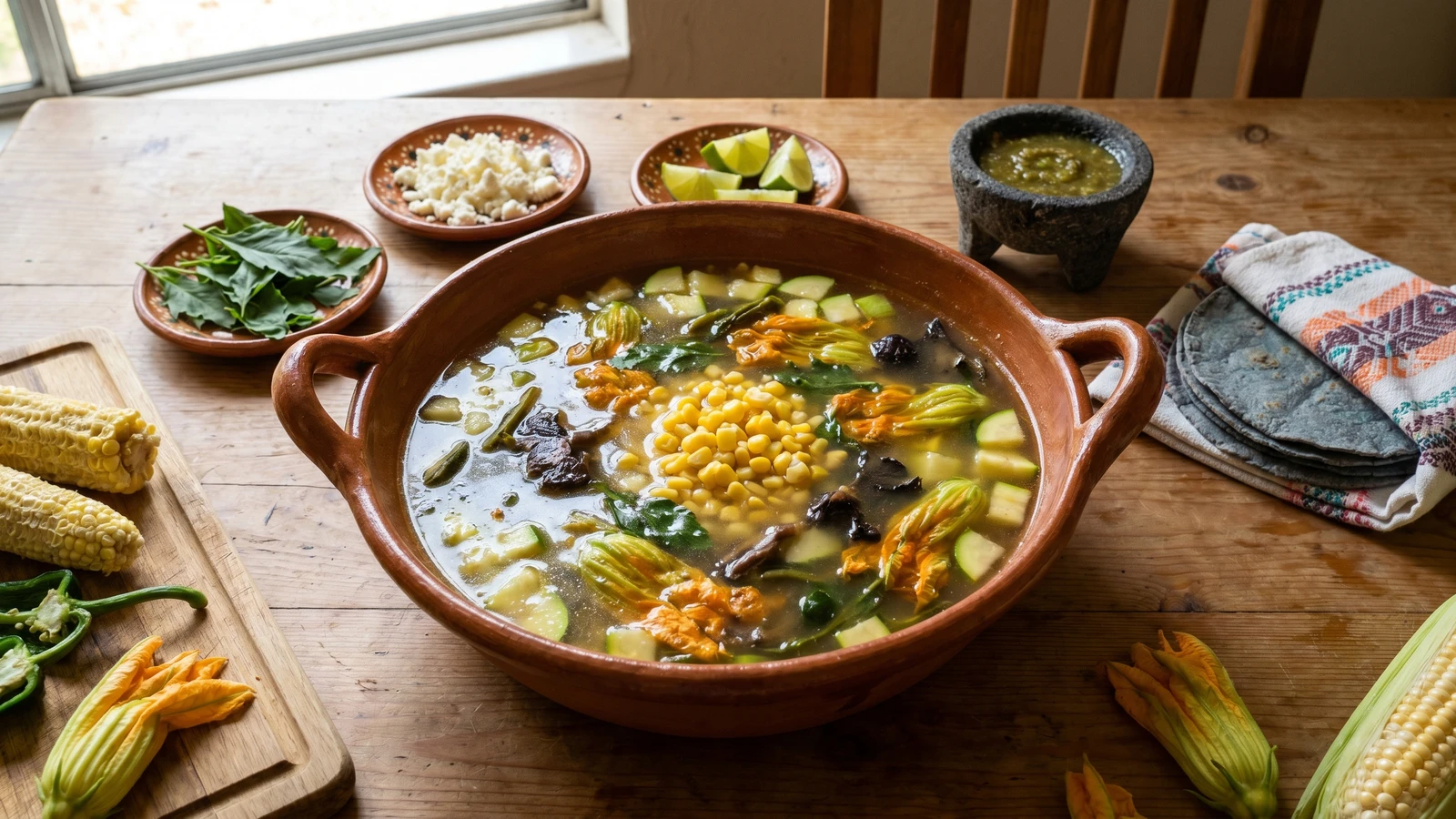
Tlaxcala's cornfield in a clay bowl: tender elote, calabacita, wild hongos, and flor de calabaza in a clean caldo perfumed with epazote. A soup built from everything the milpa gave that morning.
This is a Tlaxcala soup. Specifically from the central highland villages around Huamantla and Apizaco, where the milpa, the traditional cornfield planted with the three sisters of corn, beans, and squash, is still the spine of the rural kitchen. Sopa de milpa is the dish that puts the field on the table.
Everything in the bowl came out of the same patch of land. The corn, the squash, the squash blossoms, the wild mushrooms that come up between the corn stalks during the rainy season from June through September. The epazote that grows uninvited at the edge of the rows. This is not a soup you can fake in February. The flor de calabaza closes the moment the squash plant stops flowering. The hongos de campo, clavito, pancita, escobeta, come up in July and August and disappear by October. Cook it when the milpa is giving. The rest of the year, cook something else. Mexican grandmothers cook with what the mercado is selling today.
The technique is restrained on purpose. A light caldo built from the corn cobs themselves, vegetables cooked in stages so each one keeps its shape, manteca for the base because manteca is the fat the milpa cuisine was built on. No cream. No melted cheese. No thickeners. The fat in this soup is one spoonful of lard at the bottom of the pot, and that is enough. La cocina no es decoracion, es trabajo. The work here is restraint.
My mother did not cook this soup. She was from Jalisco and the milpa cuisine she knew was different. But on my first trip through Tlaxcala for the regional book I was building, a senora in a small comedor outside Huamantla served me a bowl of this with a stack of blue corn tortillas and told me, without asking, that this was what her mother had cooked when the rains came. I wrote the recipe in pencil at the table. I have made it every August since. Saber cocinar es saber vivir.
The milpa, an agricultural system that interplants corn, beans, and squash, alongside chiles, tomatoes, and edible wild greens (quelites), dates to at least 7000 BCE in Mesoamerica and remains the foundation of traditional rural cooking in Tlaxcala, Puebla, and the central highlands. Sopa de milpa is the culinary expression of that system: a single dish that uses what the polyculture produces simultaneously during the rainy season. The state of Tlaxcala, Mexico's smallest after Morelos, has preserved milpa agriculture and its associated cuisine more thoroughly than its larger neighbors, partly because its rural communities of Nahua descent kept planting practices that elsewhere have given way to monocultures. The use of flor de calabaza and epazote in cooking is documented in Bernardino de Sahagun's 16th-century Florentine Codex, where both were already established staples of indigenous central Mexican cuisine.
Quantity
3 ears
kernels cut from the cob, cobs reserved
Quantity
2 medium
cut into medium dice
Quantity
8 ounces
torn into bite-sized pieces
Quantity
1 large bunch, about 30 to 40 flowers
stems and pistils removed, roughly torn
Quantity
2 tablespoons
Quantity
1/2 medium
finely chopped
Quantity
3
finely chopped
Quantity
2
charred on a comal and roughly chopped
Quantity
2
roasted, peeled, seeded, and cut into rajas
Quantity
1
finely chopped
Quantity
8 cups
Quantity
2 large sprigs
Quantity
1 1/2 teaspoons, plus more to taste
Quantity
for serving
Quantity
for serving
Quantity
for serving
warmed
Quantity
for serving
| Ingredient | Quantity |
|---|---|
| fresh elote tierno (tender young corn)kernels cut from the cob, cobs reserved | 3 ears |
| calabacitas (Mexican gray squash)cut into medium dice | 2 medium |
| hongos de campo (wild mushrooms such as clavito, pancita, or oyster)torn into bite-sized pieces | 8 ounces |
| flor de calabaza (squash blossoms)stems and pistils removed, roughly torn | 1 large bunch, about 30 to 40 flowers |
| manteca de cerdo (pork lard) | 2 tablespoons |
| white onionfinely chopped | 1/2 medium |
| garlic clovesfinely chopped | 3 |
| ripe Roma tomatoescharred on a comal and roughly chopped | 2 |
| fresh chile poblanoroasted, peeled, seeded, and cut into rajas | 2 |
| fresh chile serrano (optional)finely chopped | 1 |
| water or light chicken broth | 8 cups |
| fresh epazote | 2 large sprigs |
| kosher salt | 1 1/2 teaspoons, plus more to taste |
| crumbled queso fresco (optional) | for serving |
| lime wedges (optional) | for serving |
| hand-pressed corn tortillas (optional)warmed | for serving |
| salsa verde cruda (optional) | for serving |
Heat a dry comal or heavy skillet over medium-high. Lay the tomatoes on it whole and turn them every couple of minutes until the skins blister and blacken in patches. Pull them off and chop roughly. On the same comal, char the poblanos until the skin is black and blistered on all sides. Drop them into a covered bowl to sweat for ten minutes, then rub the skin off with your fingers. Do not rinse them under water. The char is flavor. Stem, seed, and cut into rajas about the width of your finger.
In a heavy 6-quart pot, bring the water or broth to a simmer with the reserved corn cobs and the salt. Cook at a gentle simmer for fifteen minutes. The cobs give back what the kernels were holding: sweetness, starch, the perfume of the milpa. This is the trick the senoras in Huamantla use, and it is the difference between a soup that tastes of corn and a soup that tastes like water with corn in it. Discard the cobs.
In a second wide cazuela or heavy pot, melt the manteca over medium heat. Add the onion with a pinch of salt and cook for four or five minutes, until translucent and beginning to gold at the edges. Add the garlic and the serrano if you are using it. Cook one minute more, just until the garlic is fragrant. La manteca es el sabor. Olive oil will not give you this base. Vegetable oil will not give you this base.
Raise the heat to medium-high. Add the mushrooms in a single layer if you can manage it. Do not stir for two minutes. Let them sear and release their water. Then stir and cook another four or five minutes, until the liquid has cooked off and the mushrooms are browned at the edges. Wet mushrooms taste like nothing. Browned mushrooms taste like the woods after rain. Asi se hace y punto.
Stir the charred tomato into the pot with the mushrooms. Cook for three minutes, mashing the tomato into the fat with the back of your spoon, until it darkens and the raw smell is gone. Add the corn kernels and the calabacita. Stir to coat everything in the fat. Cook for two minutes more.
Pour the strained corn-cob broth into the cazuela. Add the poblano rajas. Bring to a gentle simmer and cook for twelve to fifteen minutes, until the calabacita is tender but still holds its shape and the corn is sweet on the tooth. Taste for salt. The caldo should be light and clear, not thick. This is a soup, not a stew.
Tear the epazote sprigs and stir them in. Add the squash blossoms last, all at once, and turn off the heat. Cover the pot and let the residual warmth wilt the flowers, about two minutes. They should soften and turn deep orange but still hold their shape. If you boil them, they collapse into mush and the soup loses the flowers entirely. Epazote and flor de calabaza both go in at the end. They are not aromatics to be cooked out. They are the perfume of the dish.
Ladle into cuencos de barro or wide ceramic bowls, making sure each one gets corn, squash, mushrooms, rajas, and flowers. Top with crumbled queso fresco. Set lime wedges, warm tortillas, and salsa verde on the table. The diner squeezes the lime at the last moment. Recetas probadas y garantizadas.
1 serving (about 450g)
Culinary guides, cultural storytelling, and the editorial depth that makes cooking meaningful.
Discover Culinary ExplorerChef Lupita
Aguascalientes' Bajio pozole de lengua, built with cacahuazintle hominy, tender beef tongue, chile ancho and guajillo, with xoconostle brightness and table garnishes.

Chef Lupita
Veracruz's Gulf coast rice from Alvarado, built with seafood stock, tomato, chile chipotle, epazote, shrimp, fish, jaiba, and pulpo, served loose and brothy in a clay cazuela.

Chef Lupita
Costa Chica's wet salt-beef stew, built from chile costeño, guajillo, tomato, manteca, yuca, plantain, and masa dumplings, the ranching pot of Cuajinicuilapa and Pinotepa.

Chef Lupita
Michoacán's P'urhépecha atápakua is a masa-thickened sauce and stew at once, built with pork, chile guajillo, and hierbabuena added only at the end.