
Chef Lupita
Aguascalientes Beef Tongue Pozole (Pozole de Lengua)
Aguascalientes' Bajio pozole de lengua, built with cacahuazintle hominy, tender beef tongue, chile ancho and guajillo, with xoconostle brightness and table garnishes.
A cooking platform built around craft, culture, and the stories behind what we eat.
Created by
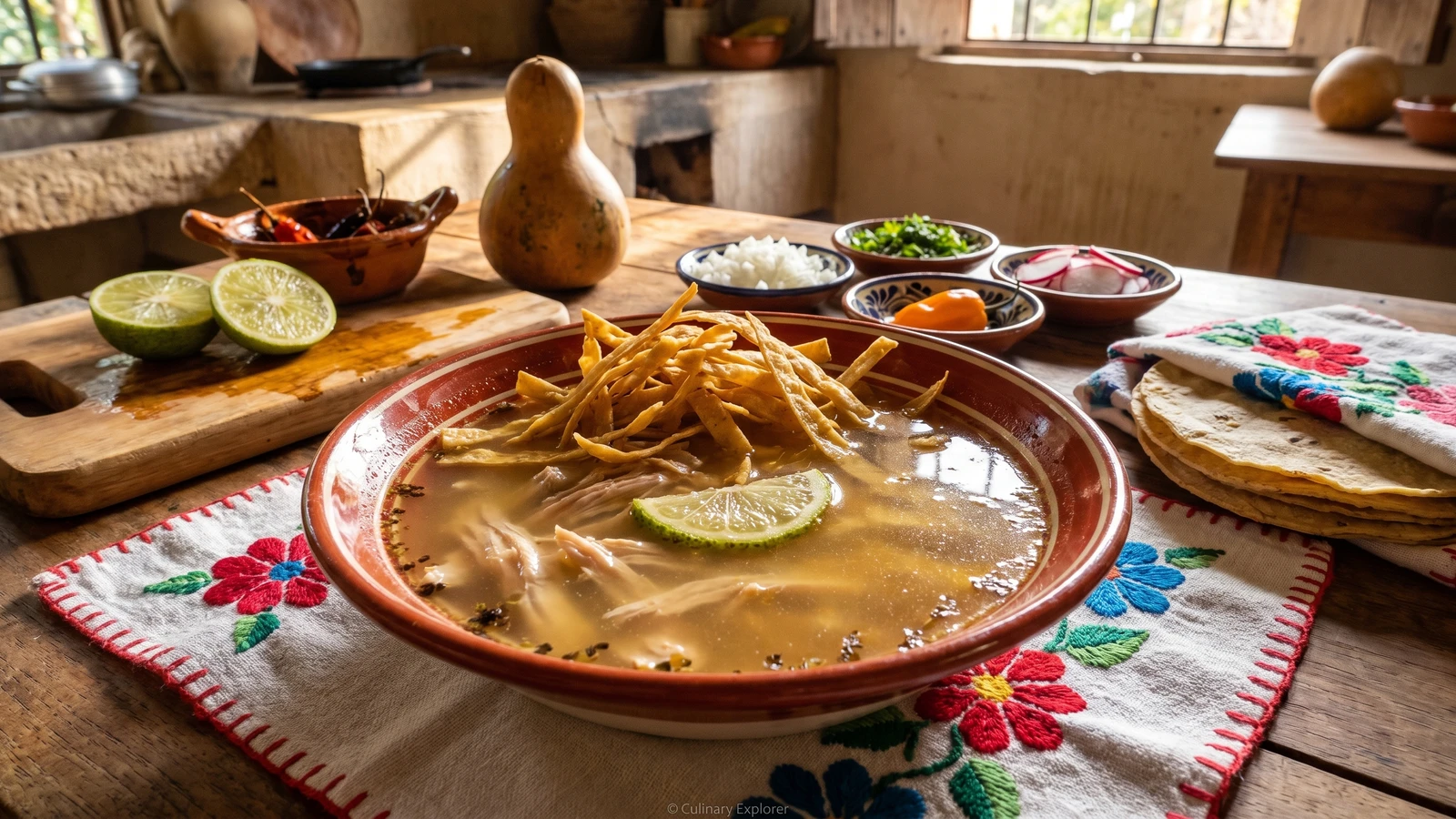
Yucatán's signature soup: turkey broth scented with charred onion, allspice, and chile xkatik, finished with the juice of lima agria and topped with crisp fried tortilla strips.
Sopa de lima is from Yucatán. Not from 'Mexico,' from Yucatán, and that distinction matters because the peninsula cooks its own cuisine, with its own chiles, its own citrus, and its own spice palette that owes more to Maya and Lebanese influence than to central Mexico. If you walk into a fonda in Mérida or Valladolid at midday, this soup is on the table. It is a dish of the casa, eaten before the cochinita, before the poc chuc, before the relleno negro.
The lime is not Persian lime and it is not Mexican key lime. It is lima agria, the Yucatecan bitter lime, with a thick bumpy skin and a flavor closer to bergamot than to a margarita. The bitterness of the peel is what defines the soup. That is why some cooks float a slice of the whole lime in the bowl. If you cannot find lima agria outside Mérida, I will give you a workaround, but understand it is a compromise. Persian lime juice with a little grapefruit zest gets you close to the bitterness. It does not get you home.
The broth is built on tatemado, the Yucatecan word for charring the aromatics on a comal until the skins blacken and the sugars caramelize. Onion, garlic, tomato, chile xkatik. This is the same technique that anchors every great Yucatecan broth, and it is non-negotiable. Skip it and you are making generic chicken soup. The recado, the seasoning paste, is allspice-heavy and warm with clove and canela, more Mediterranean than Mexican to the untrained palate, which tells you everything about the Lebanese and Spanish layers in Yucatecan cooking.
My mother did not make sopa de lima. She was from Jalisco and her notebook ended at the Veracruz border. I learned this soup in Mérida from a senora named Doña Carmela who ran a fonda two streets behind the central market. She cooled my forehead with a wet rag while I cried about the habanero I had eaten by accident, and she taught me the soup as a kind of apology. Saber cocinar es saber vivir.
Sopa de lima is documented in Yucatecan cookery from the late 19th century and is built on three culinary streams that converge nowhere else in Mexico: Maya use of native chiles and turkey, Spanish broth-making and citrus, and the Lebanese spice palette brought by waves of immigrants who settled in Mérida between the 1880s and 1920s. The lima agria itself (Citrus limetta, the sweet lime or 'lima dulce' in some regions, but agria in Yucatán's preparation) was introduced by the Spanish but adapted into the peninsula's culinary identity so completely that it is now considered indigenous to Yucatecan cooking. The traditional protein was wild ocellated turkey, the same bird used for relleno negro and escabeche oriental, and the swap to chicken is a modern accommodation, not the original recipe.
Quantity
2 pounds
or bone-in chicken thighs if turkey is unavailable
Quantity
10 cups
Quantity
1 medium
halved, one half left whole for charring, the other half finely diced for serving
Quantity
1
halved crosswise
Quantity
4
peeled, for charring
Quantity
1 medium
halved
Quantity
1
left whole
Quantity
6
Quantity
4
Quantity
2
Quantity
1 small
Quantity
1 sprig, plus 1 teaspoon dried
Quantity
2
Quantity
2 tablespoons
Quantity
1 tablespoon
or 1 teaspoon ground allspice mixed with 1/2 teaspoon ground black pepper, 1/4 teaspoon ground cloves, and 1/4 teaspoon ground canela
Quantity
3
2 juiced and 1 sliced into thin rounds for serving
Quantity
1 1/2 teaspoons, plus more to taste
Quantity
6
cut into thin strips
Quantity
for frying the tortilla strips
Quantity
1
left whole, for the table
Quantity
for serving
Quantity
for serving
| Ingredient | Quantity |
|---|---|
| bone-in turkey thighs and drumsticksor bone-in chicken thighs if turkey is unavailable | 2 pounds |
| cold water | 10 cups |
| white onionhalved, one half left whole for charring, the other half finely diced for serving | 1 medium |
| head of garlichalved crosswise | 1 |
| garlic clovespeeled, for charring | 4 |
| tomatohalved | 1 medium |
| chile xkatik (Yucatecan yellow chile) or chile gueroleft whole | 1 |
| whole allspice berries (pimienta gorda) | 6 |
| whole black peppercorns | 4 |
| whole cloves | 2 |
| stick canela (Mexican cinnamon) | 1 small |
| fresh Mexican oregano (oregano yucateco if you can find it) | 1 sprig, plus 1 teaspoon dried |
| bay leaves | 2 |
| manteca de cerdo (pork lard) | 2 tablespoons |
| recado blanco or recado de especiasor 1 teaspoon ground allspice mixed with 1/2 teaspoon ground black pepper, 1/4 teaspoon ground cloves, and 1/4 teaspoon ground canela | 1 tablespoon |
| lima agria (Yucatecan bitter lime)2 juiced and 1 sliced into thin rounds for serving | 3 |
| kosher salt | 1 1/2 teaspoons, plus more to taste |
| day-old corn tortillascut into thin strips | 6 |
| neutral oil or additional lard | for frying the tortilla strips |
| chile habanero (optional)left whole, for the table | 1 |
| chopped fresh cilantro (optional) | for serving |
| sliced radishes (optional) | for serving |
Heat a dry comal or heavy cast iron skillet over medium-high. Lay down the onion half, the tomato halves cut-side down, the halved head of garlic cut-side down, the four peeled garlic cloves, and the whole chile xkatik. Let everything blacken in spots, turning as needed. The onion should show dark patches on every side. The garlic skins should go from white to gold to brown. The chile xkatik should blister and soften. This char is the foundation of sopa de lima. Yucatecan cooks call it 'tatemar.' Skip it and you are making chicken soup, not sopa de lima.
Place the turkey pieces in a heavy 6-quart stockpot and cover with the cold water. Add the charred onion, tomato, halved head of garlic, and chile xkatik. Tie the allspice berries, peppercorns, cloves, canela stick, fresh oregano sprig, and bay leaves into a small square of cheesecloth and drop the bundle in. Bring to a gentle simmer over medium heat. Skim the gray foam that rises in the first fifteen minutes. Cold water, slow heat. A rolling boil clouds the broth and toughens the turkey.
Once the broth is clear, reduce the heat until you see lazy bubbles every few seconds. Cover partially and cook for one hour, or until the turkey pulls cleanly from the bone. Add the salt halfway through, never at the start. Salt early and the meat tightens before the broth pulls flavor from it.
While the broth simmers, heat half an inch of neutral oil or lard in a skillet over medium-high until it shimmers. Fry the tortilla strips in batches, stirring with a slotted spoon, until they are golden and rigid, about 90 seconds per batch. Drain on a paper towel and salt them lightly while they are still hot. Day-old tortillas fry crisper than fresh ones. The Yucatecan cooks I learned from save their stale tortillas in a basket for exactly this. Nothing wasted.
Pull the turkey out of the broth with tongs and set it aside to cool. Strain the broth through a fine-mesh sieve into a clean pot. Discard the spices, the spent vegetables, and the bundle. In a small skillet, melt the manteca de cerdo over medium heat. Stir in the recado blanco (or the mixed dry spices) and the charred peeled garlic, mashed to a paste with the side of a knife. Cook for about a minute, until the lard turns pale gold and the kitchen smells of allspice and clove. La manteca es el sabor. Stir this paste into the strained broth.
Pull the turkey meat from the bone in large rough pieces. Discard the skin and bones. Return the meat to the pot of broth. Add the dried oregano and bring everything to a low simmer for ten minutes so the flavors marry. Taste for salt. Off the heat, stir in the juice of two lima agria. Do not add the lime juice while the pot is boiling. Boiling kills the brightness and turns the broth flat. The lima goes in at the end, always.
Ladle the soup into wide bowls. Drop two or three slices of lima agria into each bowl. Pile the fried tortilla strips on top so they sit above the broth and stay crisp. Set the diced onion, cilantro, sliced radishes, and the whole chile habanero in small dishes on the table. Each diner crushes the habanero into their own bowl if they want heat, never into the pot. Yucatecans guard the habanero this way because not every mouth at the table wants it. Así se hace y punto.
1 serving (about 420g)
Culinary guides, cultural storytelling, and the editorial depth that makes cooking meaningful.
Discover Culinary ExplorerChef Lupita
Aguascalientes' Bajio pozole de lengua, built with cacahuazintle hominy, tender beef tongue, chile ancho and guajillo, with xoconostle brightness and table garnishes.

Chef Lupita
Veracruz's Gulf coast rice from Alvarado, built with seafood stock, tomato, chile chipotle, epazote, shrimp, fish, jaiba, and pulpo, served loose and brothy in a clay cazuela.

Chef Lupita
Costa Chica's wet salt-beef stew, built from chile costeño, guajillo, tomato, manteca, yuca, plantain, and masa dumplings, the ranching pot of Cuajinicuilapa and Pinotepa.

Chef Lupita
Michoacán's P'urhépecha atápakua is a masa-thickened sauce and stew at once, built with pork, chile guajillo, and hierbabuena added only at the end.