
Chef Lupita
Aguascalientes Beef Tongue Pozole (Pozole de Lengua)
Aguascalientes' Bajio pozole de lengua, built with cacahuazintle hominy, tender beef tongue, chile ancho and guajillo, with xoconostle brightness and table garnishes.
A cooking platform built around craft, culture, and the stories behind what we eat.
Created by
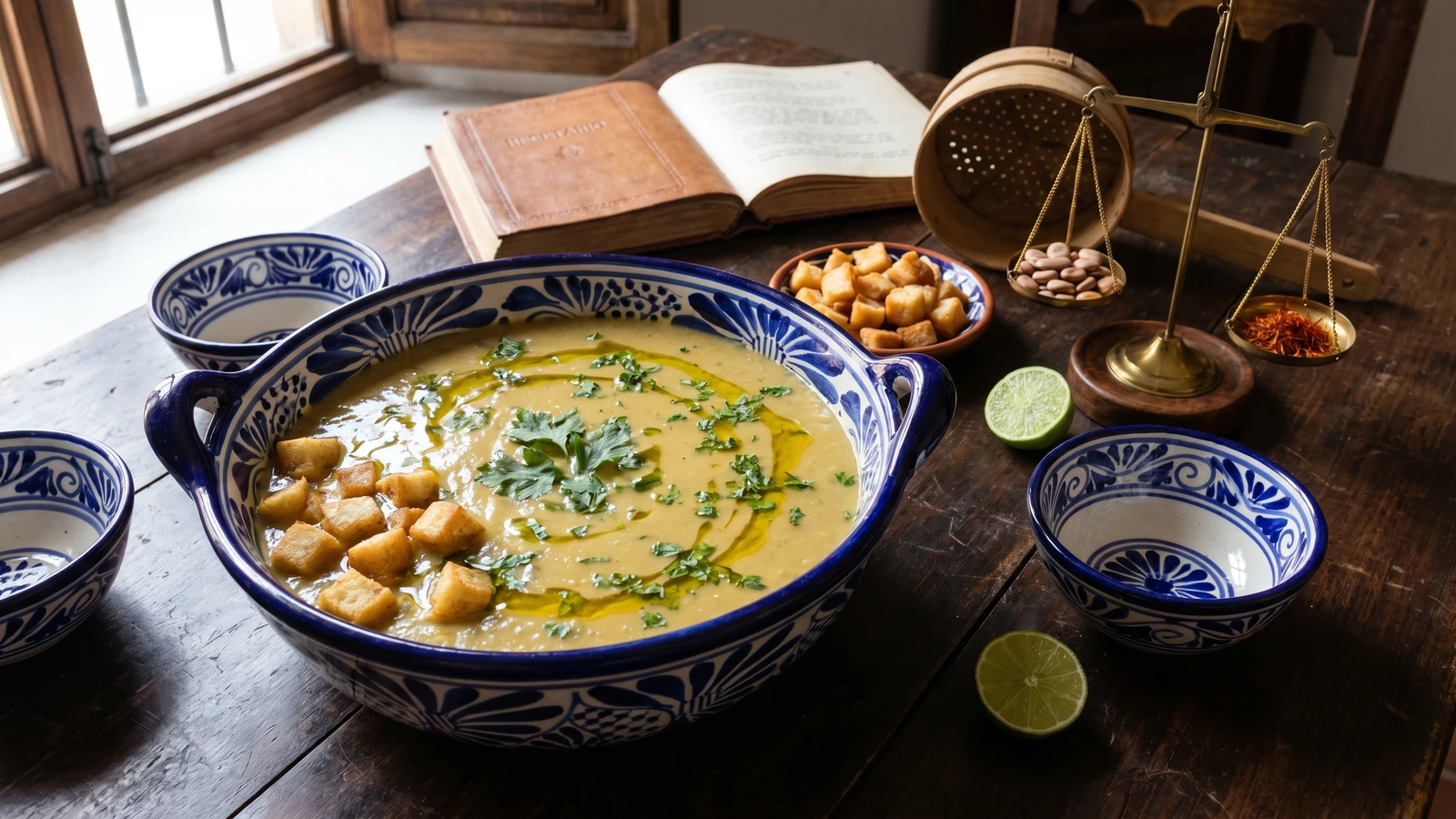
Puebla's conventual vigilia soup, built from dried habas cooked until they collapse, strained smooth, sharpened with garlic and epazote, and served quietly in Talavera with fried bread.
Puebla, Angelopolis, the convent kitchens behind thick walls and high windows. This sopa de habas belongs to vigilia, the meatless Lenten table of the refectorio, where the portera watched what came in and the cook knew how to feed a house without breaking the rule of abstinence.
The defining ingredient is the dried haba, the broad bean brought through the Spanish pantry and adopted into Mexican convent cooking because it gives body without meat. You cook it until it collapses. Then you pasar por colador, press it through a strainer, because the texture matters. A blender can help, yes, but the colador decides whether the soup is conventual or just bean water.
Do not put pork lard in this version. This is vigilia. The old recipe books use the language of manteca, but for Lenten kitchens that meant manteca de aceite, olive oil, when the canon required no animal fat. The garlic is fried in that oil, the bread is fried in that oil, and the epazote reminds you this soup is not Spanish anymore. Old World haba and wheat bread, New World herb and Mexican clay on the table. Cada estado, su propia cocina, and Puebla's convents had their own discipline.
I have seen versions of this in Puebla recetarios where the instructions are almost rude from being so brief: cook, strain, fry, serve. They assumed the cook already knew. I don't assume that. I explain because saber cocinar es saber vivir.
Puebla's convent kitchens preserved Lenten soups like sopa de habas through manuscript recetarios tied to houses such as Santa Rosa, Regina Coeli, and the Clarisas, including traditions later studied in Cocina y Vida Conventual and the Biblioteca Angelopolitana de Puebla. The Regina Coeli 1773 manuscript, the Quaderno de cosas curiosas de cocina, and the Libro de cocina del hermano fray Geronimo de San Pelayo show how colonial kitchens adapted Iberian ingredients, including habas, wheat bread, almonds, saffron, and olive oil, to New World herbs and produce. In vigilia cooking, meat broth and pork lard were avoided when required, so olive oil or manteca de aceite carried the flavor instead.
Quantity
1 pound
rinsed and picked over
Quantity
8 cups, plus more as needed
Quantity
1/2 medium
Quantity
3 large
divided
Quantity
1
Quantity
1 small sprig, plus leaves for serving
Quantity
1 1/2 teaspoons, plus more to taste
Quantity
1/4 cup
divided
Quantity
2 bolillos or 1/2 loaf
cut into 1-inch cubes
Quantity
1/4 teaspoon
Quantity
1 pinch
crushed and steeped in 2 tablespoons hot water
Quantity
1 tablespoon
finely chopped
Quantity
for serving
| Ingredient | Quantity |
|---|---|
| dried peeled fava beans (habas secas peladas)rinsed and picked over | 1 pound |
| water | 8 cups, plus more as needed |
| white onion | 1/2 medium |
| garlic clovesdivided | 3 large |
| bay leaf | 1 |
| fresh epazote | 1 small sprig, plus leaves for serving |
| kosher salt | 1 1/2 teaspoons, plus more to taste |
| olive oil (manteca de aceite)divided | 1/4 cup |
| bolillos or day-old pan virotecut into 1-inch cubes | 2 bolillos or 1/2 loaf |
| freshly ground black pepper | 1/4 teaspoon |
| saffron threadscrushed and steeped in 2 tablespoons hot water | 1 pinch |
| fresh parsley (optional)finely chopped | 1 tablespoon |
| lime halves (optional) | for serving |
Spread the dried habas on a tray and pick through them. Remove any stones, dark beans, or broken skins. Rinse under cool water until the water runs clear. This is market work, not decoration. If you skip it, you may find grit in the refectorio bowl, and nobody forgives that.
Put the habas in a heavy pot with 8 cups water, the white onion, 2 garlic cloves, bay leaf, and salt. Bring to a simmer, then lower the heat so the bubbles stay gentle. Cook uncovered for 1 hour to 1 hour 20 minutes, stirring now and then, until the beans split, soften, and begin to fall apart. Add hot water if the level drops below the beans. A hard boil makes the soup muddy and the skins stubborn.
Add the epazote sprig during the last 10 minutes of cooking. Not at the beginning. Epazote gives a green, medicinal edge that belongs to the Mexican pot, but if you cook it for an hour it turns harsh. Remove the bay leaf, onion, garlic, and spent epazote when the habas are soft.
Set a fine-mesh strainer over a clean pot or deep bowl. Press the cooked habas through with a wooden spoon, adding a little cooking liquid to help them move. You want a thick, smooth soup, not a paste and not a watery broth. A blender may be used first, but finish through the colador. The old convent cooks wrote this step because it changes the texture. Así se hace y punto.
Heat 3 tablespoons olive oil in a clay cazuela or heavy skillet over medium. Add the bread cubes and fry, turning often, until the edges are golden and crisp. Remove to a plate. This bread is not garnish for prettiness. It is wheat from the convent pantry, used to give bite against the soft haba.
Thinly slice the remaining garlic clove. Add the last tablespoon of olive oil to the same cazuela if needed, then fry the garlic just until pale gold. Do not brown it hard. Bitter garlic will take over the whole pot. Stir in the black pepper and the saffron water, scraping the bottom so the bread flavor comes with it.
Pour the strained haba soup into the cazuela with the garlic and saffron. Simmer 10 minutes, stirring often, until the surface looks satiny and the soup holds a soft line when the spoon passes through it. Taste for salt. The flavor should be quiet but not timid: bean, garlic, olive oil, epazote, saffron at the back.
Ladle into Talavera bowls or a shallow poblano cazuela. Add the fried bread at the table so it keeps its bite. Scatter a few fresh epazote leaves, and parsley if your house uses it. Lime is optional. This is a Lenten soup, not a fiesta pot. Let it be austere.
1 serving (about 380g)
Culinary guides, cultural storytelling, and the editorial depth that makes cooking meaningful.
Discover Culinary ExplorerChef Lupita
Aguascalientes' Bajio pozole de lengua, built with cacahuazintle hominy, tender beef tongue, chile ancho and guajillo, with xoconostle brightness and table garnishes.

Chef Lupita
Veracruz's Gulf coast rice from Alvarado, built with seafood stock, tomato, chile chipotle, epazote, shrimp, fish, jaiba, and pulpo, served loose and brothy in a clay cazuela.

Chef Lupita
Costa Chica's wet salt-beef stew, built from chile costeño, guajillo, tomato, manteca, yuca, plantain, and masa dumplings, the ranching pot of Cuajinicuilapa and Pinotepa.

Chef Lupita
Michoacán's P'urhépecha atápakua is a masa-thickened sauce and stew at once, built with pork, chile guajillo, and hierbabuena added only at the end.