
Chef Freja
Æblegelé
Tart autumn apples, slow-boiled and strained clear overnight, then cooked with sugar to a trembling pale amber jelly that belongs on the cheese board, on morning toast, and in the kitchen of anyone who respects the season.
A cooking platform built around craft, culture, and the stories behind what we eat.
Created by Chef Freja
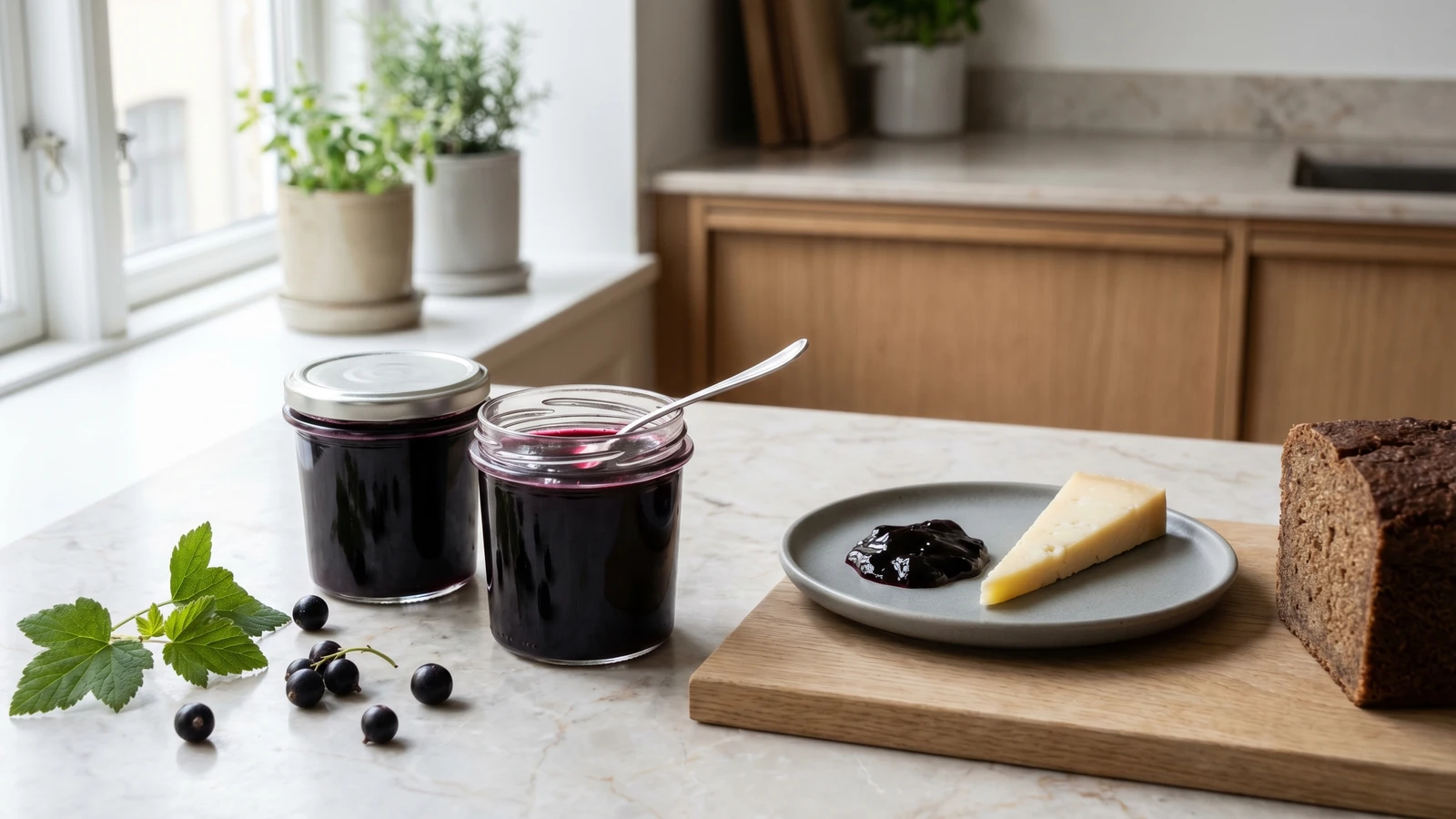
Danish blackcurrant jelly strained overnight and boiled with sugar to a dark, jewel-bright set. The jar you open when the cheese board comes out and the evenings grow long again.
The blackcurrants ripen in the last days of July, sometimes the first week of August. You'll know because the bushes turn from red to black almost overnight, and the birds notice before you do. If you don't pick them quickly, the starlings take every last one. The season decides, and the season here is brief.
Solbærgelé is what you make when the harvest outpaces your appetite, which it always does. The process is honest and unhurried: cook the berries until they collapse, strain the juice through a cloth overnight, then boil that juice with sugar until it sets. Two days from start to finish, most of it waiting. The result is a jelly so dark it's nearly black, tart and clear, the kind of preserve that makes a wedge of aged Vesterhavsost or a thick slice of rugbrod feel like a quiet occasion. One jar holds the whole of August inside it, and in January, when you open it, you'll taste exactly what I mean.
The one thing I need you to resist: pressing the jelly bag. The juice drips slowly, and every instinct will tell you to squeeze. Don't. Pressed juice forces pulp through the cloth and clouds the jelly. What you want is clarity, a jar you can hold to the window and see the light come through, deep purple and luminous. Let gravity do the work. The joy of waiting is real here, and the jelly rewards your patience with something you can't get any other way.
Blackcurrants have grown in Danish gardens since at least the 1500s, prized less for fresh eating than for their extraordinary concentration of vitamin C, a quality that made solbærsaft (blackcurrant cordial) a household winter medicine across Sjælland and Jutland for centuries. During the Second World War, when citrus imports to Denmark stopped entirely, the government actively encouraged home cultivation of blackcurrant bushes, and preserving the harvest in jars of gelé and saft became a matter of public health as much as kitchen tradition. The Danish preference for gelé over jam reflects something characteristic: clarity and intensity over volume.
Quantity
1kg
stripped from stalks
Quantity
300ml
Quantity
approximately 600g, measured to juice yield
| Ingredient | Quantity |
|---|---|
| fresh blackcurrantsstripped from stalks | 1kg |
| water | 300ml |
| granulated sugar | approximately 600g, measured to juice yield |
Put the blackcurrants and water into a large heavy-bottomed pot. You don't need to be fussy about removing every tiny stalk fragment; a few won't hurt. Bring to a gentle simmer over medium heat, then lower the flame and cook for twenty to twenty-five minutes, pressing the berries against the side of the pot with a wooden spoon every few minutes. You want them completely collapsed, soft, and swimming in deep purple juice. The kitchen will smell sharp and fruity, almost wine-like. That's right.
Set a jelly bag or a large square of muslin over a deep bowl, secured with string or a rubber band so it won't collapse under the weight. Pour the cooked berries and all their juice into the cloth. Let it drip. Walk away. Leave it for at least eight hours, or overnight. The juice will come through slowly, clear and intensely colored, collecting in the bowl beneath. Do not press the bag, do not squeeze it, do not be tempted. Pressing forces pulp through the weave and the jelly loses its clarity. You'll end up with something cloudy and dull instead of the jewel-bright preserve you're after.
The next morning, measure your juice. You should have roughly 700 to 800ml from a kilogram of berries. For every 500ml of juice, weigh out 375g of granulated sugar. This ratio gives you a jelly that sets firmly but stays tart, not cloying. Blackcurrants are naturally very high in pectin, so you need nothing added. Pour the strained juice into a clean heavy pot, add the sugar, and stir over low heat until every grain has dissolved completely. Don't rush this step. Undissolved sugar crystallizes in the finished jelly and ruins the smooth set you're working toward.
Once the sugar has dissolved, raise the heat and bring the liquid to a full rolling boil. Let it boil hard for eight to twelve minutes. The surface will foam and rise; that's the pectin reacting with the sugar and the heat. Stir occasionally to keep it from catching on the bottom. After eight minutes, start testing. Take the pot off the heat, drop a teaspoon of the liquid onto one of your frozen plates, wait ten seconds, then push it with your fingertip. If the surface wrinkles and holds its shape, the jelly is set. If it runs and stays liquid, put the pot back on the heat, boil for two more minutes, and test again. You'll know when it's right.
Use a spoon to skim any foam from the surface. The foam is harmless but it clouds the jelly, and after all that patient overnight straining you want the finished jar to be perfectly clear. Ladle the hot jelly into sterilized jars, filling them almost to the brim. Seal immediately with sterilized lids. As the jelly cools over the next hour, the lids will pull inward with a small click. That click is the vacuum seal forming, and it means the jar will keep in a cool, dark cupboard for up to a year. Let the jars cool completely before you move them. The jelly needs to set undisturbed.
1 serving (about 260g)
Culinary guides, cultural storytelling, and the editorial depth that makes cooking meaningful.
Discover Culinary ExplorerChef Freja
Tart autumn apples, slow-boiled and strained clear overnight, then cooked with sugar to a trembling pale amber jelly that belongs on the cheese board, on morning toast, and in the kitchen of anyone who respects the season.

Chef Freja
Autumn apples simmered slowly with vanilla until they collapse into a rough, golden sauce. The condiment that waits on the shelf for flaeskesteg, for roast duck, for the meals that carry you through the Danish winter.

Chef Freja
The pan sauce that holds the Danish Christmas plate together. Duck drippings, good stock, cream, and a spoonful of red currant jelly for the tart brightness that makes juleaften taste like itself.

Chef Freja
September plums slow-cooked with onion, ginger, vinegar, and warm spice into a dark, glossy chutney that belongs beside aged cheese on a cold evening. The joy of waiting, sealed in a jar.