
Chef Jeong-sun
Agwi-jjim (Braised Monkfish with Bean Sprouts)
Firm monkfish buried under crisp soybean sprouts, minari, and a red gochugaru sauce thickened at the end; Masan's market dish asks for heat, timing, and a steady hand.
A cooking platform built around craft, culture, and the stories behind what we eat.

Created by
Oxtail braised on the bone until the meat loosens and the sauce shines with gelatin, a slow Sunday dish where patience, skimming, and restraint do the real work.
Oxtail teaches patience before it teaches flavor. My teacher Master Seong-nyeo made us blanch it, rinse it, and trim it before a grain of seasoning touched the pot. We grumbled, quietly. She heard us anyway. Then she held up the cloudy first water and said, "You can hide carelessness with chili, but not from the broth." She was right.
Sokkori-jjim is a dish for a table that has time: a holiday table, a birthday meal, a cold Sunday when rice is already waiting and the side dishes are modest because the main pot is doing the talking. The tail is full of bone, tendon, and connective tissue, which is why it becomes so good if you don't rush it. A quick boil gives you toughness. A low braise gives you meat that comes away with chopsticks and a sauce that coats the spoon.
Do not make this too sweet. Oxtail already brings richness; sugar should round the soy sauce, not turn the dish into candy. Pear and onion do some of the softening, radish and carrot take the salt into themselves, and the final reduction is where the dish becomes jjim instead of soup. Write it down. Memory is a borrowed bowl.
Jjim (찜) is Korea's family of slow-cooked or braised dishes, used for meat, fish, and vegetables long before modern pressure cookers made the work shorter. Beef was precious through much of Korean history, so bone-heavy cuts like tail were valued for soups such as gomtang and, when seasoned with soy, for special-occasion braises in the same household logic as galbi-jjim. Sokkori-jjim as it is commonly served today belongs mostly to modern home and restaurant tables, where wider beef access made a long oxtail braise possible for more families.
Quantity
1.8kg
cut across the bone into 2 to 3 inch pieces
Quantity
as needed
for soaking and blanching
Quantity
10 cups
for the first braise
Quantity
1/2 medium
peeled
Quantity
6
lightly crushed
Quantity
4 thin slices
Quantity
2
cut into 3 inch lengths
Quantity
1 teaspoon
Quantity
1 cup
cut into 1 1/2 inch chunks
Quantity
2 medium
cut into 1 1/2 inch chunks
Quantity
6
soaked until soft, stems removed
Quantity
8
Quantity
6
Quantity
1/2 cup
Quantity
3 tablespoons
grated
Quantity
2 tablespoons
grated
Quantity
2 tablespoons
Quantity
1 tablespoon
Quantity
1 tablespoon
Quantity
1 tablespoon
Quantity
4
minced
Quantity
1/2 teaspoon
freshly ground
Quantity
1/4 teaspoon
Quantity
2
thinly sliced on the diagonal
Quantity
1 teaspoon
Quantity
2
separated and cooked into yellow and white strips
| Ingredient | Quantity |
|---|---|
| oxtailcut across the bone into 2 to 3 inch pieces | 1.8kg |
| cold waterfor soaking and blanching | as needed |
| waterfor the first braise | 10 cups |
| onionpeeled | 1/2 medium |
| garlic cloveslightly crushed | 6 |
| fresh ginger | 4 thin slices |
| scallion whitescut into 3 inch lengths | 2 |
| whole black peppercorns | 1 teaspoon |
| Korean radish (mu)cut into 1 1/2 inch chunks | 1 cup |
| carrotscut into 1 1/2 inch chunks | 2 medium |
| dried shiitake mushroomssoaked until soft, stems removed | 6 |
| peeled chestnuts (optional) | 8 |
| jujubes (daechu) (optional) | 6 |
| soy sauce | 1/2 cup |
| Korean pear or Asian peargrated | 3 tablespoons |
| oniongrated | 2 tablespoons |
| mirin or rice wine | 2 tablespoons |
| brown sugar | 1 tablespoon |
| rice syrup or honey | 1 tablespoon |
| toasted sesame oil | 1 tablespoon |
| garlic clovesminced | 4 |
| black pepperfreshly ground | 1/2 teaspoon |
| salt (optional) | 1/4 teaspoon |
| scallion greensthinly sliced on the diagonal | 2 |
| toasted sesame seeds | 1 teaspoon |
| eggs for jidan (optional)separated and cooked into yellow and white strips | 2 |
Put the oxtail in a large bowl and cover with cold water by 2 inches. Soak 30 minutes, changing the water once if it turns very red. This pulls out excess blood so the braise tastes clean instead of muddy. Drain well.
Cover the oxtail with fresh cold water in a large pot and bring it to a hard boil. Boil 7 minutes, then drain. Rinse each piece under warm running water, rubbing away gray foam and loose bone bits. Wash the pot before the meat goes back in. This is not fussiness; it is the difference between a clear richness and a greasy heaviness.
Return the rinsed oxtail to the clean pot with 10 cups water, the half onion, crushed garlic, ginger, scallion whites, and peppercorns. Bring to a boil, then lower to a gentle simmer and skim the surface for the first 15 minutes. Cover with the lid slightly ajar and simmer 2 hours, until the meat has begun to loosen but is not falling apart.
Lift the oxtail into a bowl. Strain the broth and discard the boiled aromatics. Let the broth stand 10 minutes, then skim off as much fat as you can from the surface. You should have about 4 cups broth; if you have more, boil it down, and if you have less, add water. The measured broth matters because the soy sauce has to season the pot, not drown it.
Stir together the soy sauce, grated pear, grated onion, mirin, brown sugar, rice syrup, sesame oil, minced garlic, and black pepper. Taste it on a spoon. It should be salty first, gently sweet second, and fragrant with garlic and sesame. If it tastes like dessert, you have gone too far.
Put the oxtail back in the pot with 4 cups of the strained broth and the seasoning mixture. Simmer uncovered over medium-low heat for 35 minutes, turning the pieces every 10 minutes so the sauce reaches every side. The liquid should move steadily but not crash around the meat.
Add the radish, carrots, shiitake mushrooms, chestnuts, and jujubes if using. Continue simmering uncovered 35 to 45 minutes, gently turning the vegetables once or twice, until the radish is tender and the oxtail meat pulls easily from the bone with chopsticks. Add a splash of water if the sauce reduces before the meat is tender.
Raise the heat to medium and spoon the sauce over the meat for 8 to 12 minutes, until it reduces to about 1 1/2 cups and looks glossy from the gelatin. This final reduction is what makes it jjim. If it stays soupy, the flavor sits in the pot instead of clinging to the oxtail.
Taste the sauce only after it has reduced. Add up to 1/4 teaspoon salt if it needs sharpening, but do not add more soy sauce at the end or the sweetness and salt will become uneven. Scatter with sliced scallion, toasted sesame, and jidan strips if you made them. Rest 10 minutes before serving so the sauce settles back into the meat.
1 serving (about 430g)
Culinary guides, cultural storytelling, and the editorial depth that makes cooking meaningful.
Discover Culinary ExplorerChef Jeong-sun
Firm monkfish buried under crisp soybean sprouts, minari, and a red gochugaru sauce thickened at the end; Masan's market dish asks for heat, timing, and a steady hand.

Chef Jeong-sun
A quick Korean rice bowl built on contrast: warm rice, cold popping flying-fish roe, chopped vegetables, gim, sesame oil, and the crisp rice bottom a hot stone bowl gives you.
Chef Jeong-sun
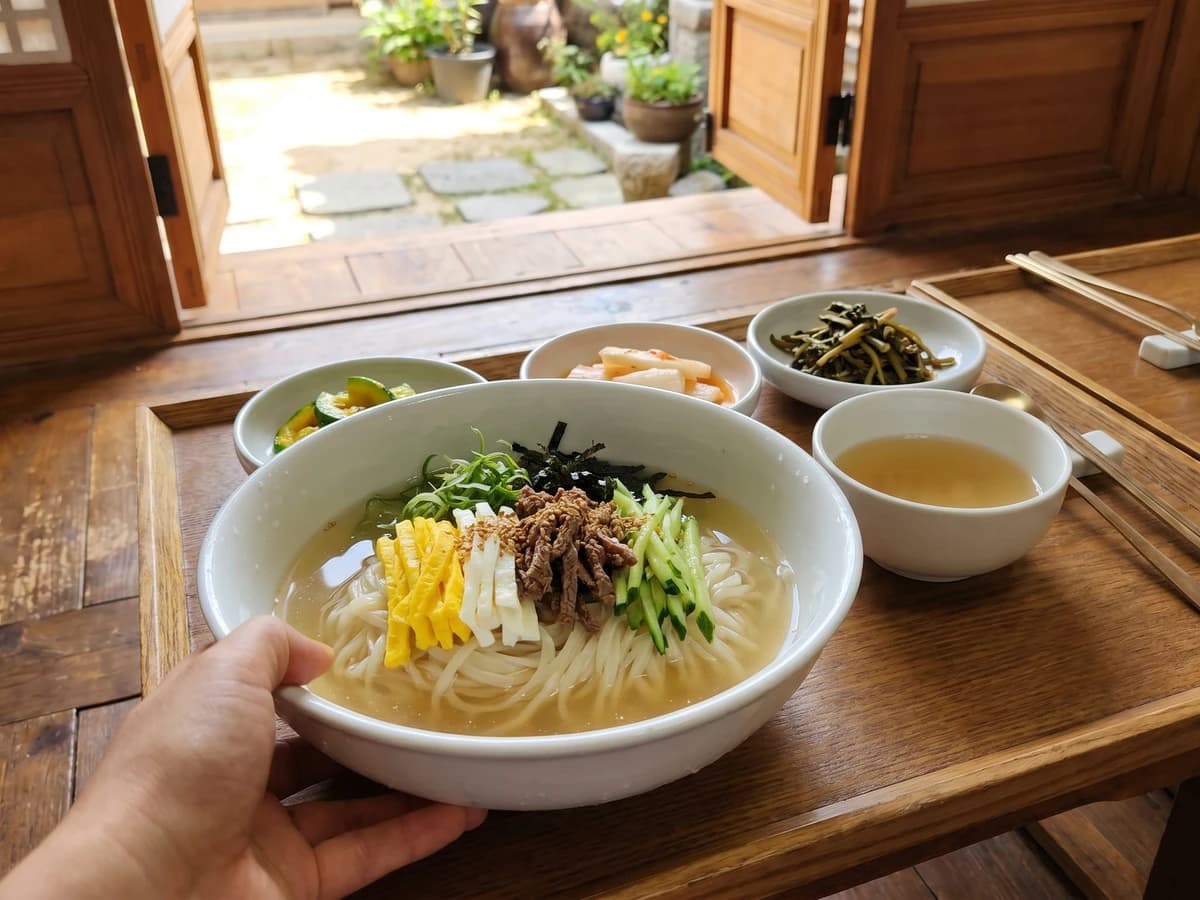
Andong's guest noodles, wheat and roasted soybean flour rolled thin, boiled and rinsed cold, then set in a clear chilled anchovy broth with careful strips of beef, egg, and cucumber.

Chef Jeong-sun
Andong's ritual-table rice served on an ordinary day: separate soy-sesame namul, warm rice, and clear radish soup, mixed without gochujang so every vegetable keeps its own voice.