Culinary Explorer

A cooking platform built around craft, culture, and the stories behind what we eat.
Discover Culinary Explorer
Soft Molasses Cookies

Soft Molasses Cookies

Created by

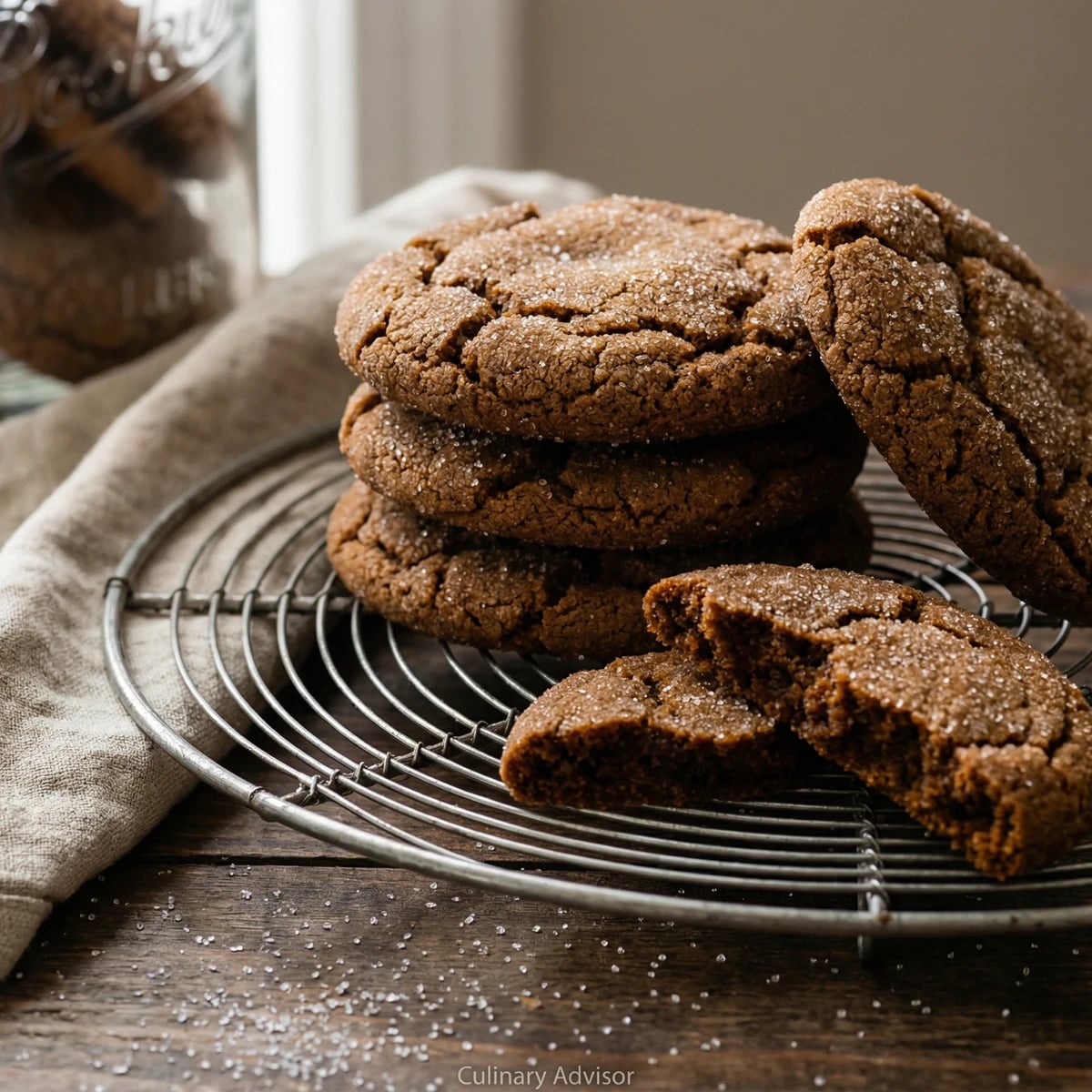
Thick, chewy spiced cookies rolled in sparkling sugar, their crackled tops hiding centers so soft they bend rather than break. Dark molasses brings the deep, almost bittersweet warmth that made these a cornerstone of American baking.

Pastries & Cookies
American
Make Ahead
Holiday
Comfort Food
20 min
Active Time
12 min cook2 hr 30 min total
Yield24 cookies

Molasses cookies belong to the earliest chapter of American baking. Before refined white sugar became affordable, molasses was the sweetener of the colonies. It came cheap from Caribbean trade routes, and thrifty New England housewives built an entire tradition around its dark, complex sweetness. These cookies are descendants of that tradition.

The secret to their remarkable texture lives in the molasses itself. Unlike granulated sugar, which dries out baked goods over time, molasses is hygroscopic. It pulls moisture from the air and holds it in the crumb. A properly made molasses cookie stays soft for nearly a week, improving on day two as the spices mellow and deepen.

I've tested dozens of versions over the years. Some spread thin and crisp. Others puff tall and cakey. This recipe lands precisely where a molasses cookie should: thick enough to show crackled fissures across the sugared top, soft enough to bend slightly when you break one in half. The edges set while the centers stay pillowy. The spice blend hits your nose before the first bite reaches your mouth.

Don't skip the chilling step. Cold dough holds its shape in the oven, giving you those dramatic cracks and thick, chewy centers. Room temperature dough spreads before it sets, and you'll end up with something closer to a ginger snap than the soft cookie you're after.

The technique, the tradition, and the story behind every dish.

Discover Culinary Explorer

Ingredients

all-purpose flour

Quantity

2 1/4 cups (280g)

baking soda

Quantity

2 teaspoons

ground ginger

Quantity

1 1/2 teaspoons

ground cinnamon

Quantity

1 teaspoon

ground cloves

Quantity

1/2 teaspoon

ground allspice

Quantity

1/4 teaspoon

fine sea salt

Quantity

1/2 teaspoon

unsalted butter

Quantity

3/4 cup (170g)

softened

dark brown sugar

Quantity

1 cup (200g)

packed

large egg

Quantity

1

room temperature

unsulphured dark molasses

Quantity

1/3 cup (113g)

pure vanilla extract

Quantity

1 teaspoon

granulated sugar

Quantity

1/2 cup (100g)

for rolling

Equipment Needed

  • Stand mixer or hand mixer
  • Two half-sheet pans
  • Parchment paper
  • Wire cooling rack
  • #40 cookie scoop (optional but recommended)

Instructions

  1. 1

    Combine dry ingredients

    Whisk together the flour, baking soda, ginger, cinnamon, cloves, allspice, and salt in a medium bowl. The spices should be evenly distributed throughout the flour with no visible clumps. Set aside.

    Fresh spices make a real difference here. If your ground ginger has been in the cabinet for two years, it's lost most of its punch. Smell it before you use it.
  2. 2

    Cream butter and sugar

    Beat the softened butter and brown sugar together in a stand mixer fitted with the paddle attachment, or in a large bowl with a hand mixer. Start on medium speed and beat for 3 to 4 minutes until the mixture turns noticeably lighter in color and increases in volume. Scrape down the sides of the bowl halfway through. You're building air into the dough, which contributes to that soft, pillowy texture.

  3. 3

    Add wet ingredients

    Add the egg and beat on medium speed until fully incorporated, about 30 seconds. Pour in the molasses and vanilla extract, then beat again until the mixture is smooth and uniform in color. It will look glossy and deeply brown, almost like chocolate frosting. Don't worry if it appears slightly curdled at first. Keep mixing and it will come together.

    Coat your measuring cup with a thin film of neutral oil before measuring the molasses. It will slide right out instead of clinging to the sides.
  4. 4

    Mix in flour

    Add the flour mixture to the wet ingredients all at once. Mix on low speed just until no dry streaks remain. The dough will be soft and sticky. Resist the urge to add more flour. This slack texture is what gives the cookies their characteristic chewiness.

  5. 5

    Chill the dough

    Cover the bowl tightly with plastic wrap pressed directly against the surface of the dough. Refrigerate for at least 2 hours, or overnight. The dough needs to firm up enough to roll into balls without sticking to your hands. Patience here pays dividends in texture.

  6. 6

    Prepare for baking

    When ready to bake, position racks in the upper and lower thirds of your oven and preheat to 350°F. Line two baking sheets with parchment paper. Pour the granulated sugar into a shallow bowl.

  7. 7

    Shape and coat cookies

    Scoop rounded tablespoons of dough, about 1.5 inches in diameter. Roll each portion between your palms to form smooth balls. Drop each ball into the sugar and roll to coat completely, then place on the prepared baking sheets. Space them 2 inches apart. They will spread. Flatten each ball slightly with the palm of your hand to about 3/4 inch thick.

    If the dough becomes too soft and sticky as you work, return it to the refrigerator for 15 minutes. Cold dough shapes easily and bakes up thicker.
  8. 8

    Bake until crackled

    Bake for 10 to 12 minutes, rotating the pans from top to bottom and front to back at the halfway point. The cookies are done when the tops are covered in deep cracks and the edges appear set but the centers still look slightly underdone and puffy. They will firm up as they cool. Pull them at exactly this moment. Overbaking by even two minutes transforms these from soft to crisp.

  9. 9

    Cool and store

    Let the cookies rest on the baking sheets for 5 minutes. They're fragile when hot. Transfer to a wire rack to cool completely. The texture continues to develop as they reach room temperature. Once cooled, store in an airtight container at room temperature where they'll stay soft for up to a week.

Chef Tips

  • Use unsulphured dark molasses, sometimes labeled 'full flavor' or 'robust.' Blackstrap molasses is too bitter for cookies. Light molasses lacks the depth these need. Grandma's and Brer Rabbit both make reliable dark varieties.
  • The two teaspoons of baking soda might seem like a lot, but molasses is acidic. The soda neutralizes that acidity while providing lift. The reaction also contributes to the craggy, crackled surface.
  • For uniform cookies, use a #40 cookie scoop (about 1.5 tablespoons). Consistent portioning means consistent baking times across the batch.
  • These cookies freeze beautifully. Scoop and roll the dough balls, freeze them on a sheet pan until solid, then transfer to a freezer bag. Bake directly from frozen, adding 2 to 3 minutes to the baking time. Keep a stash ready for unexpected guests or sudden cravings.

Advance Preparation

  • Dough can be refrigerated for up to 3 days before baking. The flavor actually improves as the spices have time to bloom.
  • Shaped dough balls freeze for up to 3 months. Bake from frozen at 350°F for 13 to 15 minutes.
  • Baked cookies stay soft in an airtight container at room temperature for 7 days, or freeze for up to 2 months.

Frequently Asked Questions

Nutrition Information

1 serving (about 30g)

Calories
190 calories
Total Fat
6 g
Saturated Fat
3.5 g
Trans Fat
0 g
Unsaturated Fat
2 g
Cholesterol
12 mg
Sodium
60 mg
Total Carbohydrates
23 g
Dietary Fiber
0 g
Sugars
21 g
Protein
1.5 g

Note: Chef personas and recipes are created with AI assistance. Cook with care: follow safe food-handling practices, check doneness with a thermometer when needed, and adapt for allergies and your kitchen.

Where cooking meets culture.

Culinary guides, cultural storytelling, and the editorial depth that makes cooking meaningful.

Discover Culinary Explorer

More from The Great American Cookie Collection

Browse the full collection