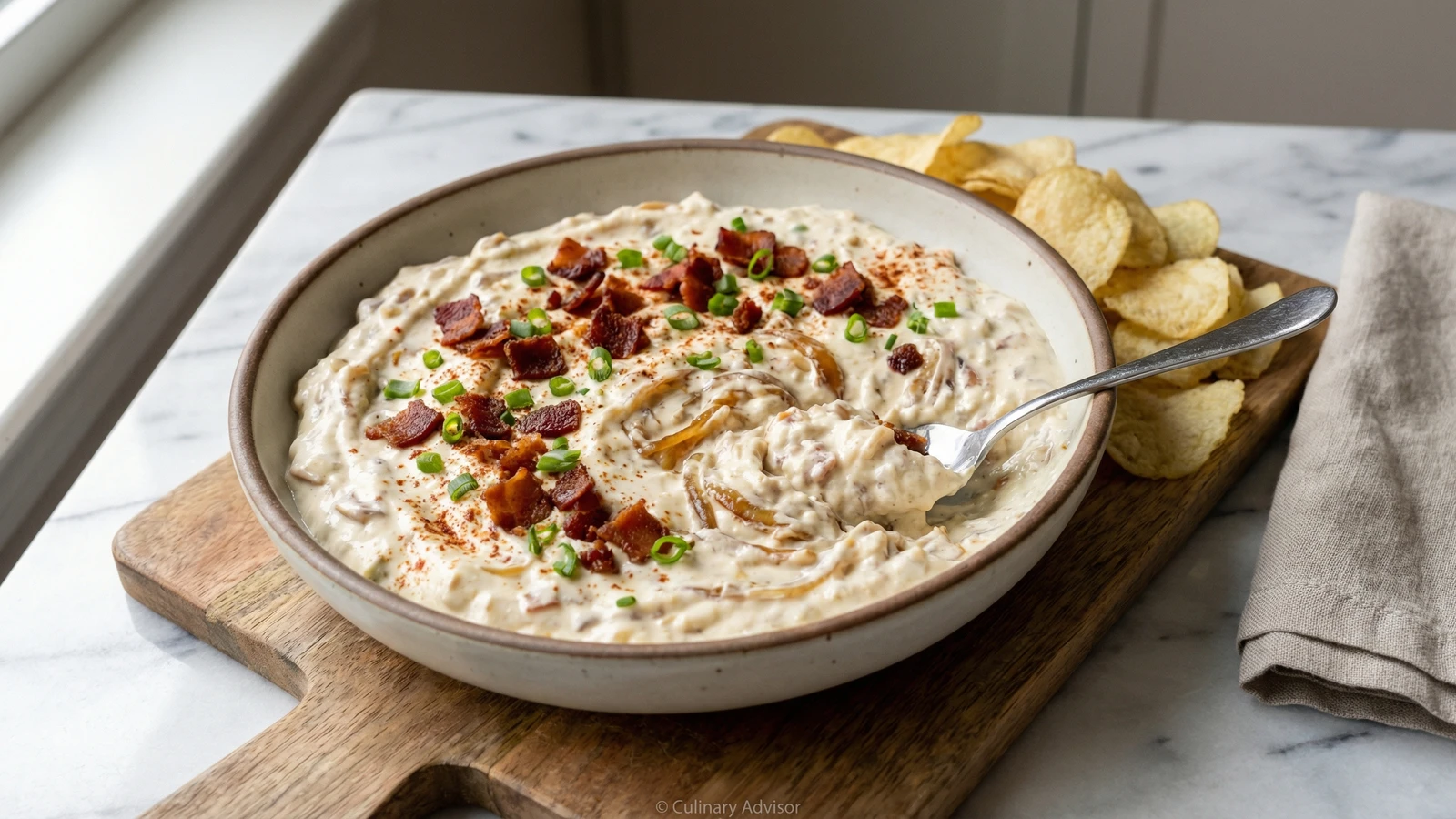
Slowly caramelized onions and shatteringly crisp bacon folded into a tangy sour cream base, this is the dip that made Lipton jealous. Real ingredients, honest technique, and the kind of flavor that empties the bowl before halftime.
Appetizers & Snacks
American
Game Day
Super Bowl
Potluck
15 min
Active Time
50 min cook•1 hr 5 min total
YieldAbout 3 cups (serves 12-16 as an appetizer)
There is a reason onion dip became an American institution. It hits every pleasure center: creamy, savory, tangy, with just enough sweetness to keep you reaching back. The tragedy is that most versions rely on a packet of dehydrated soup mix and call it a day.
This version takes longer. I won't lie to you about that. Proper caramelization requires forty-five minutes of patience, occasionally stirring onions while they transform from sharp and pungent to mahogany-sweet. You'll cook them in bacon fat, which builds layers of smoky depth that no shortcut can replicate. The bacon itself gets crumbled throughout, adding texture and salt against the cool, tangy cream.
The good news for hosts? This dip improves with time. Make it the day before your party and the flavors marry overnight. By the time your guests arrive, you'll have something that tastes like you spent all day in the kitchen. You didn't. You spent forty-five minutes the night before, then refrigerated your triumph.
The technique, the tradition, and the story behind every dish.
Arrange bacon slices in a single layer in a large cold skillet, preferably cast iron. Set over medium heat and cook slowly, turning occasionally, until the fat renders and the bacon turns deeply golden and crisp, 12 to 15 minutes. The slow start extracts more fat without burning. Transfer bacon to a paper towel-lined plate. Reserve 3 tablespoons of the rendered fat in the skillet, pouring off excess into a jar for another use.
Starting bacon in a cold pan allows fat to render gradually, producing crispier results and more usable drippings.
2
Begin caramelizing onions
Add sliced onions to the bacon fat, tossing to coat. Sprinkle with one teaspoon of salt. The salt draws moisture from the onions, which is essential for proper caramelization. Cook over medium heat, stirring every few minutes, for the first 15 minutes. The onions will release liquid and begin to soften, filling your kitchen with a fragrance that makes neighbors knock on doors.
3
Continue to deep caramelization
Reduce heat to medium-low. Continue cooking for another 25 to 30 minutes, stirring every 5 minutes or so. Watch the color progression: pale gold at 20 minutes, amber at 30, deep mahogany by 40. If onions stick, add a splash of water and scrape up the fond. Those browned bits are concentrated flavor. You want onions that are jammy, sweet, and a fraction of their original volume.
True caramelization cannot be rushed. High heat produces burnt edges and raw centers. Low and slow transforms harsh allium into something almost candy-sweet.
4
Add garlic and Worcestershire
Clear a small space in the center of the onions and add minced garlic. Let it sizzle for 30 seconds until fragrant, then stir into the onions. Add Worcestershire sauce and stir well, scraping up any remaining fond. The sauce will sizzle and reduce almost immediately. Remove from heat and let cool for 10 minutes. Hot onions will curdle your sour cream.
5
Prepare the dairy base
While onions cool, combine sour cream and softened cream cheese in a large bowl. Beat with a wooden spoon or spatula until smooth and uniform. The cream cheese adds body that helps the dip cling to chips without being heavy. Stir in smoked paprika and cayenne if using.
6
Combine and crumble
Fold the cooled onion mixture into the dairy base until evenly distributed. Crumble the reserved bacon, leaving some pieces larger for texture. Fold in most of the bacon and chives, reserving about 2 tablespoons of each for garnish. Season with black pepper and additional salt to taste.
7
Chill and serve
Transfer dip to a serving bowl, cover, and refrigerate for at least 2 hours, preferably overnight. The cold rest allows flavors to meld and the dip to firm to proper scooping consistency. Before serving, let sit at room temperature for 15 minutes, then top with reserved bacon and chives. Serve with sturdy kettle chips, thick-cut potato chips, or raw vegetables.
The dip will thicken considerably when chilled. If too thick after resting, stir in a tablespoon of sour cream to loosen.
Chef Tips
•Thick-cut bacon is essential here. Thin supermarket strips render too little fat and turn papery rather than crisp. Ask your butcher for slab bacon and slice it yourself at a quarter-inch thickness.
•Yellow onions caramelize best because they balance sugar and moisture content. Sweet onions like Vidalias contain too much water and turn mushy. Red onions work but produce a grayish color.
•For a slightly smoky variation, substitute 2 tablespoons of the bacon fat with butter and add an extra quarter teaspoon of smoked paprika. The butter contributes milk solids that brown alongside the onions.
•This dip pairs beautifully with a cold lager or a crisp hard cider. The carbonation cuts through the richness, and the slight bitterness balances the caramelized sweetness.
Advance Preparation
•The complete dip can be made up to 3 days ahead. Store covered in the refrigerator. Flavors deepen significantly after the first night.
•Caramelized onions can be made up to 5 days ahead and refrigerated separately. Combine with dairy base and bacon the day before serving.
•For make-ahead bacon, cook until just barely crisp, as it will soften slightly when folded into the dip. Reserve extra crispy pieces for garnish.
•Scaling for crowds: This recipe doubles or triples easily. Use a larger pan or work in batches for the onions. Allow extra caramelization time for larger quantities.
Frequently Asked Questions
Nutrition Information
1 serving (about 39g)
Calories
435 calories
Total Fat
37 g
Saturated Fat
23 g
Trans Fat
0.5 g
Unsaturated Fat
12 g
Cholesterol
86 mg
Sodium
150 mg
Total Carbohydrates
9 g
Dietary Fiber
1 g
Sugars
3 g
Protein
5 g
Where cooking meets culture.
Culinary guides, cultural storytelling, and the editorial depth that makes cooking meaningful.