Culinary Explorer

A cooking platform built around craft, culture, and the stories behind what we eat.
Discover Culinary Explorer
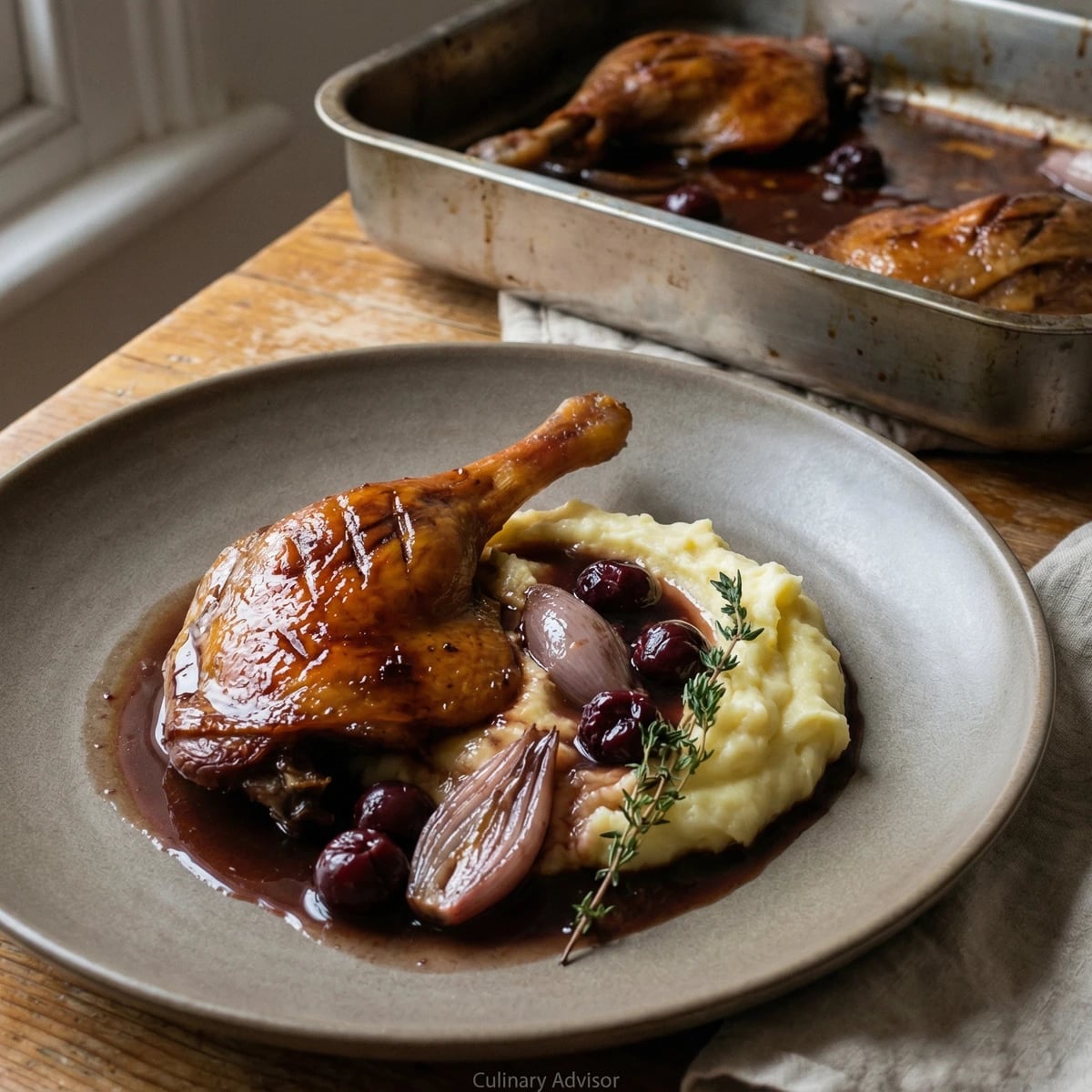
Slow-Roast Duck Legs with Port and Cherry Sauce

Slow-Roast Duck Legs with Port and Cherry Sauce

Created by Chef Thomas

Duck legs, slow-roasted until the fat renders and the skin turns to glass, served with a dark, glossy sauce of port and sour cherries that tastes like winter at its best.

Main Dishes
British
Dinner Party
Comfort Food
Special Occasion
15 min
Active Time
2 hr 15 min cook2 hr 30 min total
Yield4 servings

January. Properly cold now. The kind of evening where you close the curtains before five and the kitchen becomes the warmest room in the house. This is when I want duck.

Duck legs are patient, forgiving things. You score the skin, season them well, and put them in a low oven where the fat renders out slowly and the skin tightens and crisps over a couple of hours. The kitchen fills with a scent that's hard to describe and impossible to ignore: rich, savoury, faintly herbal from the thyme, with that particular warmth that only rendered duck fat carries. You don't need to do much. Check on them once. Trust the oven. Trust the time.

The sauce makes itself while you wait. Dried sour cherries soaked in ruby port until they swell and darken. The whole lot simmered with stock and a splash of vinegar in the roasting tin, scraping up those sticky, caramelised bits that hold all the flavour. It reduces to something dark and glossy that tastes of winter fruit and woodsmoke and the sort of evening you want to stay inside for.

I wrote this one down in the notebook years ago. Just the bones of it: duck, port, cherries, Tuesday, rain. I've made it dozens of times since, and the only thing that changes is what goes alongside. The duck stays the same. A recipe is a conversation, not a contract, but sometimes you arrive at something that doesn't need revising.

The technique, the tradition, and the story behind every dish.

Discover Culinary Explorer

Ingredients

duck legs

Quantity

4

fine sea salt

Quantity

to taste

black pepper

Quantity

to taste

banana shallots

Quantity

3

peeled and halved lengthways

garlic cloves

Quantity

3

unpeeled and lightly crushed

fresh thyme

Quantity

4 sprigs

bay leaves

Quantity

2

dried sour cherries (Morello)

Quantity

100g

ruby port

Quantity

200ml

chicken or duck stock

Quantity

250ml

red wine vinegar

Quantity

1 tablespoon

unsalted butter

Quantity

a knob

cold

Equipment Needed

  • Heavy roasting tin or large ovenproof pan
  • Small saucepan for the port and cherries
  • Sharp knife for scoring
  • Wooden spoon

Instructions

  1. 1

    Season and score the duck

    Take the duck legs out of the fridge a good hour before you start. Cold meat in a hot pan fights you. Score the skin in a crosshatch with a sharp knife, cutting through the fat but not into the flesh beneath. Season generously with fine sea salt and black pepper, rubbing it into the scores. The salt draws moisture from the skin, and dry skin is what crisps. This is the part most people skip. Don't.

    If you have time, salt the duck legs uncovered in the fridge the night before. By morning the skin will be taut and dry to the touch. That's what you want.
  2. 2

    Render the fat slowly

    Set the oven to 160C/140C fan. Place the duck legs skin-side down in a cold, dry roasting tin or ovenproof pan. No oil. No butter. Put them over a medium-low heat on the hob and let the fat render out slowly. This takes fifteen minutes or so. Don't rush it. You'll hear a gentle, steady sizzle, not a fierce spit. When the skin has gone golden and the tin has a good puddle of clear duck fat, they're ready for the oven.

    Starting in a cold pan is the trick. The fat renders gradually and evenly, and you end up with skin that's properly crisp rather than burnt at the edges and flabby in the middle.
  3. 3

    Slow-roast with aromatics

    Tuck the shallot halves, garlic cloves, thyme sprigs, and bay leaves around the duck legs in the tin. Turn the legs skin-side up. They should be sitting in their own rendered fat with the aromatics nestled beneath them. Slide the tin into the oven and leave it alone for an hour and a half to two hours. The kitchen will start to smell of something deep and savoury after about forty minutes. That's the thyme and the duck fat doing their work. The legs are done when the skin is dark golden and crackling, and the meat pulls easily from the bone when you press it with a spoon.

  4. 4

    Soak the cherries in port

    While the duck is in the oven, warm the port in a small saucepan until it just begins to shiver at the edges. Drop in the dried cherries, take the pan off the heat, and let them sit. They'll swell and soften and turn the port a shade darker. By the time you need them, they'll have drunk up half the liquid. That's fine. That's what you want.

  5. 5

    Build the sauce

    When the duck is done, lift the legs out onto a warm plate and cover loosely. Rest them while you make the sauce. Pour off all but a tablespoon of the duck fat from the tin (save it, it's liquid gold for roast potatoes). Set the tin over a medium heat on the hob, scraping up the sticky bits from the bottom with a wooden spoon. Pour in the port and cherries and let it bubble for a minute, then add the stock and the red wine vinegar. Let it simmer and reduce by about a third, until it coats the back of the spoon and tastes rich and concentrated, sharp and sweet in equal measure. Season and taste. Then taste again.

    The vinegar is important. Port is sweet and the sauce needs a counterpoint. A single tablespoon pulls the whole thing into balance. Without it, you're halfway to a dessert.
  6. 6

    Finish and serve

    Take the sauce off the heat and stir in the cold butter. It will melt into the liquid and give it a glossy, rounded finish. Place a duck leg on each warm plate and spoon the cherry sauce over and around it, letting the cherries settle in dark little pools. Serve with something that can absorb the sauce: a pile of buttery mash, or some polenta if you prefer, and a green vegetable cooked simply. Steamed greens. Braised cavolo nero. Whatever the season gives you. There are few better feelings than putting a plate like this in front of someone on a cold evening.

Chef Tips

  • Buy the best duck legs you can find. A good butcher will have them, or a farmers' market if you're lucky. The difference between a supermarket duck leg and one from a bird that's lived a proper outdoor life is not subtle. It's the difference between cooking something and cooking something worth eating.
  • Save every drop of rendered duck fat. Strain it through a sieve into a clean jar and keep it in the fridge. It lasts for months and there is nothing better for roasting potatoes. Nothing. This is not negotiable.
  • Ruby port, not tawny. You want the fruit and the sweetness, not the nuttiness. And don't use anything you wouldn't drink. The sauce concentrates the flavour of the port, so a poor one will announce itself. A decent supermarket ruby will do the job well.
  • If you can get jarred Morello cherries in juice rather than dried, use them. Drain them, use the juice as part of the liquid in the sauce, and add the cherries at the end. The texture is different, softer, more yielding, and the sauce comes together a little faster.

Advance Preparation

  • Salt the duck legs uncovered in the fridge a day ahead. The skin dries out and the seasoning penetrates the meat. This single step makes the biggest difference to the finished dish.
  • The port and cherry sauce can be made up to two days ahead and reheated gently. Add the butter only when reheating, just before serving.
  • Cooked duck legs reheat surprisingly well. Place them skin-side up on a rack over a tray in a hot oven for ten minutes until the skin crisps again.

Frequently Asked Questions

Nutrition Information

1 serving (about 270g)

Calories
485 calories
Total Fat
20 g
Saturated Fat
8 g
Trans Fat
0 g
Unsaturated Fat
11 g
Cholesterol
170 mg
Sodium
890 mg
Total Carbohydrates
32 g
Dietary Fiber
3 g
Sugars
23 g
Protein
38 g

Note: Chef personas and recipes are created with AI assistance. Cook with care: follow safe food-handling practices, check doneness with a thermometer when needed, and adapt for allergies and your kitchen.

Where cooking meets culture.

Culinary guides, cultural storytelling, and the editorial depth that makes cooking meaningful.

Discover Culinary Explorer

More from Sunday Roasts & Slow Suppers

Browse the full collection