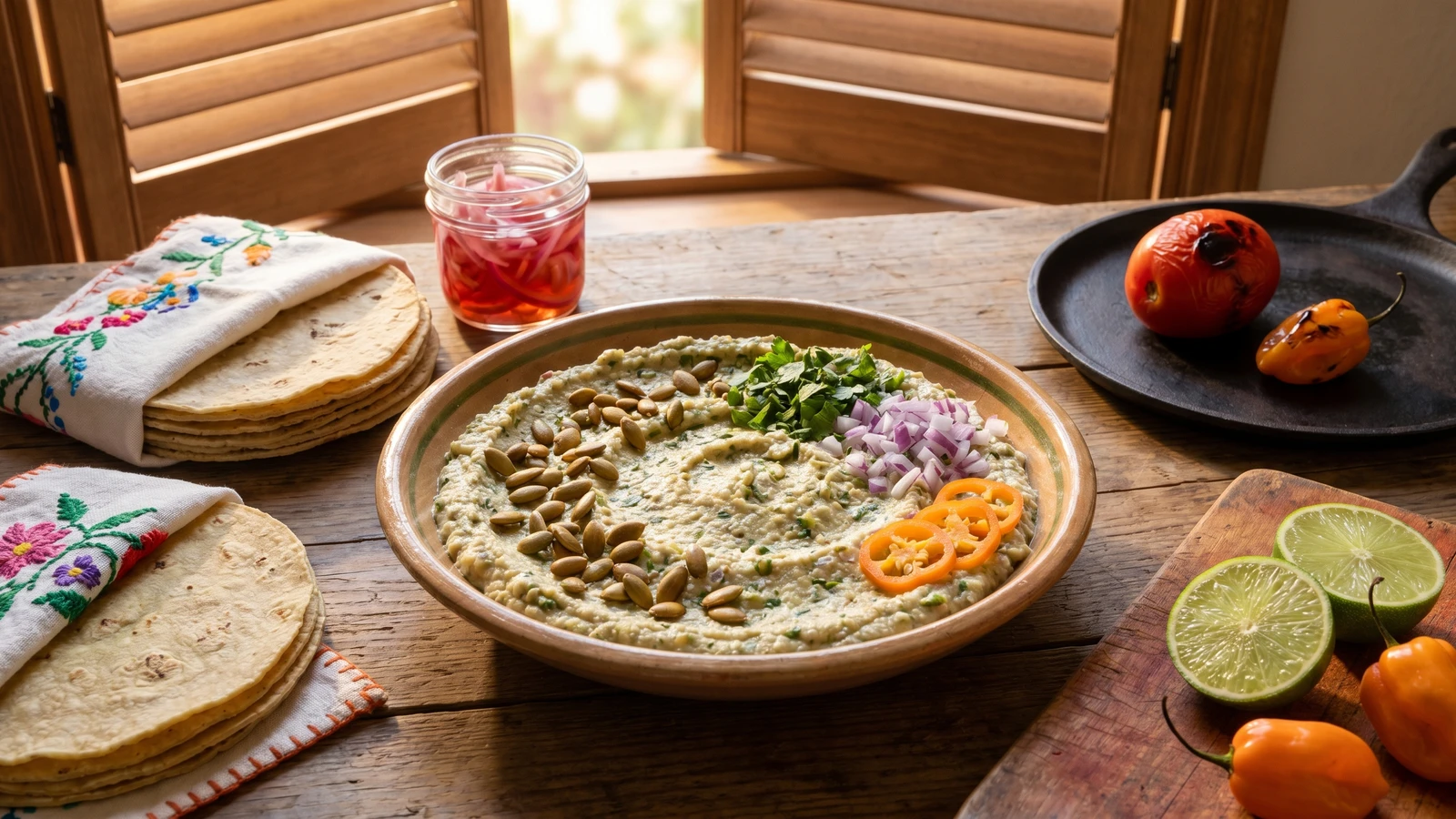
Yucatan's Mayan pumpkin seed dip, built from toasted pepitas, comal-charred tomato, habanero, and sour orange. Older than the conquest, scooped with a hand-pressed tortilla.
Appetizers & Snacks
Mexican
Dinner Party
Potluck
Game Day
20 min
Active Time
15 min cook•35 min total
Yield6 to 8 servings as an appetizer
Sikil p'aak is from the Yucatan Peninsula. Mayan, not Spanish. The name is Yucatec Maya: sikil for pumpkin seed, p'aak for tomato. The dish was on the Peninsula's tables centuries before Cortes set foot in Veracruz, and the cooks who still make it the old way in Merida, Valladolid, and the small towns of the Puuc region will tell you that. Esto no es comida de un solo Mexico. This is the food of a region with its own language, its own grammar, its own pantry.
The ingredients tell you everything. Pepitas, toasted on a comal until they pop and turn the color of dark gold. Tomatoes and habanero charred whole on the same comal until the skins blister black. Cilantro, purple onion, the sour orange that the Peninsula uses where the rest of Mexico reaches for lime. Naranja agria is not optional here. It is the acid the dish was built around. If you cannot find it, mix lime and sweet orange, but understand that you are compromising, not improvising.
The habanero is the chile of the Peninsula. Not jalapeno, not serrano. Habanero. It carries a floral heat that comes through after the burn, and it belongs in this dip the way mole belongs to Puebla. I have watched senoras in the Mercado Lucas de Galvez in Merida grind pepitas on a metate while their daughters charred tomatoes on a clay comal blackened by years of fires. The work looks simple. It is not. The technique is the recipe.
My mother did not make sikil p'aak. She was from Jalisco and the Peninsula was not her kitchen. But I traveled to Yucatan in my second year of the 32-state project and a woman named Dona Reina in Ticul taught me this dip in her open-air kitchen, with a comal over a wood fire and three generations of her family watching. She did not measure anything. She tasted, added, tasted again. When I asked her why she used so much cilantro, she said: 'Asi lo hacia mi mama.' That is the only answer the dish requires. Saber cocinar es saber vivir.
Sikil p'aak predates the Spanish conquest by at least a thousand years and appears in the colonial-era Maya manuscripts that documented indigenous foodways, including references in the Chilam Balam books written in Yucatec Maya using Latin script. The dish belongs to a broader Maya tradition of squash-seed sauces that includes papadzules and pipianes, all of which exploit the high oil content of native cucurbit seeds as a thickening and flavoring agent in a region with little dairy. Yucatecan cuisine was inscribed alongside Michoacan's in UNESCO's recognition of Traditional Mexican Cuisine in 2010, but the Peninsula's culinary identity, built on recados, sour orange, habanero, achiote, and the pib (the underground oven), remains distinct enough that many Yucatecos consider their cooking a regional cuisine of its own rather than a subset of Mexican food.
The technique, the tradition, and the story behind every dish.
or 1 tablespoon fresh lime juice plus 1 tablespoon fresh orange juice
warm water
Quantity
1/3 to 1/2 cup, as needed
kosher salt
Quantity
1 teaspoon, plus more to taste
tostadas or hand-pressed corn tortillas (optional)
Quantity
for serving
sliced fresh habanero (optional)
Quantity
for the table
Ingredient
Quantity
raw hulled pumpkin seeds (pepitas)
1 1/2 cups
Roma tomatoes
2 medium
fresh chile habanero
1
fresh cilantro leaves and tender stems
1/2 cup, chopped, plus more for garnish
purple onion
1/4 cup, finely chopped, plus more for garnish
fresh juice of naranja agria (sour orange)or 1 tablespoon fresh lime juice plus 1 tablespoon fresh orange juice
2 tablespoons
warm water
1/3 to 1/2 cup, as needed
kosher salt
1 teaspoon, plus more to taste
tostadas or hand-pressed corn tortillas (optional)
for serving
sliced fresh habanero (optional)
for the table
Equipment Needed
•Cast iron comal or heavy 10-inch skillet for toasting and charring
•Tongs for turning the tomatoes and habanero
•High-powered blender or food processor
•Wooden spoon for stirring the pepitas
•Clay cazuelita or shallow Yucatecan slipware bowl for serving
Instructions
1
Toast the pepitas
Heat a dry comal or heavy cast iron skillet over medium-low. Add the pepitas in a single layer. Stir constantly with a wooden spoon. After three or four minutes they will begin to puff and pop, jumping in the pan like popcorn. Keep stirring. They are ready when they are golden and a few have turned darker at the edges, about six to eight minutes. Pull them off the heat immediately and pour them onto a plate to cool. If they go past golden into brown, they turn bitter and the whole dip is finished. No me vengas con atajos. The toast is the dish.
Listen to the seeds, not the clock. The popping is the signal. When the popping slows and the smell turns nutty, you are within seconds of done.
2
Char the tomatoes and habanero
Return the comal to medium-high heat with nothing on it. Place the whole tomatoes and the whole habanero directly on the dry surface. Turn them with tongs every two or three minutes. You want black blistered patches on every side, the skins splitting, the flesh softening. The tomatoes take about eight to ten minutes. The habanero, smaller, takes about five. This is how the Peninsula builds flavor: no oil, no water, just the hot comal and the patience to char. Pull them off when the skins are blackened in spots and the tomatoes are soft enough to collapse under tongs.
3
Grind the pepitas
Transfer the cooled pepitas to a blender or food processor. Reserve about two tablespoons of whole toasted seeds for garnish. Grind the rest on high until they form a fine, sandy powder that starts to clump from their own oils. This takes about a minute. Do not add liquid yet. The seeds need to release their fat first or the dip will turn pasty instead of creamy. In a Mayan kitchen this work happens on a metate, the volcanic stone slab, and you can taste the difference. A blender gets you most of the way. Asi se hace y punto.
4
Build the dip
Add the charred tomatoes, skins and all, to the blender with the ground pepitas. Add the chopped cilantro, the purple onion, the naranja agria juice, and the salt. For the habanero, taste first. Half a habanero gives heat with control. A whole one gives the heat that Yucatecos actually eat. Pulse to combine, then blend, adding the warm water a few tablespoons at a time until the dip is thick but spreadable, like a coarse hummus. You want texture, not a puree.
5
Taste and rest
Taste for salt and for sour. The naranja agria should cut through the richness of the seeds. If it tastes flat, add another pinch of salt and a few more drops of sour orange. Scrape the sikil p'aak into a clay bowl or a shallow cazuelita. Cover and rest at room temperature for at least fifteen minutes. The flavors marry. The dip thickens as the seeds drink the liquid. If it gets too thick, loosen it with another spoonful of warm water before serving.
6
Garnish and serve
Scatter the reserved whole toasted pepitas across the top, along with a small handful of chopped cilantro and a pinch more of purple onion. Set out tostadas or warm hand-pressed corn tortillas at the table. Put a few slices of fresh habanero in a small dish for the brave. Sikil p'aak is eaten with the hand and the tortilla, not with a spoon. Recetas probadas y garantizadas.
Chef Tips
•Use raw hulled pepitas, not the salted roasted ones sold as a snack. The pre-roasted seeds are toasted past the point you want and they are already salted, which will throw off the balance of the dip. Buy raw and toast them yourself. The smell alone is worth the work.
•Naranja agria is the acid the Peninsula cooks with. It is sold in some Latin markets in the United States, frozen or bottled. If you cannot find it, mix equal parts fresh lime juice and fresh sweet orange juice. It is a compromise, not an upgrade, but it will get you close enough that the dish still reads as Yucatecan.
•Char the tomato and habanero on the dry comal. No oil, no water. The Peninsula's flavor is built on direct contact with hot metal or hot stone. A broiler will do in a pinch, but it is not the same. The comal gives you the slow blistering that the broiler rushes past.
•Sikil p'aak is better after an hour of resting. Make it before your guests arrive, cover it, and let it sit. The seeds keep drinking the liquid, the flavors deepen, and the dip you set on the table is twice the dip it was when you blended it.
Advance Preparation
•Sikil p'aak can be made up to two days ahead and refrigerated in a covered container. Bring back to room temperature before serving and stir in a tablespoon or two of warm water to loosen it.
•The pepitas can be toasted up to a week ahead and stored in an airtight jar at room temperature. The charring of the tomato and habanero should happen the day you make the dip.
Frequently Asked Questions
Nutrition Information
1 serving (about 70g)
Calories
180 calories
Total Fat
15 g
Saturated Fat
3 g
Trans Fat
0 g
Unsaturated Fat
11 g
Cholesterol
0 mg
Sodium
215 mg
Total Carbohydrates
5 g
Dietary Fiber
2 g
Sugars
1 g
Protein
9 g
Where cooking meets culture.
Culinary guides, cultural storytelling, and the editorial depth that makes cooking meaningful.