
Chef Takumi
Arare (あられ, small mochi rice crackers)
Arare begins as firm mochi, cut small and dried until patient enough to puff. Brush it with soy at the end, and the little hailstones turn crisp and savory.
A cooking platform built around craft, culture, and the stories behind what we eat.
Created by
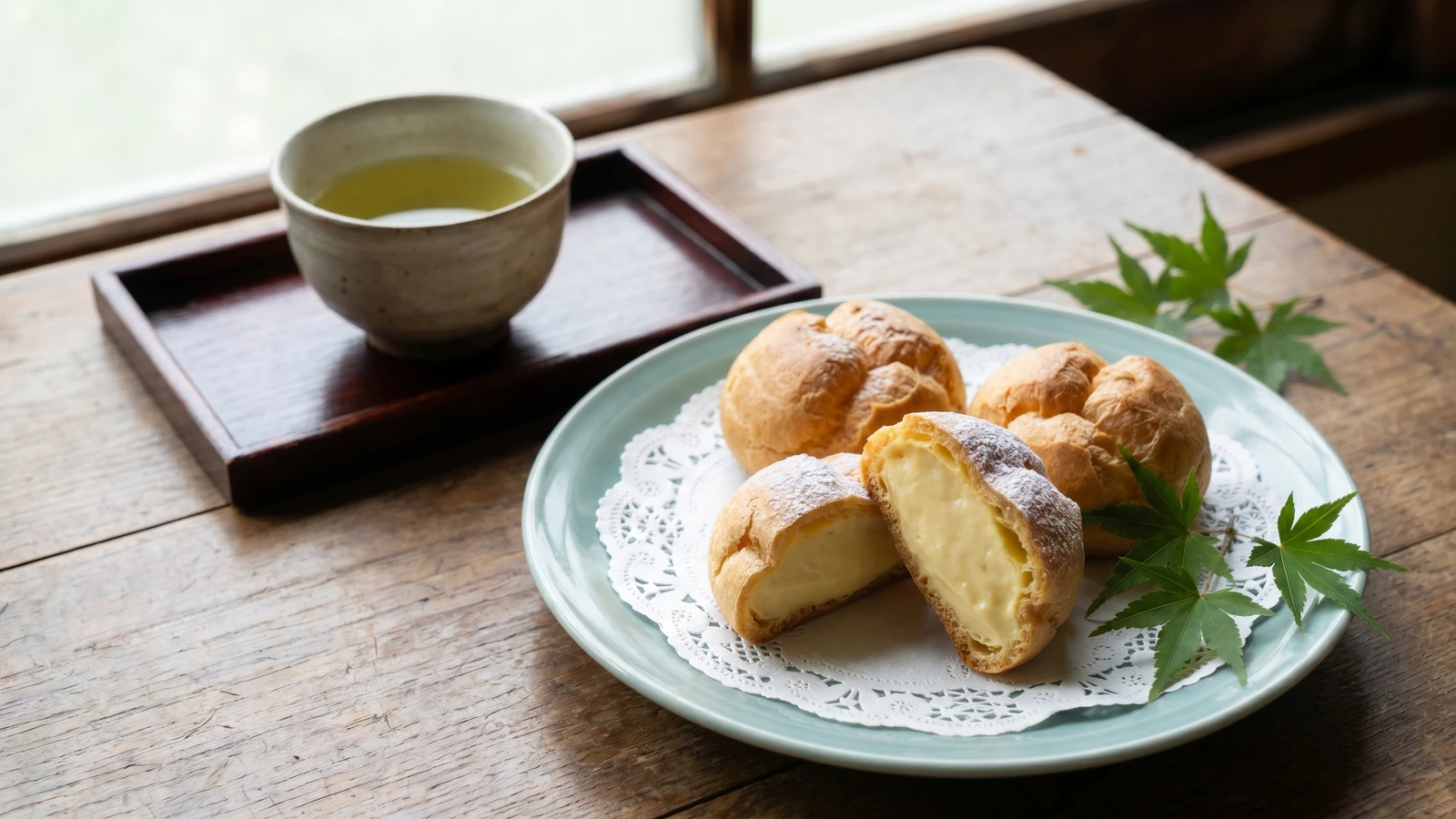
Shu cream is choux made calm: a dry dough, eggs worked in slowly, a hot oven, and a cool vanilla filling piped only when the shell can keep its crispness.
Shu cream looks like the pastry that will punish you for blinking. It won't. The shell rises because water trapped in the dough turns to steam, and the egg-rich paste stretches around it until the oven sets it in place. That hollow middle isn't magic. It's physics with better manners than usual.
The one detail that decides it is drying the dough before the eggs go in. Stir the flour over heat until the paste gathers, leaves a thin film on the pan, and loses its raw wet shine. Do that and the dough can accept egg without becoming batter. Skip it and the shells spread low and look offended. Eggs go in slowly, only until the dough falls from the spoon in a thick ribbon.
At the Japanese bakery counter, shu cream is yōgashi, a Western-style sweet that became ordinary enough to buy on the way home for tea. We keep the shell plain, the vanilla custard clean, and the filling hidden until the last moment. Pipe the cream into a completely cool shell. Warm pastry melts it, and a filled shell left waiting too long trades crispness for softness.
Serve one or two. Leave the plate room. This is comfort food, not architecture, and the best ones make no announcement beyond a dry shell giving way to cold custard.
Shu cream, or shūkurīmu, is the Japanese rendering of chou à la crème, and it entered Japan as yōgashi, Western-style confectionery, during the Meiji era. Hirota, founded in Osaka in 1924, built a business around small cream puffs and helped make the sweet an everyday bakery purchase rather than only a hotel confection. The Japanese name preserves the sound of chou rather than the English phrase cream puff, a small sign of how the sweet became local while keeping the trace of its route.
Quantity
60ml
Quantity
60ml
Quantity
50g
cut into small pieces
Quantity
1 teaspoon
Quantity
1/4 teaspoon
Quantity
75g
sifted
Quantity
2 to 3
beaten and at room temperature
Quantity
300ml
Quantity
1/2 bean or 1 teaspoon extract
Quantity
3
Quantity
65g
Quantity
25g
Quantity
15g
Quantity
1 pinch
Quantity
150ml
cold
Quantity
for dusting
| Ingredient | Quantity |
|---|---|
| whole milk, for the shells | 60ml |
| water | 60ml |
| unsalted butter, for the shellscut into small pieces | 50g |
| granulated sugar, for the shells | 1 teaspoon |
| fine sea salt, for the shells | 1/4 teaspoon |
| cake floursifted | 75g |
| large eggsbeaten and at room temperature | 2 to 3 |
| whole milk, for the custard | 300ml |
| vanilla bean or vanilla extract | 1/2 bean or 1 teaspoon extract |
| large egg yolks | 3 |
| granulated sugar, for the custard | 65g |
| cornstarch | 25g |
| unsalted butter, for the custard | 15g |
| fine sea salt, for the custard | 1 pinch |
| heavy creamcold | 150ml |
| powdered sugar (optional) | for dusting |
Put the 300ml milk and vanilla bean in a small saucepan and warm until tiny bubbles gather at the edge. Take it off the heat and let it stand for 10 minutes if using a bean. You're drawing the vanilla into the milk before the eggs arrive, so the custard tastes clean and even, not perfumed only in one corner.
Whisk the yolks and 65g sugar until the mixture lightens a little, then whisk in the cornstarch and salt. Sugar loosens the yolks and helps protect them from scrambling, while the starch gives the custard its body. A smooth paste now means a smooth filling later.
Whisk half the warm milk into the yolks, then pour everything back into the pan. Cook over medium heat, whisking constantly, until the custard thickens and slow bubbles break at the surface, about 2 minutes. Keep cooking for 30 seconds after it thickens. The starch must fully cook, or the custard will taste raw and loosen as it cools. Off the heat, whisk in the 15g butter and vanilla extract if using it.
Scrape the custard into a shallow bowl and press a piece of parchment or film directly on the surface. Chill until completely cold, at least 1 hour. The cover prevents a skin, and the cold matters: warm custard melts the cream and softens the shell before it ever reaches the table.
Heat the oven to 200C or 400F. Line a baking sheet with parchment and, if you like order, trace ten 4cm circles on the underside as a guide. Have the beaten eggs ready in a small bowl. Choux waits badly once the flour is cooked, so set the bench before you begin.
Combine the 60ml milk, 60ml water, 50g butter, 1 teaspoon sugar, and 1/4 teaspoon salt in a saucepan. Bring it to a full boil, with the butter completely melted. The boil disperses the fat through the liquid; if the flour goes in too soon, the paste cooks unevenly and the shells rise unevenly.
Add the sifted cake flour all at once and stir hard with a wooden spoon. Keep the pan over medium heat and cook the paste for 2 to 3 minutes, until it gathers into one smooth mass, pulls from the sides, and leaves a thin film on the bottom of the pan. This is the first secret. You're drying the dough so it can take in egg without becoming batter, and you're gelatinizing the flour so the shell can stretch around the steam in the oven.
Move the hot dough to a bowl and let it cool for 3 minutes, just so the eggs don't scramble. Beat in the eggs a little at a time, mixing fully after each addition. You may not need every drop. Stop when the dough is glossy and falls from the spoon in a thick V-shaped ribbon. Eggs give the dough stretch and structure, but too much egg turns it loose, and loose dough cannot climb.
Spoon the dough into a piping bag fitted with a plain round tip. Pipe ten mounds, each about 4cm wide, leaving space between them. Pat down any pointed tips with a wet fingertip so they don't scorch before the shell is cooked. A small, neat mound rises more evenly than a dramatic one. We are making shu cream, not a monument.
Bake at 200C or 400F for 15 minutes, then lower the oven to 180C or 350F and bake 18 to 22 minutes more. Do not open the oven until the shells are deeply golden and the cracks look dry. The heat must set the outside before the steam escapes from within. Open the door early and the half-set shell loses its lift.
Pierce each shell near the side with a skewer, then return them to the turned-off oven with the door cracked for 10 minutes. The small hole lets trapped moisture leave, which keeps the inside from turning damp. Move the shells to a rack and cool completely. A shell that is even a little warm will melt the filling and trade crispness for sog.
Whisk the chilled custard until smooth. In another bowl, whip the cold heavy cream to soft peaks, then fold it into the custard in two additions. Stop when the filling is smooth, pale, and pipeable. The cream lightens the custard, but it should still taste of egg, milk, and vanilla, with nothing hidden.
Cut a small slit in the side or base of each cooled shell and pipe in the custard cream just before serving, stopping when the puff feels full but not strained. Dust lightly with powdered sugar if you like. Fill late. The hollow shell was built to hold cream, but once it does, the clock starts, and the crisp edge begins to soften.
1 serving (about 85g)
Culinary guides, cultural storytelling, and the editorial depth that makes cooking meaningful.
Discover Culinary ExplorerChef Takumi
Arare begins as firm mochi, cut small and dried until patient enough to puff. Brush it with soy at the end, and the little hailstones turn crisp and savory.

Chef Takumi
Chocolate shu cream is judged twice: first by the hollow shell, then by the custard. Dry the dough properly, choose chocolate with backbone, and the little puff behaves.

Chef Takumi
Start with the lightest choux: tiny unfilled puffs, properly dried over heat, loosened with eggs, and baked until the shell lifts hollow under a coat of pearl sugar.

Chef Takumi
Zarame senbei is not a cookie wearing a Japanese coat. It is a rice cracker, dried well, baked crisp, brushed with soy, then caught while hot with coarse sugar.