
Chef Elsa
Dillfisolen
Tender Austrian green beans folded into a silky, dill-bright cream sauce built on a proper Einbrenn. The Gasthaus side dish that quietly steals the whole meal.
A cooking platform built around craft, culture, and the stories behind what we eat.
Created by
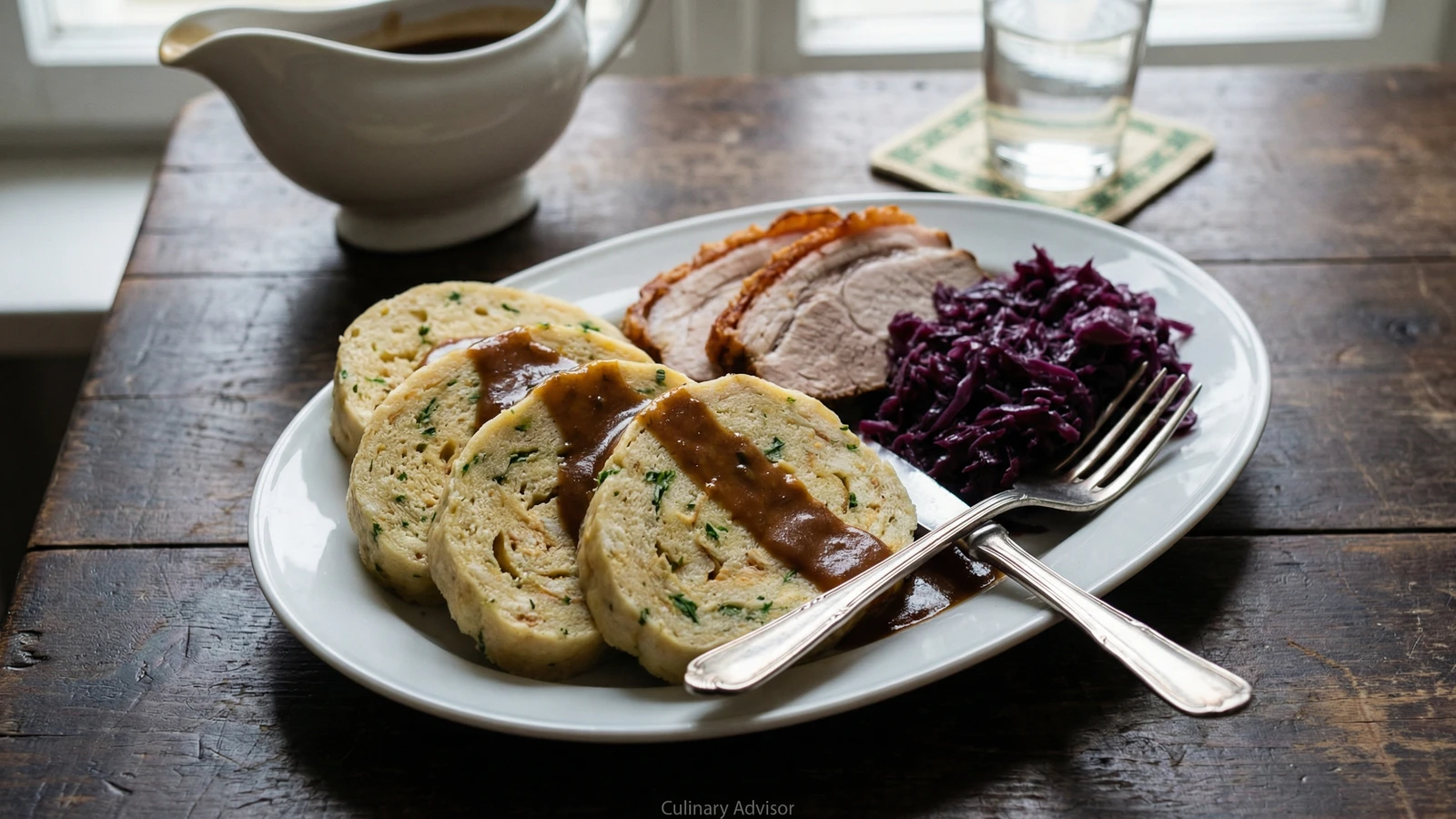
Bread dumpling dough rolled into a log, wrapped in cloth, and simmered until the slices come out pillowy and firm, ready to soak up every drop of roast gravy on the plate.
Gretel always said that the Knödel is the measure of an Austrian cook. Not the Strudel, not the Torte. The Knödel. Because Knödel are simple, and simple food has nowhere to hide.
Serviettenknödel are the version you make when you're feeding a table. Instead of shaping individual dumplings and watching over them like a nervous parent, you pack the dough into one long roll, wrap it in a cloth (the Serviette that gives the dish its name), and let the simmering water do the work. When it's done, you unwrap it and slice thick rounds that hold together beautifully, each one with a smooth, firm exterior and a soft, bread-pudding interior. They're the classic companion to Schweinsbraten, roast duck, or goose with Rotkraut, and they belong on that plate the way a frame belongs around a painting.
I remember watching my grandmother Eva make these for Christmas. She had a particular tea towel she always used, bleached white and worn thin from years of Knödel duty. She'd butter the cloth, shape the log, roll it tight, and tie the ends with the same string she used for every roast. The whole thing went into the pot and she didn't fuss with it for forty minutes. When she sliced it at the table, the rounds fell apart in neat, perfect discs and everyone reached for the gravy boat at once. That's what good Serviettenknödel do. They make the whole meal make sense.
Knödel sit at the crossroads of Austrian and Bohemian cooking, a tradition that stretches back centuries through the former Habsburg lands. The Serviettenknödel variation, wrapped and simmered in a napkin rather than shaped by hand, developed as a practical solution for feeding large households and Gasthaus dining rooms. In the Austrian provinces, bread Knödel were a way to use stale bread, a thrift tradition baked into the cuisine itself. Tyrolean and Salzburg kitchens claim the strongest Knödel traditions, with local variations adding Speck, spinach, or cheese to the same foundational bread dough.
Quantity
400g
cut into small cubes
Quantity
250ml
lukewarm
Quantity
3 large
Quantity
1 medium
finely diced
Quantity
40g
Quantity
3 tablespoons
finely chopped
Quantity
1/2 teaspoon
Quantity
pinch
freshly grated
Quantity
freshly ground, to taste
Quantity
2 tablespoons
| Ingredient | Quantity |
|---|---|
| stale Semmeln or white bread rollscut into small cubes | 400g |
| whole milklukewarm | 250ml |
| eggs | 3 large |
| onionfinely diced | 1 medium |
| unsalted butter | 40g |
| fresh flat-leaf parsleyfinely chopped | 3 tablespoons |
| salt | 1/2 teaspoon |
| nutmegfreshly grated | pinch |
| black pepper | freshly ground, to taste |
| plain flour (optional) | 2 tablespoons |
Place the bread cubes in a large bowl and pour the lukewarm milk over them. Toss gently so every piece gets some milk. Don't drown them. You want the bread to soften and absorb the liquid, not turn to porridge. Let this sit for fifteen minutes. If after that time some cubes still have dry centers, press them down lightly with your hands. The bread should feel damp and yielding throughout but still hold its shape when you squeeze a handful.
Melt the butter in a small pan over medium-low heat. Add the diced onion and cook slowly until it turns soft and translucent, about five minutes. You don't want any color here. Golden-brown onion would change the flavor of the Knödel entirely, pulling it toward a Speckknödel character when what you want is something clean and mild. Stir in the chopped parsley for the last thirty seconds, just long enough to release its scent. Set the pan aside to cool slightly.
Beat the eggs in a small bowl, then pour them over the soaked bread cubes along with the butter, onion, and parsley mixture. Add the salt, nutmeg, and a few grinds of pepper. Mix everything together with your hands. This is a hands job, not a spoon job. You need to feel whether the mixture is holding together. Squeeze and fold until it forms a cohesive, slightly sticky mass. If it feels too wet and won't hold its shape when you press it into a ball, add flour one tablespoon at a time. If it's too dry and crumbly, add a splash more milk. The dough should feel like wet sand that holds when you pack it.
Lay out a clean linen or cotton tea towel on your worktop. Brush or rub the center third generously with butter. This keeps the dough from sticking when you unwrap it later. Spoon the dough onto the buttered area and shape it with damp hands into a compact log about 25 centimeters long and 8 centimeters in diameter. Think of a thick rolling pin. Pack it firmly. Air pockets inside the log will become holes in your finished slices, and nobody wants a Knödel with a cave in the middle. Roll the cloth tightly around the log and tie both ends securely with kitchen string. It should look like a Christmas cracker.
Bring a large, wide pot of salted water to a gentle boil. Lower the wrapped Knödel into the water. It needs to be fully submerged, so choose your pot accordingly. If the log floats at first, weigh it down with a plate for the first few minutes until the bread swells and it sinks on its own. Reduce the heat to a lazy simmer. You want soft, steady bubbles, not a rolling boil. A hard boil will batter the cloth around and your Knödel will cook unevenly or, worse, break apart. Simmer for 35 to 40 minutes, turning it once halfway through.
Lift the Knödel out of the water and let it rest in the cloth for five minutes. The carry-over heat finishes the center while the outside firms up enough to slice cleanly. Unwrap carefully, the cloth will be hot, and use a sharp serrated knife or, better, a piece of taut sewing thread to cut thick rounds about two centimeters wide. Thread gives you the cleanest cut because it doesn't compress the bread the way a blade does. Loop the thread around the log, cross the ends, and pull. Each slice should hold together firmly with a soft, pillowy interior and a smooth surface ready to drink up gravy.
Arrange the slices overlapping slightly on a warm platter or next to your roast. Serviettenknödel exist to catch the sauce. Set them where the gravy can pool against the cut surfaces and let them do their work. These are best within minutes of slicing. If you're holding them, cover with a damp cloth in a low oven, but don't wait long. Mahlzeit!
1 serving (about 160g)
Culinary guides, cultural storytelling, and the editorial depth that makes cooking meaningful.
Discover Culinary ExplorerChef Elsa
Tender Austrian green beans folded into a silky, dill-bright cream sauce built on a proper Einbrenn. The Gasthaus side dish that quietly steals the whole meal.

Chef Elsa
Thin-sliced waxy potatoes layered with garlic-steeped cream and baked low and slow until the top turns golden brown and the kitchen smells like the kind of cooking that makes people wander in from the next room.

Chef Elsa
Silky Viennese mashed potatoes pressed through a ricer, enriched with cold butter and warm milk, finished with a whisper of nutmeg. The quiet side dish that makes the whole plate work.

Chef Elsa
Yesterday's boiled potatoes, coarsely grated and torn in a hot pan with too much butter until the edges go golden and crisp. Farmhouse cooking at its most honest, served straight from the skillet.