Culinary Explorer

A cooking platform built around craft, culture, and the stories behind what we eat.
Discover Culinary Explorer
Schwammerlsauce

Schwammerlsauce

Created by

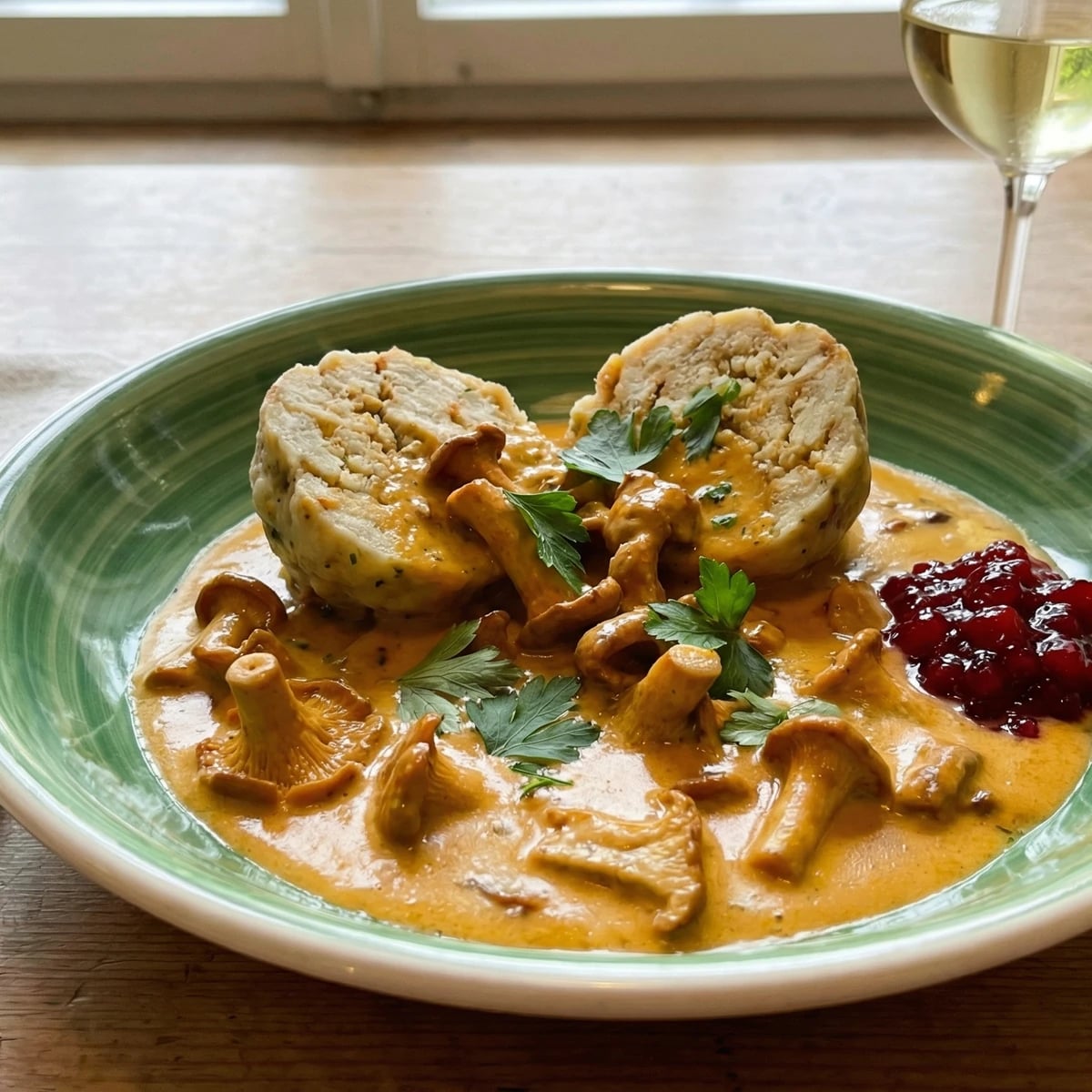
Golden chanterelles simmered in cream and white wine, ladled generously over Semmelknödel with Preiselbeeren on the side. This is what Austrians mean when they say good home cooking.

Sauces & Condiments
Austrian
Weeknight
Comfort Food
15 min
Active Time
20 min cook35 min total
Yield4 servings

Schwammerl is the Austrian word for mushrooms, and if you spend any time in the Alps between July and October you'll hear it constantly. At the Grünmarkt in Salzburg, the mushroom sellers arrive before dawn with crates of Eierschwammerl, the golden chanterelles that grow in the forests above the city. They smell like damp earth and apricots and something faintly peppery that you can't quite name. You buy as many as you can carry, because the season is short and once it's over, it's over.

Schwammerlsauce is what you do with those mushrooms when you want to feed people well without making a fuss. You cook them in butter until they give up their liquid, then you bring them back to life with a splash of white wine and a pour of cream. Parsley at the end. That's the whole recipe. It takes less than thirty minutes from cutting board to table, and when you ladle it over a plate of Semmelknödel (bread dumplings), it becomes one of the most satisfying things in the Austrian kitchen.

Gretel always said that Austrian cooking is simple food done well. Schwammerlsauce proves her right. There's nowhere to hide in a dish this straightforward. The mushrooms have to be good, the butter has to be real, and you have to let the pan do the work instead of crowding it. If you respect the ingredients and give them space, they'll reward you with a sauce that tastes like an autumn afternoon in the Salzkammergut.

Schwammerl (mushrooms) have been foraged in Austria's Alpine forests for centuries, and chanterelles, called Eierschwammerl in Austrian German, remain the most prized wild variety. Cream sauces paired with Knödel trace back to the peasant cooking traditions of Upper Austria and Salzburg, where bread dumplings were the staple that stretched a meal and soaked up whatever the forest and the cow provided. The pairing of Schwammerlsauce with Semmelknödel and a side of Preiselbeeren became a Gasthaus standard across the Alpine regions by the 19th century, a dish that sat comfortably on both farmhouse tables and bourgeois menus.

The technique, the tradition, and the story behind every dish.

Discover Culinary Explorer

Ingredients

fresh chanterelles (Eierschwammerl)

Quantity

500g

cleaned and torn or sliced

shallot

Quantity

1 medium

finely diced

garlic

Quantity

2 cloves

finely sliced

unsalted butter

Quantity

40g

dry white wine

Quantity

100ml

heavy cream (Schlagobers)

Quantity

250ml

beef or vegetable stock

Quantity

100ml

plain flour

Quantity

1 tablespoon

fresh flat-leaf parsley

Quantity

2 tablespoons

finely chopped

lemon juice

Quantity

1 teaspoon

salt

Quantity

to taste

white pepper

Quantity

to taste

freshly ground

nutmeg

Quantity

pinch

freshly grated

Semmelknödel (bread dumplings)

Quantity

for serving

Preiselbeeren (lingonberry compote)

Quantity

for serving

Equipment Needed

  • Wide heavy-bottomed pan or skillet (28cm)
  • Wooden spoon
  • Pastry brush for cleaning mushrooms

Instructions

  1. 1

    Clean the mushrooms

    Brush the chanterelles clean with a dry pastry brush or a damp cloth. Don't run them under water. Chanterelles are sponges and they'll soak up liquid, which means they'll stew in the pan instead of browning. If they're very dirty, rinse them quickly and spread them on a clean tea towel to dry completely before cooking. Tear larger ones in half along the grain. Leave small ones whole. You want irregular, natural shapes, not uniform slices.

    If fresh chanterelles aren't in season, use a mix of whatever fresh wild mushrooms look best at your market. Steinpilze (porcini), Pfifferlinge, or even good cremini will work. What won't work is the pre-sliced button mushrooms in a plastic tray. They have nothing to say in a sauce like this.
  2. 2

    Sear the mushrooms

    Melt half the butter in a wide, heavy pan over high heat. When the foam subsides and the butter smells nutty, add the mushrooms in a single layer. Don't touch them. This is the moment where most people lose their nerve and start stirring. Resist. The mushrooms need contact with the hot pan to brown, and stirring just releases their moisture too early. Let them sit for two minutes until golden on the underside, then toss once and cook another minute. They should be golden at the edges and smell like the forest floor on a warm day. Remove them to a plate.

    If your pan isn't big enough to hold all the mushrooms in one layer, do this in two batches. Crowded mushrooms release water and steam instead of browning. That grey, soggy result is the number one reason people think they don't like cooked mushrooms.
  3. 3

    Build the sauce base

    Lower the heat to medium. Add the remaining butter to the same pan. When it melts, add the diced shallot and a pinch of salt. Cook gently for three minutes until soft and translucent, not browned. Add the sliced garlic and stir for thirty seconds, just until fragrant. Sprinkle the flour over the shallots and stir it in. Cook for one minute, stirring constantly. The flour needs this minute to lose its raw taste. It's also what will give the sauce its body without making it gluey.

  4. 4

    Deglaze with wine

    Pour in the white wine all at once. It will hiss and bubble. Good. Scrape up any golden bits stuck to the bottom of the pan. Those bits are concentrated flavor. Let the wine reduce by half, about two minutes. You want the sharp alcohol smell to cook off, leaving behind a clean acidity that will balance the cream later. If you can find a Grüner Veltliner, use it. Austrian wine in an Austrian sauce makes sense.

  5. 5

    Add cream and stock

    Pour in the stock and the cream. Stir to combine and bring to a gentle simmer. Let it cook for five to six minutes, stirring occasionally, until the sauce thickens enough to coat the back of a wooden spoon. Draw your finger through the coating. If the line holds without running back together, the sauce is there. Don't rush this. Low heat, gentle bubbles. If you boil cream hard, it can break on you, and fixing a split sauce is no one's idea of a good evening.

  6. 6

    Finish and serve

    Return the mushrooms and any juices from the plate to the sauce. Stir gently and let everything warm through for one minute. Add the lemon juice, a grating of nutmeg, and the chopped parsley. Taste for salt and white pepper. The lemon juice won't make the sauce taste lemony. It lifts the cream and brightens the mushrooms. You'll miss it if it's not there. Ladle the sauce generously over Semmelknödel and set a spoonful of Preiselbeeren on the side of the plate. The tart lingonberries cut through the richness the way nothing else can. Mahlzeit!

Chef Tips

  • White pepper, not black. Viennese sauces use white pepper because it disappears into the cream instead of leaving dark specks. It also has a slightly different heat, sharper and more immediate, which suits a delicate sauce better than the slow burn of black pepper.
  • The nutmeg should be freshly grated and used with restraint. You want the barest whisper of it. If you can identify nutmeg as a distinct flavor in the finished sauce, you've used too much. It should just make you wonder why the cream tastes so good.
  • Don't skip the Preiselbeeren. That tart, fruity bite alongside the rich cream sauce is the whole point of the Austrian pairing. You can find lingonberry preserves at Scandinavian or specialty shops. A small jar lasts a long time and it belongs in your fridge if you cook Austrian food.
  • If you're making Semmelknödel to go with this, make them first and keep them warm in a low oven. The sauce comes together quickly and doesn't wait well, so you want the dumplings ready when the sauce is done.

Advance Preparation

  • The mushrooms can be cleaned and torn up to four hours ahead. Store them on a tray lined with paper towels in the fridge, uncovered.
  • The finished sauce can be made two hours ahead and gently reheated over low heat with a splash of stock if it thickens too much. Add the parsley only after reheating.

Frequently Asked Questions

Nutrition Information

1 serving (about 175g)

Calories
370 calories
Total Fat
31 g
Saturated Fat
19 g
Trans Fat
0 g
Unsaturated Fat
11 g
Cholesterol
105 mg
Sodium
580 mg
Total Carbohydrates
16 g
Dietary Fiber
5 g
Sugars
4 g
Protein
4 g

Note: Chef personas and recipes are created with AI assistance. Cook with care: follow safe food-handling practices, check doneness with a thermometer when needed, and adapt for allergies and your kitchen.

Where cooking meets culture.

Culinary guides, cultural storytelling, and the editorial depth that makes cooking meaningful.

Discover Culinary Explorer

More from Austrian Sauces & Condiments

Browse the full collection