
Chef Klaus
Badische Dinnele
The Baden flatbread that keeps its bread body: sour cream, onion, and Speck on a yeast dough baked hard and hot until the edges blister.
A cooking platform built around craft, culture, and the stories behind what we eat.
Created by
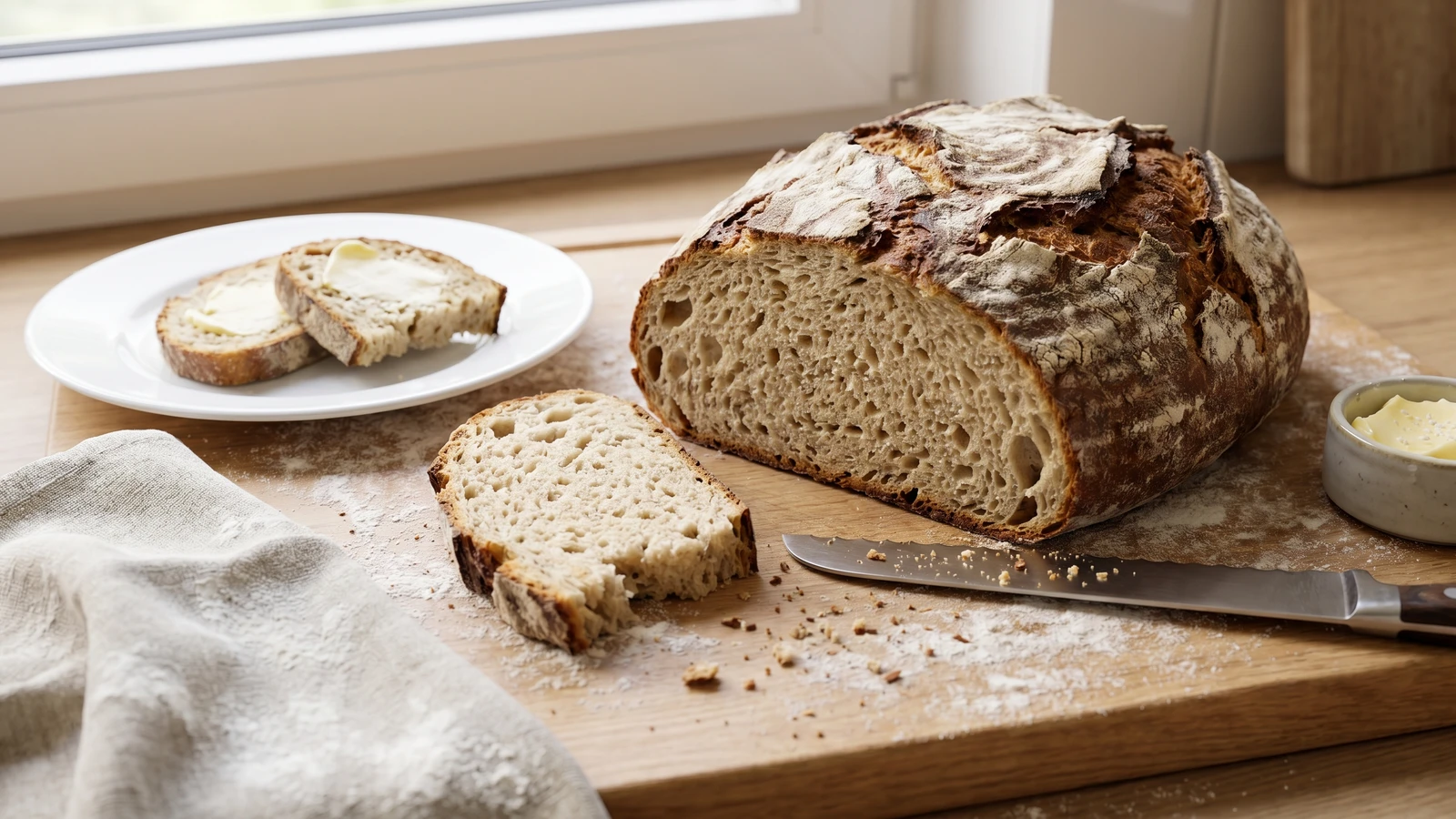
Swabia's country loaf off the Alb: wheat for lift, rye for sour depth, spelt for nutty softness, and wet hands doing the shaping before the oven finishes the crust.
Schwäbisches Landbrot belongs to the Swabian table the way a knife belongs beside it. Weeknight soup, Sunday cold cuts, a board of cheese, a smear of butter with radishes when the garden is kind. This is not a sweet white loaf and it's not a northern brick of rye. Im Norden anders, im Süden anders: the north leans darker and tighter with rye, while Swabia gives wheat the lead and lets rye and spelt bring sourness, keeping, and a little nutty softness.
The version from the Alb often comes close to Genetztes, the wet-shaped bread. I don't flour it into obedience. I wet my hands, fold the slack dough onto itself, and let the rough surface tear where it wants in the heat. That wet handling matters because extra bench flour dries the skin and tightens the crumb; water lets the dough seal without choking it. Erst verstehen, dann kochen.
The single technique that decides the loaf is fermentation, not decoration. The dough must rise until it is airy and alive but still strong enough to hold. Too young and it bakes dense, too far and it spreads like a tired pancake. Watch the dough, not the clock: bubbles at the edge, a soft wobble in the bowl, and a finger dent that fills back slowly.
Good bread is larder food. It uses the grains the region grows and it keeps well because the sourdough acids slow staling and give the rye something to hold onto. Das braucht seine Zeit. Cut it too warm and you smear the crumb you worked a day to build. Wait, then eat.
Swabian mixed-grain country breads grew from a region where wheat, rye, and spelt were all part of farm baking, especially around the Swabian Alb, where Dinkel, spelt, remained unusually important after it faded in many other German regions. The German bread ordinance tradition later classified such loaves by grain share, but village bakers had long worked more practically: enough wheat for lift, enough rye or sourdough for flavour and keeping, and spelt when the local field gave it. Genetztes Brot, wet-shaped bread, is especially associated with Swabia and southern Germany, where very soft doughs were handled with water rather than extra flour to keep the crumb open and the crust rugged.
Quantity
100g
100 percent hydration
Quantity
150g
for the levain
Quantity
150g
for the levain
Quantity
420g
Quantity
160g
Quantity
90g
Quantity
370g
for the final dough
Quantity
14g
Quantity
5g
Quantity
as needed
for wet shaping
| Ingredient | Quantity |
|---|---|
| active rye sourdough starter100 percent hydration | 100g |
| rye flour Type 1150 or medium rye flourfor the levain | 150g |
| lukewarm waterfor the levain | 150g |
| bread flour or wheat flour Type 1050 | 420g |
| spelt flour Type 1050 or whole spelt flour | 160g |
| rye flour Type 1150 or medium rye flour | 90g |
| lukewarm waterfor the final dough | 370g |
| fine sea salt | 14g |
| caraway seeds (optional) | 5g |
| waterfor wet shaping | as needed |
Mix the active rye starter with 150g rye flour and 150g lukewarm water until no dry flour remains. Cover it and leave it 10 to 12 hours at cool room temperature, until domed, fragrant, and just starting to sink at the centre. Use it at that point because the acid is developed and the yeasts are still lively; wait until it collapses flat and you've traded lift for sharpness.
Put the ripe levain in a large bowl with 370g lukewarm water and loosen it with your hand. Add the wheat flour, spelt flour, remaining rye flour, salt, and caraway if you're using it, then mix until you have a sticky, rough dough with no dry pockets. Don't chase smoothness yet. Rye and spelt both dislike bullying, and a short mix keeps the crumb from turning tight.
Cover the bowl and rest the dough for 30 minutes, then wet your hand and fold the dough over itself from all four sides. Rest 30 minutes and fold again. The rest lets flour hydrate so the dough strengthens without hard kneading; the folds build enough structure to hold the wet loaf while leaving the crumb open.
Cover the dough and leave it 3 to 4 hours at room temperature, folding once more after the first hour if it still slumps heavily. It is ready when it has risen by about half, shows bubbles along the bowl, and moves with a soft wobble. Watch that, not the clock. A sourdough bread that looks asleep will bake asleep.
Wet the work surface and your hands lightly, turn out the dough, and fold it into a round or long loaf with quick, firm movements. Use water, not a snowdrift of flour, because flour dries the skin and stops the rough tearing that marks a good Genetztes. Set the loaf seam-side down in a well-floured banneton or a towel-lined bowl, using rye flour or rice flour so it releases cleanly.
Cover the shaped loaf and refrigerate it 8 to 12 hours. The cold proof slows the yeast while the acids keep working, so the bread gains flavour and the wet dough firms enough to handle. In the morning it should look puffed but not blown out; press it gently and the dent should fill back slowly.
Put a Dutch oven, baking steel, or heavy baking stone in the oven and heat to 250C for at least 45 minutes. Bread needs stored heat underneath it, not just hot air around it; that first hard heat gives oven spring before the crust sets. Runter mit der Temperatur comes later.
Turn the cold loaf onto baking paper or a floured peel. Leave it unscored if you want the Swabian rough tear, or give one shallow slash if your proof is tight. Bake covered in the hot Dutch oven, or with strong initial moisture on a stone, for 20 minutes at 250C. The trapped moisture keeps the crust flexible long enough for the loaf to rise and split where the dough is weakest.
Remove the lid, lower the oven to 220C, and bake 25 to 30 minutes more, until the crust is deep brown, the torn edges are almost mahogany, and the loaf sounds hollow when tapped underneath. Dark is flavour here, pale is unfinished. If you use a thermometer, the centre should read about 96C.
Cool the loaf on a rack for at least 2 hours before slicing. The crumb is still setting while the loaf cools; cut it early and the knife drags starch into a gummy line. Weggeworfen wird nichts: stale slices become Brotchips, bread soup, or breadcrumbs for Frikadellen. Bread has a second life if you let it.
1 serving (about 100g)
Culinary guides, cultural storytelling, and the editorial depth that makes cooking meaningful.
Discover Culinary ExplorerChef Klaus
The Baden flatbread that keeps its bread body: sour cream, onion, and Speck on a yeast dough baked hard and hot until the edges blister.

Chef Klaus
The farmhouse loaf that made sense of a weekly oven firing: rye for keeping, wheat for lift, sourdough for the crumb, and a dark crust that earns its crack.

Chef Klaus
The Bavarian pretzel lives by its lye bath: a pale dough goes in, a dark glossy Breze comes out, with thin arms, a proud belly, and salt that bites clean.

Chef Klaus
A Bavarian wheat-rye loaf for the Brotzeit board, mild from ripe sourdough, dark-crusted from a fierce first heat, and firm enough to carry cold cuts without sagging.