
Chef Klaus
Allgäuer Krautkrapfen
The Allgäu pan dish that makes a meal from noodle dough, winter kraut, onion, and fat: brown the cut sides first, then cook gently so the rolls hold.
A cooking platform built around craft, culture, and the stories behind what we eat.
Created by
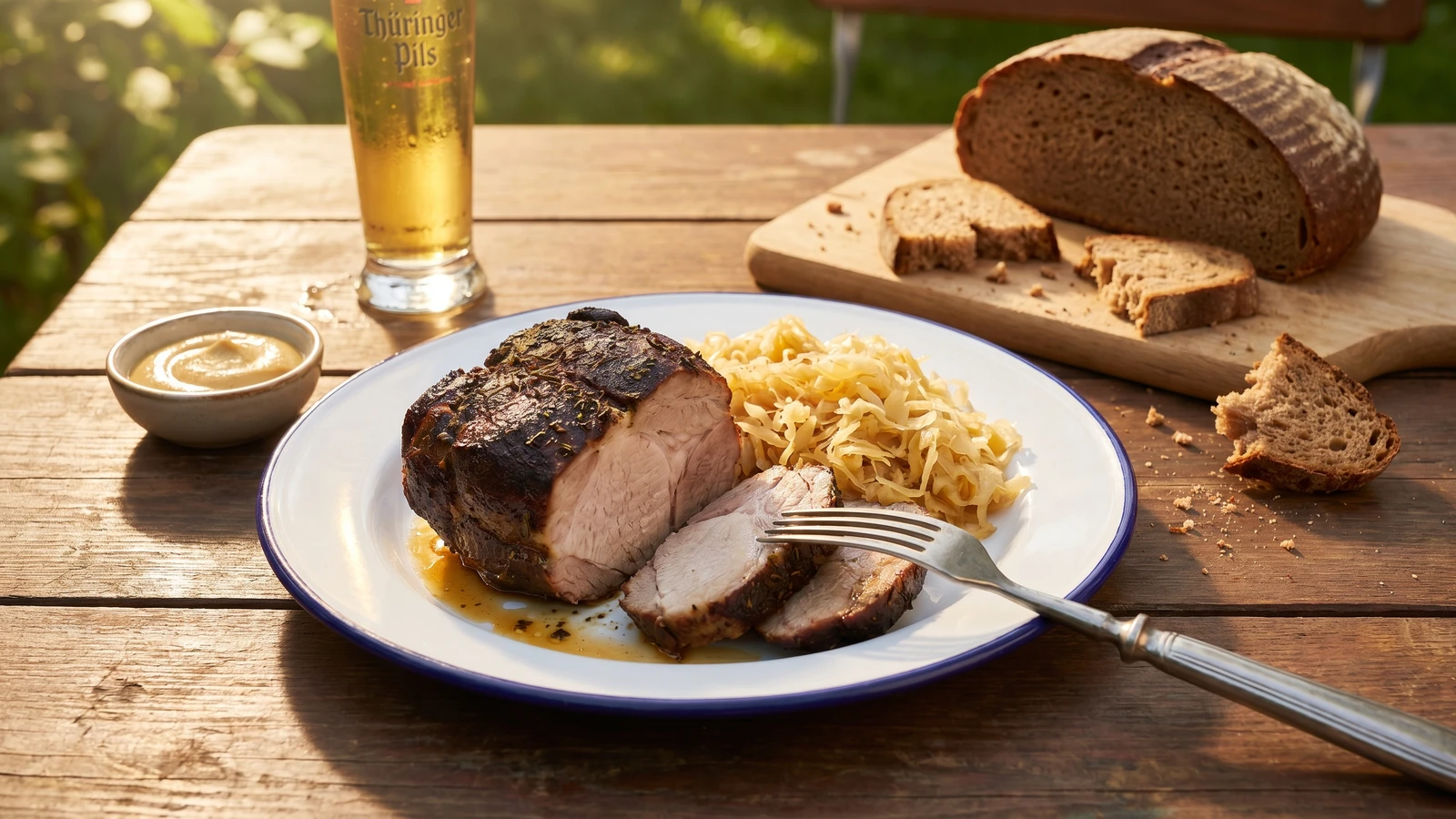
Fist-sized pork neck from Schmölln, rubbed with marjoram and turned slowly over birch embers until the fat softens through the meat. Bread, sauerkraut, mustard. The smoke is the sauce.
Schmöllner Mutzbraten is Ostthüringen on a skewer: fist-sized pork neck from Schmölln, salt, black pepper, marjoram, and birchwood embers. It belongs to town festivals, garden tables, club feasts, and the kind of Sunday when the food is outside because the fire needs room. This is no Bavarian roast with crackling and dark beer sauce. Das ist kein Bierzelt.
Im Norden anders, im Süden anders. In the north, pork often comes cured or smoked from the larder; in the south, the argument is crackling, caraway, and gravy. Around Schmölln and the Altenburger Land, the fight is narrower: pork neck or shoulder, birch or not, garlic or not. For Schmöllner Mutzbraten I keep it strict: neck, marjoram, birch, bread, sauerkraut, mustard.
The fire decides it. You don't grill this over flame. You turn it slowly above clean birch embers, close enough for the fat to gloss and drip, far enough that the marjoram doesn't burn black before the inside is done. Pork neck has fat seams for a reason; low steady heat melts them into the meat, high heat gives you a scorched cube with a tight center.
The sauerkraut is not decoration. It is the winter larder doing its job, acid against pork fat, with bread to catch the juices and mustard to finish the bite. No gravy from a jar, and no made-up sauce because the plate looks bare. Nicht aus dem Glas. Erst verstehen, dann kochen.
Schmöllner Mutzbraten is tied to Schmölln in the Altenburger Land of eastern Thuringia and is usually dated to the years around 1900, when local inns and butchers began selling fist-sized pork neck from a rotating Mutzbratenstand over birchwood. The protected local name narrows the method: pork neck, salt, pepper, marjoram, birchwood, and the standard plate of bread, sauerkraut, and mustard, while nearby East Thuringian and West Saxon cooks may add garlic, caraway, beer, or different wood. The surprise is how young the dish is by German standards; it is not medieval feast food, but a town-fair roast that turned an ordinary cut into local ceremony.
Quantity
1.8kg
cut into 6 fist-sized pieces
Quantity
18g
Quantity
2 tablespoons
rubbed between the fingers
Quantity
2 teaspoons
Quantity
1 tablespoon
Quantity
enough for 1.5 to 2 hours of steady embers
Quantity
1 tablespoon
Quantity
1
thinly sliced
Quantity
700g
lightly drained
Quantity
1
grated
Quantity
1
Quantity
4
lightly crushed
Quantity
1/2 teaspoon
Quantity
150ml
Quantity
6 thick slices
Quantity
to serve
| Ingredient | Quantity |
|---|---|
| boneless pork neck (Schweinekamm)cut into 6 fist-sized pieces | 1.8kg |
| fine sea salt | 18g |
| dried marjoramrubbed between the fingers | 2 tablespoons |
| freshly cracked black pepper | 2 teaspoons |
| neutral oil or melted lard (optional) | 1 tablespoon |
| untreated birch logs or birchwood chunks | enough for 1.5 to 2 hours of steady embers |
| lard for the sauerkraut | 1 tablespoon |
| onionthinly sliced | 1 |
| sauerkrautlightly drained | 700g |
| tart applegrated | 1 |
| bay leaf | 1 |
| juniper berrieslightly crushed | 4 |
| caraway seeds (optional) | 1/2 teaspoon |
| pork stock, apple juice, or water | 150ml |
| dark rye bread or crusty rolls | 6 thick slices |
| German mustard | to serve |
Cut the pork neck into 6 fist-sized pieces, each about 5 to 6cm thick and 220 to 300g, leaving the fat seams in place. Mix the salt, marjoram, and black pepper, then rub every surface well, pushing the seasoning into the folds. The size matters: small cubes dry out before the fat melts, and one large roast never gets enough birchwood character on the cut faces.
Cover the seasoned pork and refrigerate it at least 8 hours, up to 24. Salt first draws moisture to the surface and then pulls it back in, carrying the marjoram and pepper with it; rush this and the seasoning sits outside like dust. Bring the meat out 45 minutes before grilling, so the center is no longer refrigerator-cold when the outside starts browning.
Melt the lard in a pot and soften the onion until it turns glassy, not brown, because burnt onion fights the sour cabbage. Add the sauerkraut, grated apple, bay leaf, juniper, caraway if using, and stock, apple juice, or water. Cover and simmer 40 to 50 minutes, stirring now and then, until the cabbage is tender but still has bite. Keep the cooking liquor in the pot; it carries salt, acid, and fat. Weggeworfen wird nichts.
Light charcoal or small birch logs and wait until the flames have settled into steady embers. Set up a two-zone grill or a rotisserie fire at about 150 to 170C, with the meat sitting beside or above the heat rather than directly in a flare. Use untreated birch only; construction timber, painted wood, and resinous softwood taste bitter and don't belong near food. Flames burn marjoram before the fat has time to soften. Runter mit der Temperatur.
Thread the pork pieces onto a rotisserie spit or long metal skewers with a finger-width space between pieces, so heat can move around each one. If the pork is very lean, wipe it lightly with oil or melted lard, but don't make an oil marinade; this dish is seasoned meat, not wet meat. Set the skewers 20 to 30cm from the embers and start turning at once, because rotation bastes the pork with its own fat instead of letting one side blacken.
Cook the pork 75 to 105 minutes, turning every 5 to 8 minutes if you don't have a rotisserie. Keep the grill steady and add small amounts of fuel as needed; big changes in heat tighten the meat before the fat has done its work. The Mutzbraten is ready when the outside is dark brown with specks of marjoram, the fat seams look glossy, and the center reads 74 to 76C on an instant-read thermometer. If the edges blacken early, move the meat farther from the fire. If it stays pale after an hour, add a few fresh embers. Das braucht seine Zeit.
Rest the pork 10 to 15 minutes before cutting, because the juices need a moment to settle back into the meat. Slice each piece across the grain or serve it whole, as it would come from the stand. Put sauerkraut, rye bread or rolls, and mustard beside it. Stir any juices from the board into the kraut, not down the sink. No gravy. The smoke is the sauce, and Schön ist, was schmeckt.
1 serving (about 420g)
Culinary guides, cultural storytelling, and the editorial depth that makes cooking meaningful.
Discover Culinary ExplorerChef Klaus
The Allgäu pan dish that makes a meal from noodle dough, winter kraut, onion, and fat: brown the cut sides first, then cook gently so the rolls hold.

Chef Klaus
Swabian egg pasta turned toward the apple cellar: fresh Spätzle tossed with browned butter, tart apples, cinnamon, and enough restraint to stay supper, not cake.

Chef Klaus
Hesse's pork goulash belongs to Apfelwein country: shoulder, onions, and tart cider cooked low until the cheap cut turns soft and the sauce lands sweet-sour, not sour-sweet.

Chef Klaus
The old sweet supper that saves yesterday's loaf: stale bread drinks eggy milk, the pan stays moderate, and butter browns the outside only after the centre has set.