
Chef Elsa
Eiersalat (Austrian Egg Salad)
Cool, creamy Austrian egg salad with sour gherkins and tart apple in a mustard-yogurt dressing, the kind of honest Jause food that tastes like an Austrian Easter table and works beautifully all year round.
A cooking platform built around craft, culture, and the stories behind what we eat.
Created by
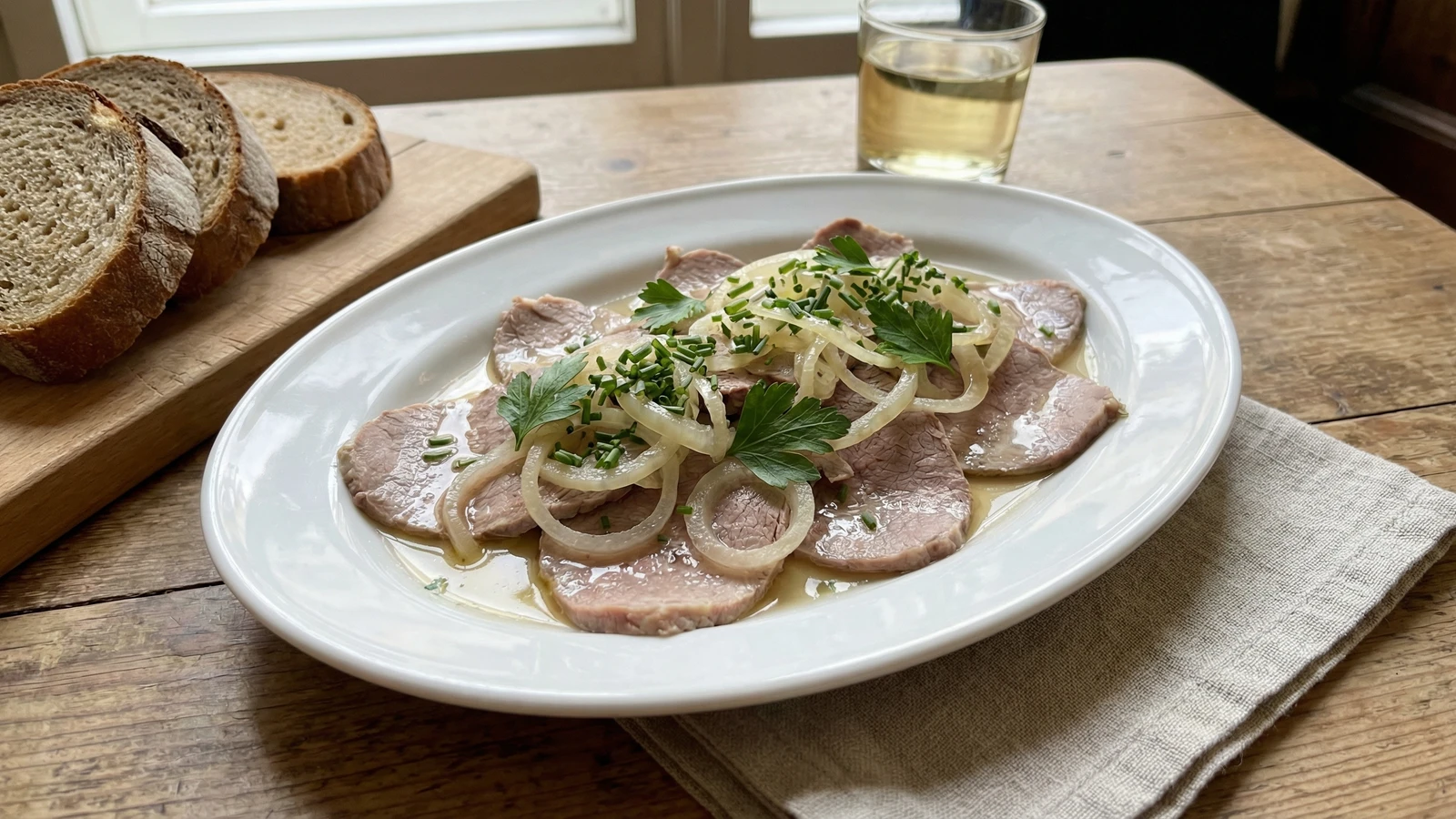
Cold boiled beef sliced thin and marinated overnight in sharp vinegar, sweet onion rings, and a slick of good oil. The Austrian grandmother's answer to what to do with yesterday's Tafelspitz.
In my grandmother Eva's kitchen in Kent, nothing was ever wasted. When Gretel came over and they made Tafelspitz together, the broth became Frittatensuppe, the marrow went on toast with coarse salt, and whatever beef was left over went into the fridge under a clean tea towel. The next day, that cold beef became Saures Rindfleisch. Gretel always said this was the dish that proved Austrian cooks understood thrift better than anyone. Not thrift as deprivation. Thrift as intelligence.
You slice the cold boiled beef thin, against the grain, and lay it in a shallow dish. Then you build a Marinade over it: sharp vinegar, thinly sliced onion rings, a good pour of oil, salt, pepper, and a little mustard if you like. The whole thing sits in the fridge for at least a few hours, better overnight. The vinegar softens the beef and the onions lose their bite, and by the time you bring it to the table the flavors have married into something tangy, savoury, and completely satisfying.
This is not a recipe you plan from scratch. It's a recipe that exists because you already made something else. That's what I love about it. Saures Rindfleisch belongs to a way of cooking where every meal sets up the next one, where the pot of Tafelspitz on Sunday becomes Monday's cold salad and nobody feels like they're eating leftovers. They feel like they're eating something that was always meant to happen.
Saures Rindfleisch is part of a broader Austrian tradition of Saure Salate (vinegar-dressed salads) that developed as preservation and thrift techniques in the days before refrigeration. The dish is closely tied to the Viennese Beisl, the casual neighbourhood tavern where cold platters of marinated meats, sausages, and salads have been served alongside beer and wine since the 18th century. In many traditional Beisln, Saures Rindfleisch appears alongside Wurstsalat and Liptauer on the Kalte Platte, the cold appetizer board that defines informal Viennese eating.
Quantity
500g
sliced thin against the grain
Quantity
2 medium
sliced into thin rings
Quantity
6 tablespoons
Quantity
4 tablespoons
Quantity
1 teaspoon
Quantity
100ml
Quantity
1 teaspoon
Quantity
to taste
Quantity
to taste
Quantity
1 tablespoon
finely cut
Quantity
1 tablespoon
chopped
Quantity
for serving
| Ingredient | Quantity |
|---|---|
| cold leftover boiled beef (Tafelspitz)sliced thin against the grain | 500g |
| onionssliced into thin rings | 2 medium |
| Apfelessig (apple cider vinegar) or Hesperidenessig | 6 tablespoons |
| neutral oil (sunflower or rapeseed) | 4 tablespoons |
| sharp mustard (Kremser Senf or Dijon) | 1 teaspoon |
| warm beef broth | 100ml |
| granulated sugar | 1 teaspoon |
| salt | to taste |
| freshly ground black pepper | to taste |
| fresh chivesfinely cut | 1 tablespoon |
| fresh flat-leaf parsleychopped | 1 tablespoon |
| crusty bread | for serving |
Take your cold boiled beef straight from the fridge. It slices cleanest when it's properly cold. Cut against the grain into slices about three to four millimeters thick. You want them thin enough to absorb the Marinade but not so thin they fall apart. If the beef was a good Tafelspitz, you'll see the grain running in clear lines. Cut perpendicular to those lines. Arrange the slices in a single layer in a wide, shallow dish. They should overlap slightly, like tiles on a roof.
Peel the onions and slice them into thin rings, about two millimeters thick. Separate the rings with your fingers and scatter them evenly over the beef slices. Use plenty. The onions are not a garnish. They are half the salad. Raw now, they'll soften and mellow in the vinegar over the next few hours until they're sweet, silky, and completely different from what you put in.
In a small bowl, whisk together the vinegar, oil, mustard, warm beef broth, sugar, a generous pinch of salt, and several grinds of black pepper. The Marinade should taste sharp and assertive on its own. It needs to be vinegar-forward, not oily. If it tastes balanced in the bowl, it will taste flat on the beef. The warm broth is important here: it helps the vinegar and oil come together into a proper emulsion and carries flavor into the meat more quickly than a cold dressing would.
Pour the Marinade evenly over the beef and onions. It should pool around the edges and coat every slice. Gently press the onion rings down into the liquid so they're submerged. Cover the dish tightly with cling film or a plate and refrigerate for at least four hours. Overnight is better. Much better. The beef needs time to drink in the vinegar, and the onions need time to give up their harshness. Patience is the only technique this dish asks of you.
Take the dish out of the fridge about fifteen minutes before serving. You want it cool, not ice-cold. Taste a slice of the beef and a piece of onion. If the Marinade has gone flat overnight, add a splash more vinegar and a pinch of salt. It should still taste bright and tangy. Arrange the beef and onions on plates or in a shallow bowl, spooning the Marinade over the top. Scatter the fresh chives and parsley across the surface. Serve with thick slices of crusty bread for soaking up the juices. Mahlzeit!
1 serving (about 265g)
Culinary guides, cultural storytelling, and the editorial depth that makes cooking meaningful.
Discover Culinary ExplorerChef Elsa
Cool, creamy Austrian egg salad with sour gherkins and tart apple in a mustard-yogurt dressing, the kind of honest Jause food that tastes like an Austrian Easter table and works beautifully all year round.

Chef Elsa
Bitter curly endive wilted just so by a warm dressing of rendered Speck, sharp vinegar, and a touch of mustard, the kind of salad that makes a roast pork dinner feel complete.

Chef Elsa
Warm broth-soaked potatoes and crispy Speck over tender Vogerlsalat, finished with a drizzle of dark Steirisches Kürbiskernöl and a soft-boiled egg that ties the whole bowl together.

Chef Elsa
Tender Austrian green beans dressed in warm Marinade the moment they leave the pot, absorbing every drop of vinegar and oil while they cool into something far greater than the sum of their parts.