
Chef Juliana
Baião de Dois com Carne de Sol e Queijo Coalho
You think this is Nordeste magic. It's not. It's rice, beans, carne de sol, queijo coalho, and a pot taught in the right order.
A cooking platform built around craft, culture, and the stories behind what we eat.
Created by
You think offal means trouble. Good, let's teach it properly: clean it, season hard, build a real refogado, and simmer until the molho turns dark, glossy, and ready for rice.
You see pork blood and kidneys on a list and hear isso não é pra mim before the pan is even on. I hear you. A gente was taught to respect the expensive cuts and act suspicious of the parts our grandparents knew how to cook, which is a very silly arrangement. Cozinhar não é dom, é um aprendizado, and sarapatel is learnable the same way rice is learnable: one plain step after another.
I won't pretend this is my childhood São Paulo counter. This dish belongs strongly to Nordeste tables, especially the people who know how to turn a slaughter day into dinner without wasting the animal. That is not backward poverty food. It is scarcity-driven intelligence, respect, and arithmetic: use what you have, season it hard, stretch it honestly, feed more people. A home cook can learn from that without pretending to own it.
The method is what makes the fear go quiet. You blanch the offal with vinegar so the smell calms down and the pieces firm up. You brown in batches so the pan builds color instead of filling with grey liquid. You make a real refogado with onion, garlic, peppers, tomato, and good fat, because flavor starts in the pot, not in a packet. Then the blood goes in carefully, tempered with hot broth, and the molho turns dark and glossy instead of clumpy.
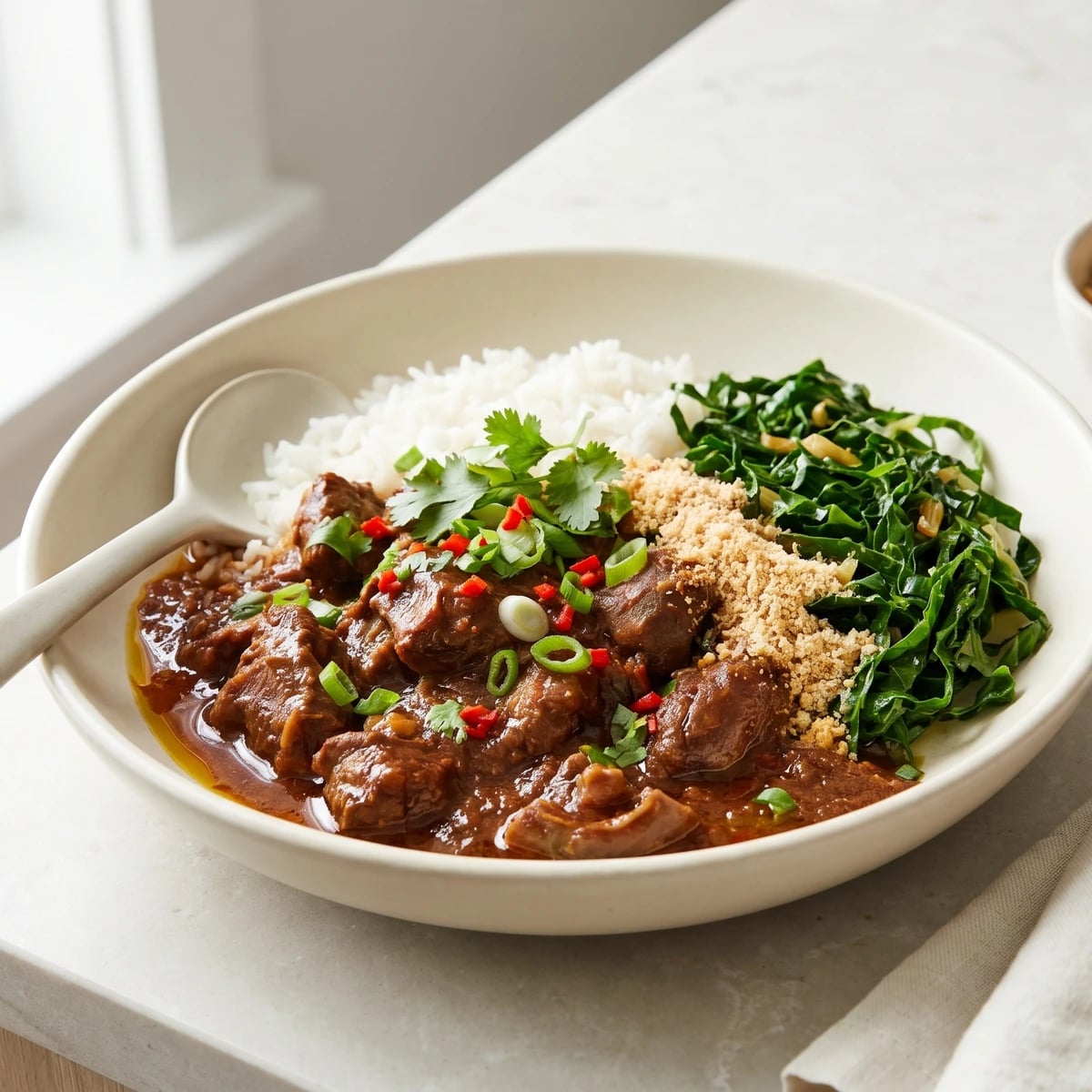
Serve it as a pê-efe with arroz soltinho, feijão caseiro, couve, and farofa, and suddenly the strange thing on the list is just dinner with character. Comida de verdade can ask something of you. That's allowed. By the end, you'll know what you're looking for, what you're smelling, and why the pot works.
Sarapatel is related to Portuguese offal-and-blood stews such as sarrabulho, but in Brazil it took deep root in the Nordeste, especially in Pernambuco, Bahia, Alagoas, and Ceará, with vinegar, peppers, cilantro, and a darker, sharper molho. It is often tied to pig slaughter and to aproveitamento integral: blood, liver, heart, kidneys, and other parts are cooked into one pot so almost nothing is wasted. Versions shift by state and by house, with pork common in one place and goat or lamb in another, and the sertanejos who carry those kitchens are the ones to trust on the finer points.
Quantity
2 pounds (900 g)
very fresh, cleaned, and cut into 1/2-inch pieces; use heart, liver, kidney, spleen, lung, or tongue
Quantity
1 cup
kept cold and mixed with 3 tablespoons white vinegar; or use 1 cup cooked pork blood, crumbled
Quantity
8 cups
for blanching
Quantity
1/2 cup
divided
Quantity
3 tablespoons
divided
Quantity
6 cloves
minced and divided
Quantity
2 teaspoons, plus more to taste
Quantity
2 teaspoons
divided
Quantity
1 teaspoon
Quantity
1 teaspoon
Quantity
1 to 2
minced
Quantity
2 medium
finely chopped
Quantity
1 medium
finely chopped
Quantity
2 medium
chopped
Quantity
2
Quantity
2 cups, plus more as needed
Quantity
1/2 cup
chopped
Quantity
1/4 cup
sliced
Quantity
2 tablespoons
chopped
Quantity
1 tablespoon
to finish
Quantity
4 cups
for serving
Quantity
4 cups
for serving
Quantity
3 cups
for serving
Quantity
1 cup
for serving
| Ingredient | Quantity |
|---|---|
| mixed pork offalvery fresh, cleaned, and cut into 1/2-inch pieces; use heart, liver, kidney, spleen, lung, or tongue | 2 pounds (900 g) |
| food-grade pork bloodkept cold and mixed with 3 tablespoons white vinegar; or use 1 cup cooked pork blood, crumbled | 1 cup |
| waterfor blanching | 8 cups |
| white vinegardivided | 1/2 cup |
| lard or neutral oildivided | 3 tablespoons |
| garlicminced and divided | 6 cloves |
| fine salt | 2 teaspoons, plus more to taste |
| colorau or annatto powderdivided | 2 teaspoons |
| ground cumin | 1 teaspoon |
| freshly ground black pepper | 1 teaspoon |
| malagueta or dedo-de-moça chilesminced | 1 to 2 |
| onionsfinely chopped | 2 medium |
| green bell pepperfinely chopped | 1 medium |
| tomatoeschopped | 2 medium |
| bay leaves | 2 |
| water or unsalted pork stock | 2 cups, plus more as needed |
| cilantrochopped | 1/2 cup |
| scallionssliced | 1/4 cup |
| fresh mint (optional)chopped | 2 tablespoons |
| white vinegar or lime juiceto finish | 1 tablespoon |
| cooked arroz brancofor serving | 4 cups |
| cooked feijão caseirofor serving | 4 cups |
| couve refogadafor serving | 3 cups |
| farofafor serving | 1 cup |
Buy the offal from a butcher you trust, as fresh as possible, and keep it cold until you cook. Ask for a mix of heart, liver, kidney, spleen, lung, or tongue, already cleaned and chopped if they'll do it. Ask for food-grade pork blood kept refrigerated and mixed with vinegar, or cooked pork blood. If the blood is not food-grade and cold, leave it. A recipe is not worth a risky pot.
Put the offal, except the liver if it is separate, in a 5-liter pot with 8 cups water and 1/4 cup vinegar. Bring to a boil and cook 5 minutes, until grey foam rises and the pieces tighten. Drain and rinse quickly. This is not to wash away flavor; it calms the strong smell and gives you clean pieces that brown better. If your liver is separate, blanch it for 1 minute only or hold it raw for the final simmer.
When the pieces are cool enough to handle, cut them into 1/2-inch pieces. Toss them with the remaining 1/4 cup vinegar, 3 minced garlic cloves, 1 teaspoon salt, 1 teaspoon colorau, cumin, black pepper, and the chopped chiles. Rest 20 minutes while you chop the onions, pepper, tomato, and herbs. The acid wakes the flavor and tames the edge, but don't leave liver in vinegar all afternoon or it turns chalky.
Lift the seasoned offal from the bowl with a slotted spoon and save the liquid in the bowl. Warm 2 tablespoons lard or oil in the pot over medium-high heat. Brown the pieces in 2 or 3 batches, 3 to 4 minutes per batch, until the edges take dark spots and the pot smells savory instead of sharp. Don't crowd the pan. Too much meat at once drops the heat, the pieces release water, and you steam them grey instead of dourar them properly.
Drop the heat to medium. Add the remaining 1 tablespoon fat, the onions, bell pepper, and a pinch of salt to the same pot. Cook 7 to 8 minutes, scraping the brown bits, until the onion is soft and the pepper has murchado. Add the tomatoes and cook until they collapse and the oil shines around the edges, about 5 minutes. Add the remaining 3 minced garlic cloves, bay leaves, and remaining 1 teaspoon colorau, and stir 1 minute, just until the garlic smells sweet. Burnt garlic is bitter and bossy.
Return the browned offal and any juices to the pot. Pour in the saved seasoning liquid and 2 cups water or unsalted pork stock. Bring to a boil, then lower to a steady simmer with the lid slightly open. Cook 1 to 1 1/2 hours, stirring now and then, until the heart and kidney pieces are tender enough to cut with a spoon and the vinegar has softened into the sauce. If the pot looks dry before the pieces are tender, add water 1/2 cup at a time. If you held liver back, add it during the last 25 minutes.
Scoop 1/2 cup hot broth from the pot into a bowl. Whisk in the fresh blood, then pour it slowly back into the pot while stirring. If the blood has clots, press it through a fine sieve first. If you're using cooked pork blood, crumble it straight into the pot instead. Simmer gently 20 to 25 minutes, until the molho darkens, thickens, and coats a spoon. Tempering keeps the blood from seizing into rubbery clumps, and the full simmer cooks it through.
Stir in the cilantro, scallions, mint if using, and 1 tablespoon vinegar or lime juice. Taste for salt, pepper, and acid. The stew should be rich first, then sharp enough to make you want the next spoonful. Rest 10 minutes off the heat. The molho thickens, the seasoning settles down, and the pot stops shouting.
Spoon the sarapatel over or beside arroz branco soltinho, with feijão caseiro, couve refogada, and farofa. If beans are part of tonight's plate, soak them ahead so they cook evenly and sit easier; finish them with a refogado and mash one ladle of cooked beans back into the pot so the caldo turns creamy instead of watery. Rice catches the molho, beans steady the plate, couve cuts the richness, and farofa brings the dry crunch. That's dinner solved, not a performance.
1 serving (about 690g)
Culinary guides, cultural storytelling, and the editorial depth that makes cooking meaningful.
Discover Culinary Explorer
Chef Juliana
You think this is Nordeste magic. It's not. It's rice, beans, carne de sol, queijo coalho, and a pot taught in the right order.

Chef Juliana
You think roast goat is for someone else's kitchen. It's not. Marinate it overnight, roast it low and patient, and let macaxeira catch the pingo like it was born for the job.

Chef Juliana
You think goat stew belongs to somebody else's kitchen. It doesn't. Brown the pieces well, build a proper refogado, and let time do the tenderness while you make rice and beans.

Chef Juliana
You think this is the dish for someone else. It isn't. Clean it well, season it hard, cook it slow, and serve it with rice, beans, and something green.