
Chef Lupita
Acitrón de Cidra Conventual
Puebla's convent-style acitrón, made from cidra peel instead of endangered biznaga, built through repeated syrup soakings until the cubes turn firm, translucent, and ready for rosca or chiles en nogada.
A cooking platform built around craft, culture, and the stories behind what we eat.
Created by
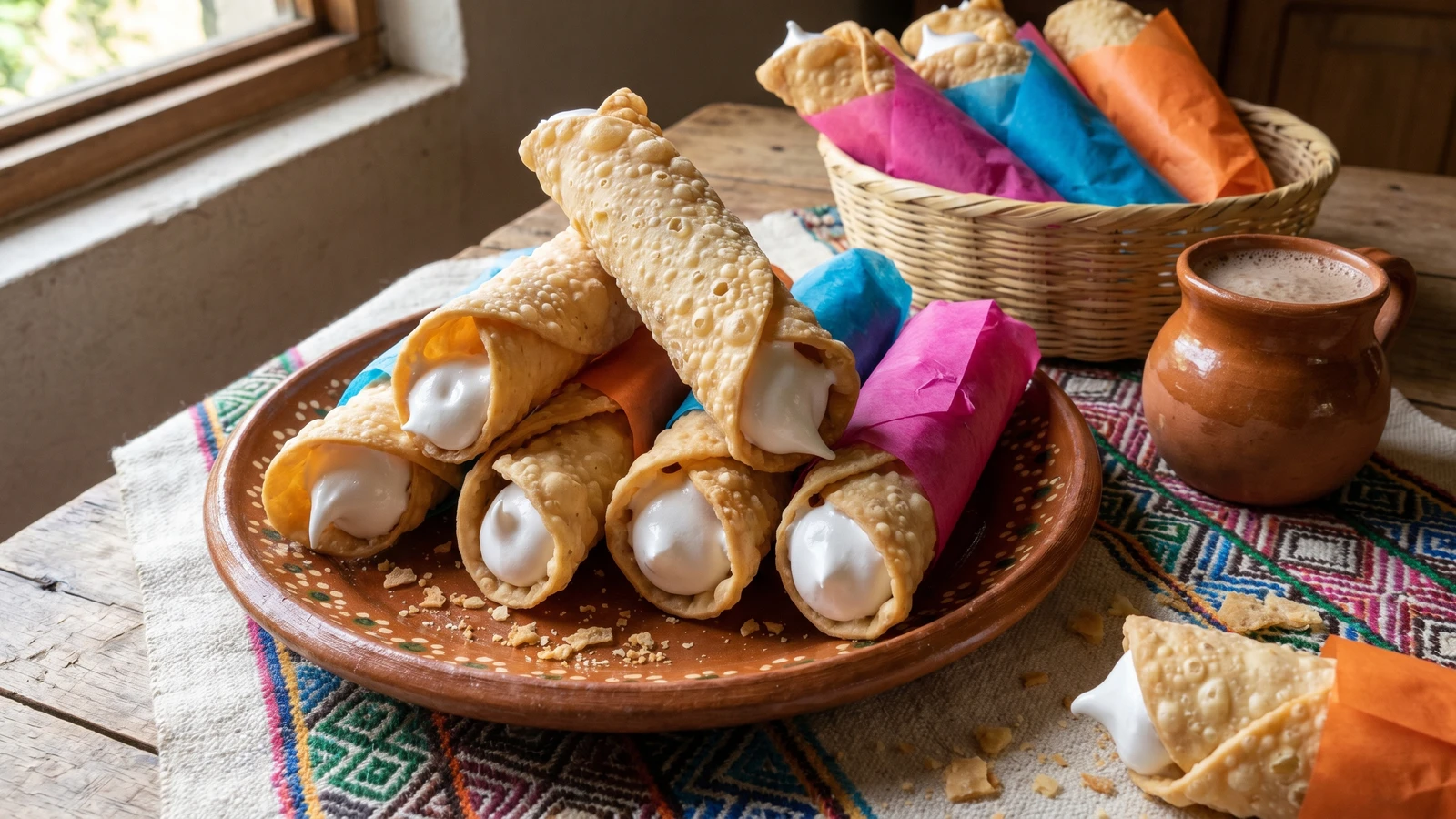
Chiapas highland gaznates, fried pastry cylinders from San Cristobal de las Casas, filled with sweet white meringue and sold wrapped in colored paper at coleto bazaars.
Chiapas, Los Altos, San Cristobal de las Casas. That is where these gaznates belong. Not in a fine pastry case. Not under a glass dome with tweezers nearby. They belong in dulceria baskets, wrapped in colored paper, stacked for feast days, school bazaars, and family visits when someone arrives with sweets instead of empty hands.
The pastry is thin wheat dough fried around a metal tube until it turns pale gold and brittle. Then it is filled with white meringue, sweet, airy, and direct. The trick is not decoration. The trick is control: dough thin enough to crack under your teeth, oil hot enough to blister the surface without soaking it, meringue firm enough to hold inside the tube without weeping all over your tray. La cocina no es decoracion, es trabajo.
I first wrote this version after talking with dulceras in San Cristobal who measured with their hands and judged the dough by the way it stretched over the tube. One señora told me, 'si se rompe, le falta descanso.' If it tears, it needs rest. She was right. You cannot bully wheat dough into obedience. You rest it, roll it thin, fry it clean, fill it the same day. Asi se hace y punto.
Gaznates belong to the Mexican family of fried wheat sweets that expanded during the colonial period, when Spanish convent pastry techniques met local feast-day markets. In Chiapas, especially San Cristobal de las Casas, the sweet became part of the coleto dulceria tradition alongside nuégados, suspiros, chimbo, turuletes, and fruit preserves sold for religious celebrations and civic bazaars. The name 'gaznate' means throat or gullet in Spanish, a blunt little joke about the pastry's hollow tube shape.
Quantity
2 cups, plus more for rolling
Quantity
2 tablespoons
Quantity
1/2 teaspoon
Quantity
2 tablespoons
softened
Quantity
2
Quantity
1/2 cup, plus more as needed
Quantity
1 teaspoon
Quantity
as needed
for frying
Quantity
3
at room temperature
Quantity
1 cup
Quantity
1/4 cup
Quantity
1 tablespoon
Quantity
1/4 teaspoon
Quantity
1 teaspoon
| Ingredient | Quantity |
|---|---|
| all-purpose flour | 2 cups, plus more for rolling |
| granulated sugar | 2 tablespoons |
| fine sea salt | 1/2 teaspoon |
| manteca de cerdosoftened | 2 tablespoons |
| large egg yolks | 2 |
| warm water | 1/2 cup, plus more as needed |
| aguardiente, rum, or cane liquor | 1 teaspoon |
| vegetable oil or fresh manteca de cerdofor frying | as needed |
| large egg whitesat room temperature | 3 |
| granulated sugar | 1 cup |
| water | 1/4 cup |
| fresh lime juice | 1 tablespoon |
| cream of tartar | 1/4 teaspoon |
| Mexican vanilla extract | 1 teaspoon |
Whisk the flour, sugar, and salt in a bowl. Rub in the manteca de cerdo with your fingertips until the flour feels sandy. Add the egg yolks, warm water, and aguardiente. Mix until a firm dough forms. If dry flour remains at the bottom, add water one teaspoon at a time. The dough should feel smooth and tight, not sticky.
Knead the dough on the counter for 6 to 8 minutes, until it becomes elastic and stops cracking at the edges. Cover with a clean cloth and rest for 30 minutes. Do not skip the rest. Wheat dough needs time to relax or it will shrink back while you roll it. No me vengas con atajos.
Divide the dough into 18 pieces. Roll each piece on a lightly floured surface into a thin oval, about 5 by 4 inches. You should almost see the shadow of your hand through it. Thick dough gives you a heavy tube. Gaznates should be brittle outside, airy inside, and light enough to eat before you realize you have eaten three.
Lightly oil metal cannoli tubes or smooth wooden dowels made for frying. Wrap one dough oval around each tube, overlapping the edges by 1/2 inch. Brush the seam with a little water and press firmly so it seals. Leave the tube ends open. The oil must reach inside and crisp the pastry cleanly.
Heat 2 inches of oil or fresh manteca de cerdo in a heavy pot to 350F. Fry 3 or 4 wrapped tubes at a time, turning often, until pale gold with small blisters across the surface, 2 to 3 minutes. Do not brown them like churros. Gaznates from San Cristobal stay light. Drain on a rack, then slide the pastry shells off the tubes while still warm enough to release.
Combine the sugar, water, and lime juice in a small saucepan. Cook over medium heat without stirring until the syrup reaches 240F, the soft-ball stage. If you do not have a thermometer, drop a little syrup into cold water. It should form a soft ball that flattens between your fingers. This syrup cooks the meringue and gives it structure.
While the syrup cooks, beat the egg whites with the cream of tartar until they hold soft peaks. With the mixer running, pour the hot syrup in a thin steady stream down the side of the bowl. Keep beating until the meringue is glossy, white, thick, and no longer warm, 8 to 10 minutes. Beat in the Mexican vanilla. The meringue should stand in firm peaks without sliding.
Transfer the meringue to a piping bag fitted with a plain round tip. Fill each fried shell from both ends so the center is packed, not hollow. Work the same day you plan to serve them. The shell and the meringue are enemies over time: one wants to stay crisp, the other carries moisture. Fill too early and the pastry softens. Saber cocinar es saber vivir.
Serve the gaznates on a clay plate or wrap each one loosely in colored paper the way they are sold at coleto bazaars. Do not add chocolate drizzle, sprinkles, or piped frosting. The sweet is the fried shell and the meringue. Cada estado, su propia cocina.
1 serving (about 40g)
Culinary guides, cultural storytelling, and the editorial depth that makes cooking meaningful.
Discover Culinary ExplorerChef Lupita
Puebla's convent-style acitrón, made from cidra peel instead of endangered biznaga, built through repeated syrup soakings until the cubes turn firm, translucent, and ready for rosca or chiles en nogada.

Chef Lupita
Ciudad de México's Tulyehualco alegría is popped huautli folded into piloncillo honey, pressed with peanuts, pepitas, and raisins, then cut into the rectangular bars that built a pueblo's identity.

Chef Lupita
Oaxaca's pre-Columbian amaranth bar, popped on a hot comal and bound with piloncillo, honey, and the sacred Zapotec grain that the Spanish tried, and failed, to outlaw.

Chef Lupita
Querétaro's mercado candy of popped amaranto pressed with dark piloncillo syrup, pepitas, pecans, and cacahuate, a Bajío sweet that respects the seed before it decorates the table.