
Chef Klaus
Bethmännchen
Frankfurt's Advent marzipan ball is small, pale gold, and exacting: real almond paste, rosewater, three almond halves pressed on firmly, then a short bake for gloss.
A cooking platform built around craft, culture, and the stories behind what we eat.
Created by
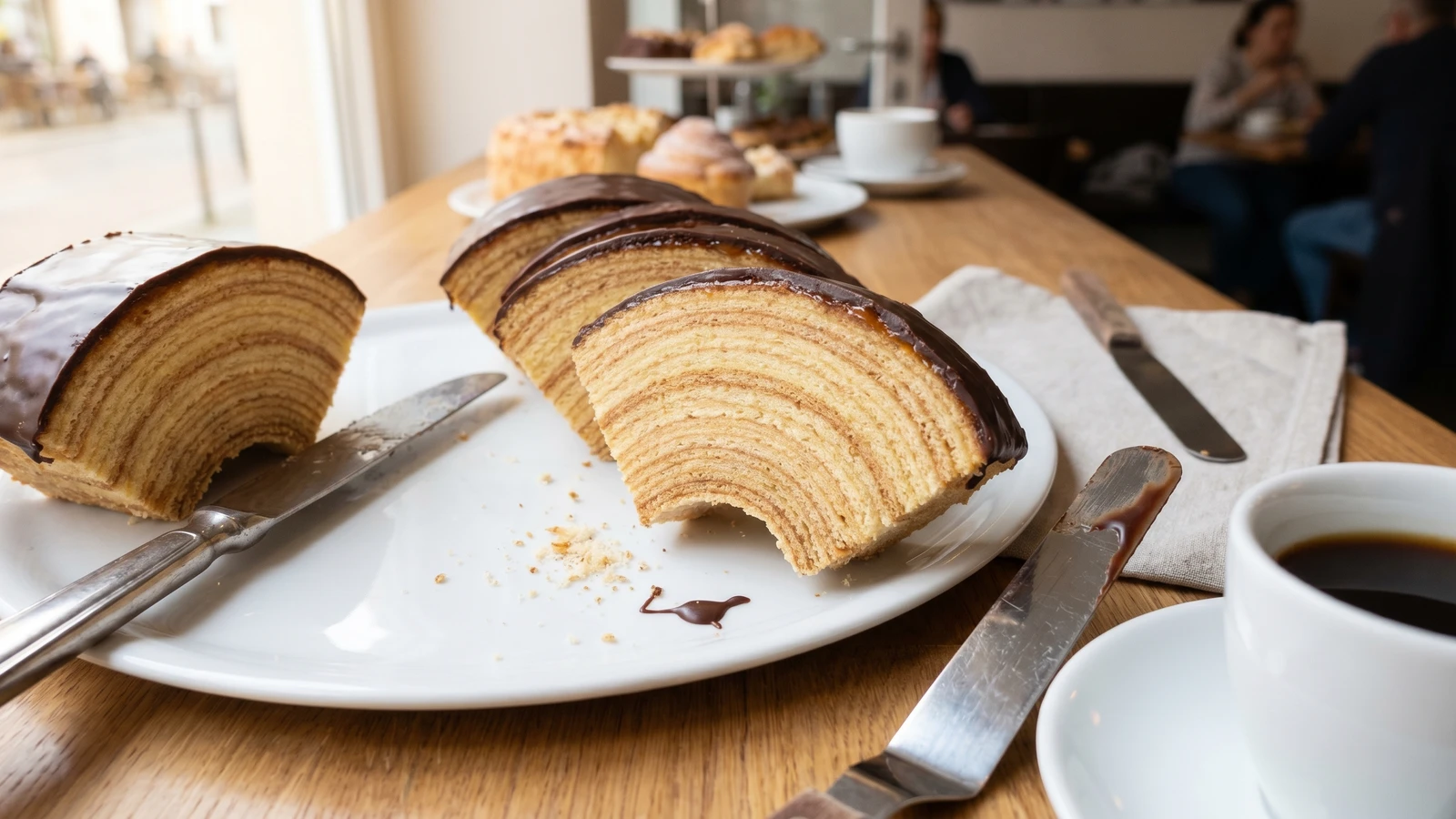
Baumkuchen is the celebration cake from Salzwedel: layer after layer browned close to heat, so the cut shows tree rings and the batter has nowhere to hide.
Baumkuchen belongs to the festive table, especially Christmas, weddings, and the Konditorei window where a cake is allowed to announce itself. Salzwedel in Saxony-Anhalt claims it hardest, and with reason. There the batter is brushed over a turning spit in thin coats, each layer browned before the next one goes on, until the cut looks like a tree trunk. A home oven won't give you the true spit shape. It can still teach you the dish properly.
The regions argue by equipment and finish more than by flavour. Salzwedel wants the spit, the ridged outside, and a clean butter-egg batter. Elsewhere you see flat Baumkuchen from a loaf tin, small Baumkuchenspitzen cut into points, or heavier versions with more almond and rum. Im Norden anders, im Süden anders, but the rule is the same: thin layer, strong top heat, full browning before the next layer.
That is the technique that decides the cake. Spread too thick and you bake a normal sponge with stripes. Spread thin and brown each coat under the grill, and the last layer becomes the bottom crust for the next one, which is why the rings stay clear when you cut it. Das braucht seine Zeit. Stand there and watch it. Walk away and you've made charcoal with butter in it.
This is not a packet cake and not a quick loaf. Nicht aus dem Glas, not from the jar, and not from a mix. Butter, eggs, almond, lemon, a little rum, and patience. When the glaze goes on, keep it clean and dark. Schön ist, was schmeckt.
Layered spit cakes appear in German-language cookery by the early modern period; Marx Rumpolt's 1581 cookbook, Ein new Kochbuch, records spit-baked cakes in the court-kitchen tradition. Salzwedel's particular Baumkuchen tradition is usually tied to the early 19th century, when local confectioners built a reputation for the cake and shipped it as a luxury good from Saxony-Anhalt. The regional argument is partly legal and partly practical: Salzwedeler Baumkuchen is bound to place and craft, while the home version copies the layered heat method in a flat tin rather than pretending a grill pan is a turning spit.
Quantity
250g
softened
Quantity
200g
Quantity
1 tablespoon vanilla sugar or 1 teaspoon extract
Quantity
6
separated, at room temperature
Quantity
1 pinch
Quantity
100g
softened
Quantity
2 tablespoons
Quantity
1 teaspoon
finely grated
Quantity
150g
Quantity
75g
Quantity
1 teaspoon
Quantity
75g
Quantity
100g
warmed and strained
Quantity
200g
60 to 70 percent cocoa, chopped
Quantity
30g
| Ingredient | Quantity |
|---|---|
| unsalted buttersoftened | 250g |
| caster sugar | 200g |
| vanilla sugar or vanilla extract | 1 tablespoon vanilla sugar or 1 teaspoon extract |
| large eggsseparated, at room temperature | 6 |
| fine salt | 1 pinch |
| marzipansoftened | 100g |
| dark rum | 2 tablespoons |
| lemon zestfinely grated | 1 teaspoon |
| plain flour | 150g |
| cornstarch | 75g |
| baking powder | 1 teaspoon |
| ground almonds | 75g |
| apricot jamwarmed and strained | 100g |
| dark chocolate60 to 70 percent cocoa, chopped | 200g |
| cocoa butter or neutral oil | 30g |
Line a 23x13cm loaf tin with baking paper, leaving a sling on the long sides, and heat the grill or broiler to high. Set the oven rack about 12cm below the element. Too close and the sugar burns before the layer sets; too far and the batter bakes pale, which gives you stripes without flavour.
Beat the butter, sugar, vanilla, and salt until pale and light, then beat in the egg yolks one at a time. Work the marzipan with the rum until smooth and beat it in with the lemon zest. The marzipan must disappear into the fat, because lumps scorch under the grill and leave bitter pockets.
Sift the flour, cornstarch, and baking powder together, then stir in the ground almonds. Fold this into the butter mixture in two turns. Whip the egg whites to soft peaks and fold them through last, because the batter needs lift but it must still spread thinly; stiff, dry whites leave streaks and tear the layers.
Spread 2 tablespoons of batter over the bottom of the tin in a thin, even coat, then grill for 2 to 3 minutes until deep golden with small darker freckles. This first layer is the foundation. If it stays pale, the next layer has nothing to mark against and the tree rings blur.
Spread another 2 tablespoons of batter over the browned surface, working gently so you don't scrape up the layer underneath, and grill again until clearly golden. Repeat until all the batter is used, 14 to 18 layers. Turn the tin now and then if your grill browns unevenly. Stand there. Baumkuchen is made by watching, not by hope.
Let the cake cool in the tin for 15 minutes, then lift it out and cool completely on a rack. Brush the outside with warm strained apricot jam so the chocolate grips instead of sliding off the dry crumb. Melt the chocolate with the cocoa butter or oil, coat the cake, and let it set before slicing. Cut with a warm knife so the glaze breaks cleanly and the rings show.
1 serving (about 110g)
Culinary guides, cultural storytelling, and the editorial depth that makes cooking meaningful.
Discover Culinary ExplorerChef Klaus
Frankfurt's Advent marzipan ball is small, pale gold, and exacting: real almond paste, rosewater, three almond halves pressed on firmly, then a short bake for gloss.

Chef Klaus
Bienenstich works when the almond top caramelises without burning and the yeast cake cools before the cream goes in. Rush either one and the bee has stung you.

Chef Klaus
North Germany's Freud-und-Leid-Kuchen, the cake for joy and sorrow both: a yeast sheet pressed full of cold butter, sugar, and almonds until the top turns crisp.

Chef Klaus
A German coffee-table cake built in layers: pale and cocoa batter, sour cherries sinking into the wave, cool buttercream, and dark chocolate combed like the Danube.