
Chef Graziella
Abbacchio a Scottadito
Roman lamb chops grilled over scorching heat, seasoned with nothing but salt, rosemary, and fire. You eat them with your hands, straight from the grill, burning your fingers because you cannot wait.
A cooking platform built around craft, culture, and the stories behind what we eat.
Created by
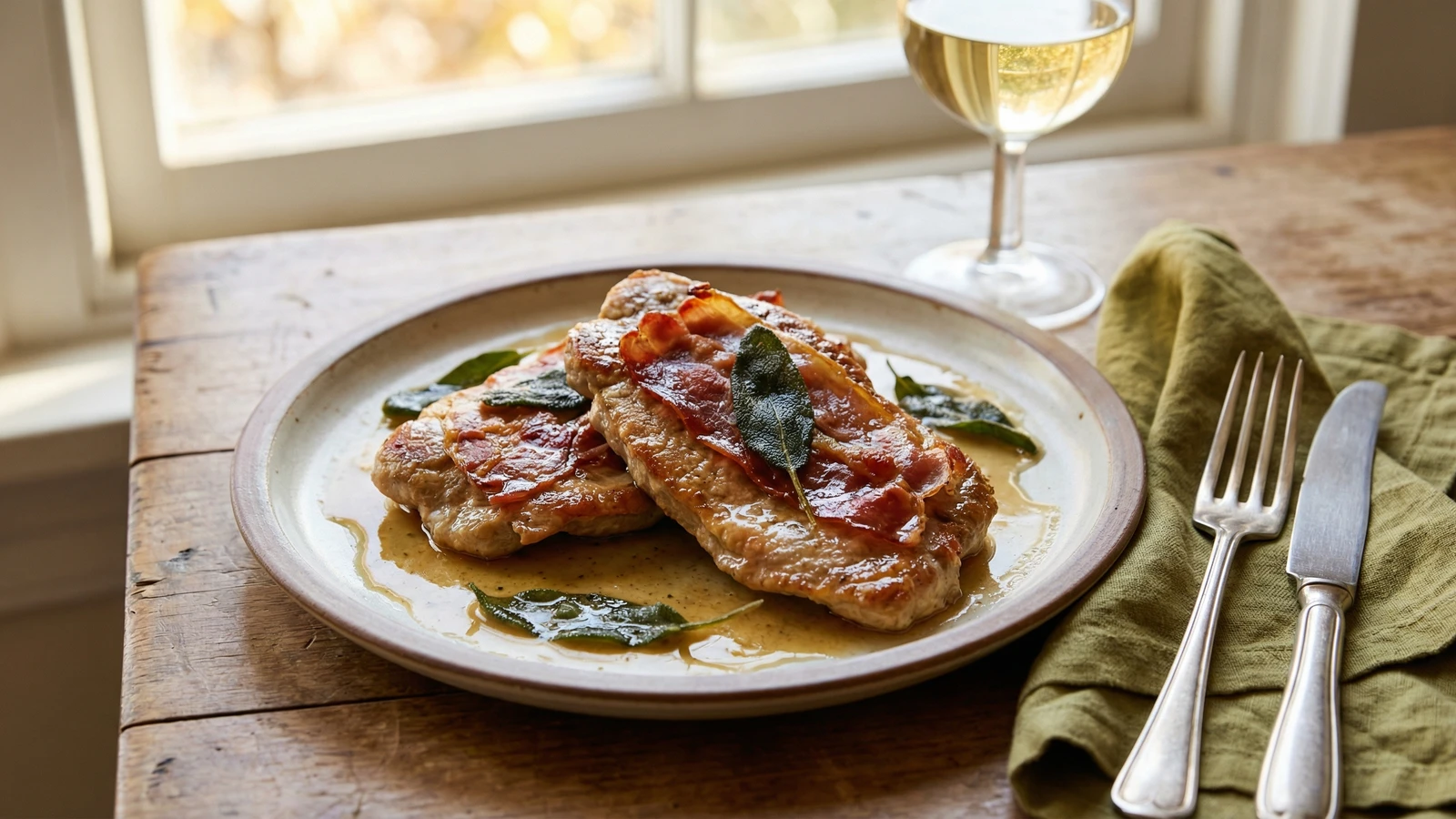
Thin veal escalopes crowned with prosciutto and sage, seared quickly in butter until the meat is tender and the ham crisps at the edges. Roman cooking at its most direct and satisfying.
Saltimbocca means 'jump in the mouth,' and the name tells you everything. This is not subtle food. It is immediate, emphatic, and impossible to ignore. The sage perfumes the butter. The prosciutto crisps against the hot pan. The veal, pounded thin enough to cook in moments, remains tender and yielding beneath.
Rome claims this dish, though the Brescians will argue. I will not settle that quarrel here. What matters is that saltimbocca belongs to a tradition of quick cooking that respects the ingredient rather than transforming it. The veal is not braised into submission. It is barely cooked at all, seared just long enough to turn opaque, then finished with wine and butter.
There are three ingredients that matter: veal, prosciutto, sage. The butter is a cooking medium, the wine a finishing touch. What you keep out is as significant as what you put in. No garlic. No tomato. No herbs beyond the sage. This is not a dish that needs anything more.
Saltimbocca appears in Roman cookbooks by the late 19th century, though it likely existed in trattorias long before anyone wrote it down. The Brescians claim it originated in Lombardy; the Romans dismiss this as provincial fantasy. What is certain is that by the mid-20th century, saltimbocca alla Romana had become synonymous with the cooking of the capital.
Quantity
8 (about 3 ounces each)
pounded to 1/4-inch thickness
Quantity
8 thin slices
Quantity
16
Quantity
4 tablespoons
Quantity
1/2 cup
Quantity
to taste
Quantity
to taste
freshly ground
| Ingredient | Quantity |
|---|---|
| veal escalopespounded to 1/4-inch thickness | 8 (about 3 ounces each) |
| prosciutto di Parma | 8 thin slices |
| fresh sage leaves | 16 |
| unsalted butter | 4 tablespoons |
| dry white wine | 1/2 cup |
| fine sea salt | to taste |
| black pepperfreshly ground | to taste |
If your butcher has not already done so, pound the veal escalopes between sheets of plastic wrap until uniformly thin, about one-quarter inch. They should be nearly translucent at the edges. Season the veal lightly with salt and pepper on one side only. The prosciutto provides salt, so restraint is essential.
Lay one slice of prosciutto on the unseasoned side of each veal escalope. The prosciutto should cover most of the meat but need not be trimmed to fit precisely. Place two sage leaves on top of the prosciutto. Press gently so everything adheres. No toothpicks. They are for amateurs who cannot control their pan temperature.
Melt 2 tablespoons of butter in a large heavy skillet over medium-high heat. When the butter foam subsides and begins to brown slightly, add as many saltimbocca as will fit without crowding, prosciutto-side down. Sear without moving until the prosciutto crisps and the edges of the veal turn opaque, about 2 minutes. Work in batches if necessary.
Turn each piece carefully with a spatula. The prosciutto side should be golden and slightly crisped, the sage leaves darkened but not burnt. Cook the second side for one minute only. The veal is thin and cooks quickly. Overcooked veal is leather. Transfer to a warm serving plate and tent loosely with foil while you finish the remaining batches, adding more butter as needed.
When all the veal is cooked, pour off any excess fat from the skillet, leaving the browned bits. Add the wine and let it boil vigorously, scraping the pan with a wooden spoon to release the fond. The wine will reduce by half in about one minute. Remove from heat and swirl in the remaining tablespoon of butter. The sauce will emulsify into something glossy and rich.
Spoon the pan sauce over the saltimbocca and serve at once. This dish waits for no one. Once the pasta is sauced, serve it promptly, inviting your guests and family to put off talking and start eating. The same applies here. The veal toughens as it cools. The sauce loses its sheen. Bring it to the table the moment it is ready.
1 serving (about 195g)
Culinary guides, cultural storytelling, and the editorial depth that makes cooking meaningful.
Discover Culinary ExplorerChef Graziella
Roman lamb chops grilled over scorching heat, seasoned with nothing but salt, rosemary, and fire. You eat them with your hands, straight from the grill, burning your fingers because you cannot wait.

Chef Graziella
Roman milk-fed lamb cut like a chicken, braised with wine, rosemary, and anchovy until the meat surrenders to the fork. The anchovy disappears. The flavor does not.

Chef Graziella
The true sauce of Amatrice: guanciale rendered to gold, tomatoes barely simmered, pecorino melted into silk. Three ingredients that tolerate no substitution and no addition.

Chef Graziella
Three ingredients expose every flaw and reward every success. The silky emulsion of pecorino and pasta water, studded with cracked black pepper, is Rome's gift to cooks who understand that simple does not mean easy.