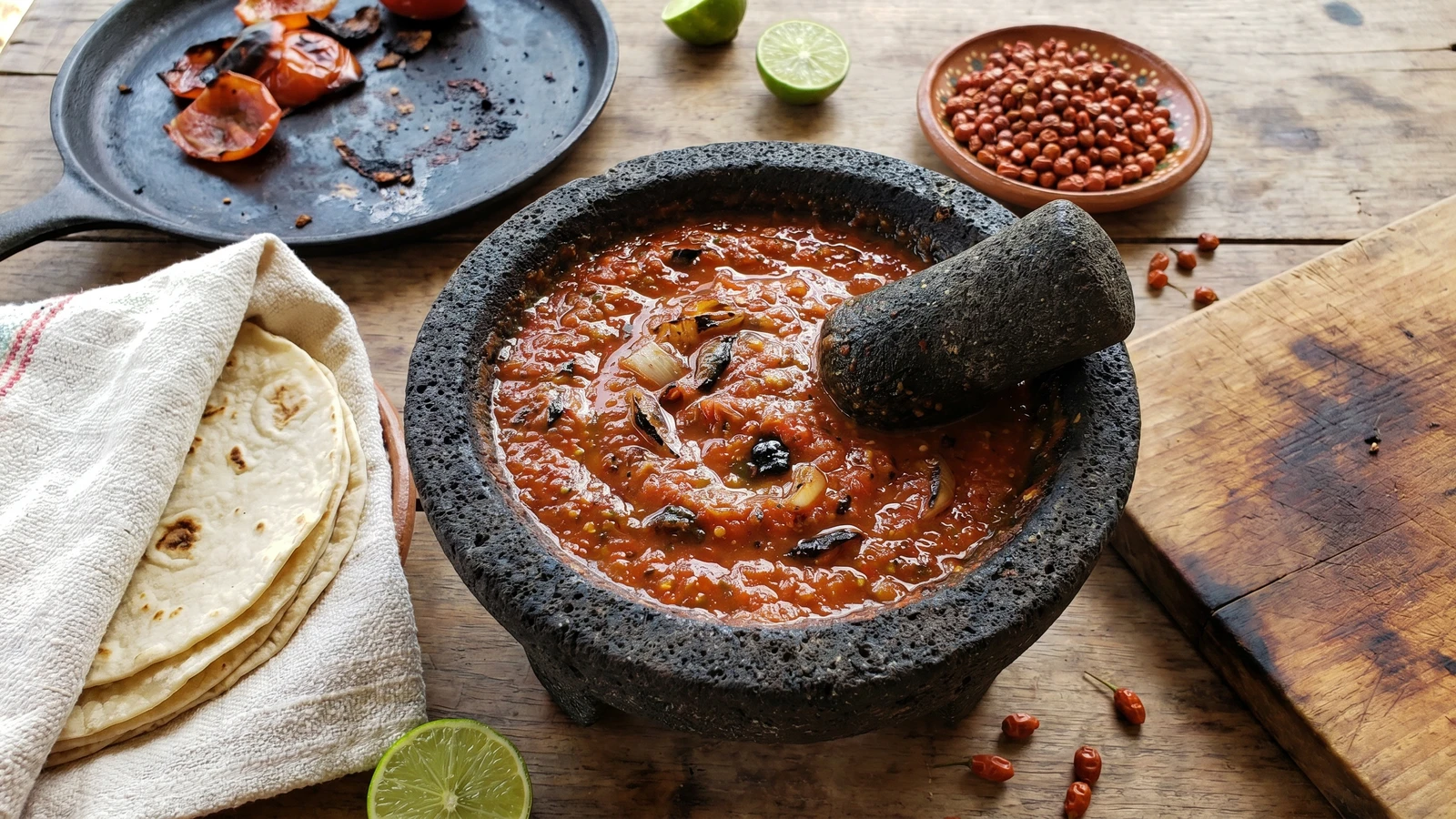
Sonora's wild chiltepín, the desert's red gold, crushed with charred tomato and garlic in a volcanic stone molcajete. The heat hits, then disappears clean.
Appetizers & Snacks
Mexican
BBQ
Outdoor Dining
Make Ahead
15 min
Active Time
15 min cook•30 min total
YieldAbout 1 cup, enough for 6 to 8 at the table
This salsa is from Sonora. Specifically from the sierras of the northeast, from the ranches around Moctezuma and Bacerac and Sahuaripa, where the chiltepín grows wild in the shade of mesquite and hackberry trees and women have been gathering it by hand for as long as anyone can remember.
The chiltepín is not a chile you cultivate. It is a chile you find. Pea-sized, round, dried red on the bush by the desert sun, and so prized in Sonora that a kilo can cost more than a kilo of beef. They call it el oro rojo del desierto, the desert's red gold, and they mean it. The heat is sharp and immediate, but it leaves clean. No lingering burn, no dulling of the palate. That is the chiltepín's signature and it is why Sonorans grind it into everything from caldos to carne asada to this salsa.
Tatemar is the verb that defines this recipe. It means to char on a dry comal until the skin blackens and the sugars in the tomato concentrate into something almost smoky. The molcajete is not optional. A blender will turn this salsa into baby food. The volcanic stone leaves texture, leaves the heat in uneven pockets, leaves the chile skin in flecks you can see. Saber cocinar es saber vivir, and in Sonora knowing how to use a chiltepín without burning it or wasting it is part of that knowing.
I collected this version from a senora named Doña Refugio in a small town outside Hermosillo. She gathered her own chiltepines every fall from the hills behind her house. She told me: the salsa is only as good as the chile, and the chile is only as good as the bush you took it from. Cada estado, su propia cocina.
The chiltepín (Capsicum annuum var. glabriusculum) is the wild ancestor of every domesticated chile species in the Americas, growing native across northwestern Mexico and the Sonoran Desert into Arizona, where it is harvested almost entirely by hand from wild bushes rather than commercially farmed. Pre-Columbian peoples of the region, including the Yaqui, Mayo, Pima, and Seri, used chiltepín not only as food but as medicine and as a trade currency, and the chile retained ceremonial and economic importance after Spanish contact. In 1999 the Mexican government designated parts of the Sierra de Sonora as a chiltepín reserve, recognizing the cultural and ecological significance of the wild harvest, which still drives a substantial seasonal economy in towns like Baviácora and Sahuaripa.
The technique, the tradition, and the story behind every dish.
•Volcanic stone molcajete and tejolote, properly seasoned
•Cast iron comal or heavy skillet
•Tongs for turning the tomato, garlic, and onion on the comal
Instructions
1
Heat the comal hard
Set a cast iron comal or heavy skillet over medium-high heat for at least five minutes. You want it hot enough that a drop of water vanishes on contact. Tatemar means to char, not to roast. The black spots are the flavor. A lukewarm comal will steam the tomato and you will end up with a watery salsa instead of a Sonoran one.
2
Char the tomato, garlic, and onion
Place the whole Roma tomatoes, the unpeeled garlic cloves, and the slab of white onion directly on the dry comal. No oil. Turn them with tongs every few minutes. The tomato skins should blister and blacken in patches, the onion should darken to a deep mahogany on each face, and the garlic skins should turn papery and brown. Total time, ten to twelve minutes. The garlic will be ready first, around five minutes. Pull each piece off the heat as it is done. Let the garlic cool enough to handle and slip the cloves out of their skins.
Do not peel the tomato. The charred skin is half the point. That smoky bitterness is what tatemado means and it is what separates this salsa from a thousand others.
3
Toast the chiltepín briefly
Lower the comal to medium. Scatter the chiltepines across the hot surface and toast them for no more than 20 to 30 seconds, shaking the pan constantly. They are tiny and they go from fragrant to burned in a breath. The moment you smell them sharpen, pull them off. A burned chiltepín is bitter and ruins the whole molcajete. The senoras in the Sonoran sierras toast them in their hands above the fire and you can too if you trust your fingers.
4
Crush the chiltepín with salt
Place the toasted chiltepines and the salt in a seasoned volcanic stone molcajete. Grind in a slow circular motion with the tejolote. The salt acts as the abrasive that breaks the chile down. Work it until the chiltepines are a coarse red dust shot through with bigger flecks of skin. This is where the dish lives. No me vengas con atajos. A blender will pulverize the seeds and turn the salsa cloudy and uniformly hot. The molcajete leaves the heat in pockets, the way Sonorans want it.
5
Add the garlic
Drop the peeled charred garlic cloves into the molcajete on top of the chiltepín. Mash them into the chile and salt until you have a rough paste. The garlic should disappear into the chile, leaving only its smoke behind.
6
Work in the tomato and onion
Roughly chop the charred onion. Add it to the molcajete with one of the tomatoes, skin and all. Crush in a circular motion until the tomato breaks down and the onion is in jagged pieces, not pulverized. Add the second and third tomatoes one at a time, mashing each before adding the next. The salsa should be loose but textured, with visible flecks of red skin and char. If it feels tight, add the cold water a tablespoon at a time.
7
Taste and rest
Taste it now. The first sensation should be the smoke from the tatemado, then the garlic, then the chiltepín climbing up the back of the throat and disappearing as fast as it arrived. That clean retreat is what makes chiltepín different from every other chile. Adjust salt. Let the salsa sit in the molcajete for ten minutes before serving. The flavors knit together fast. Bring the molcajete to the table with a lime cut in half on the side. Asi se hace y punto.
Chef Tips
•Source the chiltepín from a Sonoran or northern Mexican vendor if you can. Mercado vendors at La Merced sell them by weight, and they should be brick red, intact, and aromatic. If they look brown or shriveled to dust, they are old and the heat will be flat. A substitution is a compromise, not an upgrade, but if you cannot find chiltepín, chile pequín is the closest cousin. The flavor is similar but the heat lingers a little longer.
•Season the molcajete before you ever use it. Grind raw rice, garlic, and salt in it three or four times over the course of a week, throwing out each batch, until the grit and the porous stone settle into each other. An unseasoned molcajete will leach gray dust into your salsa.
•Do not refrigerate this salsa if you plan to eat it the same day. Cold dulls the chiltepín's brightness. Leave the molcajete on the counter, covered, and serve at room temperature. If you have leftovers, refrigerate them and let them come back to room temperature before serving.
Advance Preparation
•The chiltepín can be toasted up to a week ahead and stored in a sealed jar at room temperature. The salsa itself is best made the day it is served.
•The tomato, garlic, and onion can be tatemado a few hours ahead and held at room temperature, but do not crush the salsa until shortly before serving. The texture and brightness fade after a day.
Frequently Asked Questions
Nutrition Information
1 serving (about 40g)
Calories
10 calories
Total Fat
0 g
Saturated Fat
0 g
Trans Fat
0 g
Unsaturated Fat
0 g
Cholesterol
0 mg
Sodium
330 mg
Total Carbohydrates
3 g
Dietary Fiber
1 g
Sugars
1 g
Protein
1 g
Where cooking meets culture.
Culinary guides, cultural storytelling, and the editorial depth that makes cooking meaningful.