Culinary Explorer

A cooking platform built around craft, culture, and the stories behind what we eat.
Discover Culinary Explorer
Salbutes de Pavo en Escabeche

Salbutes de Pavo en Escabeche

Created by

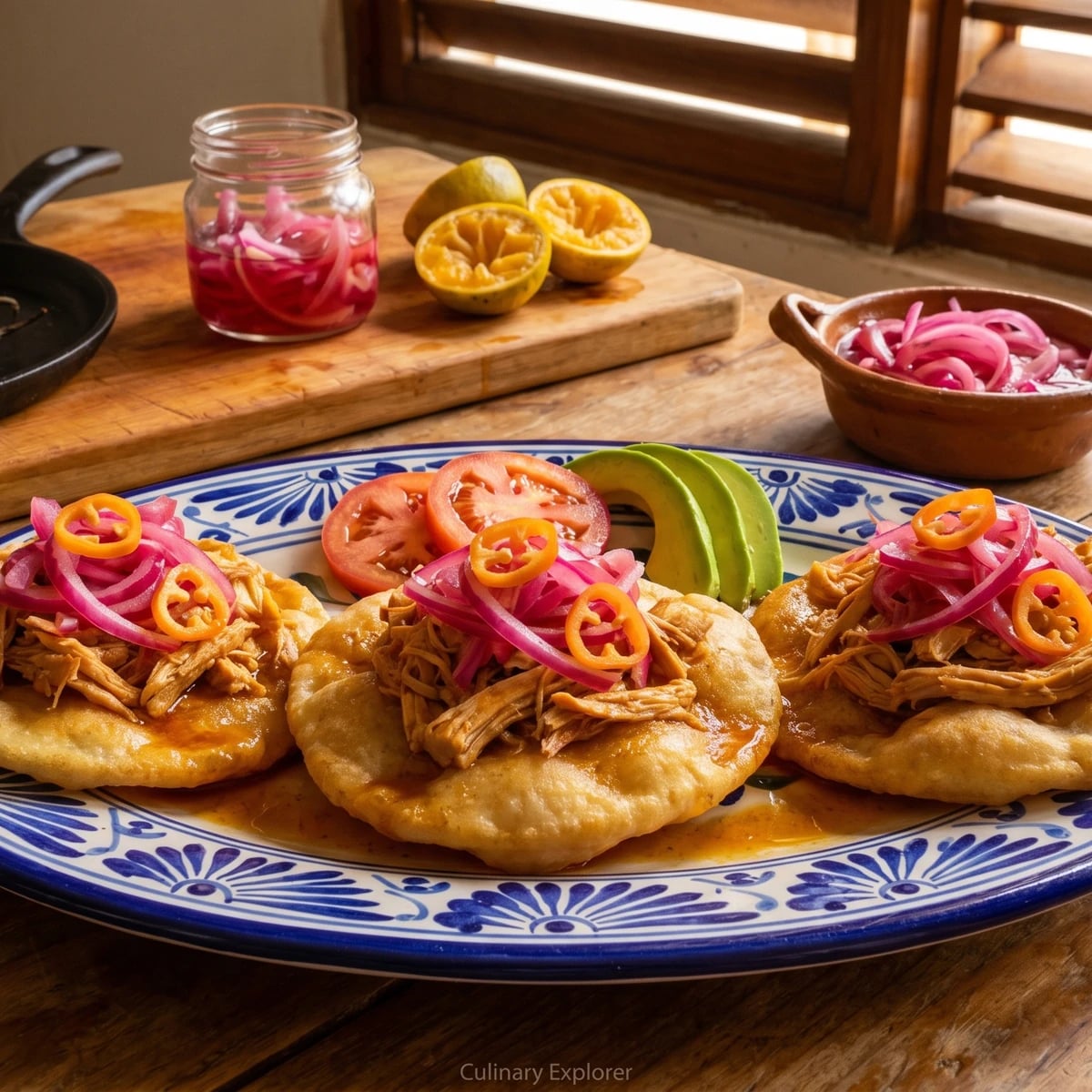
Mérida's puffy fried masa rounds carrying Valladolid's pavo en escabeche oriental, with clove, cinnamon, charred xcatic chiles, and a pile of cebolla morada en naranja agria on top.

Sandwiches & Wraps
Mexican
Weeknight
Comfort Food
Quick Meal
45 min
Active Time
1 hr 30 min cook2 hr 15 min total
Yield6 servings (about 18 salbutes)

This is Yucatecan food. Specifically, this is two dishes from two Yucatecan cities meeting on one plate. The salbut is from Mérida, where the panucherias along Calle 62 fry them by the hundreds every evening. The escabeche oriental is from Valladolid, where the women of the Mercado Municipal have been making it the same way for generations: turkey, clove, cinnamon, charred chiles xcatic, and the bracing perfume of naranja agria. Put them together and you have one of the great Peninsula combinations.

The Yucatán is its own world. Its food has more in common with the Caribbean and the Maya highlands than with central Mexico. The Peninsula has its own grammar: recado, naranja agria, hoja de plátano, chile habanero, pib. If you try to make this dish with regular orange juice and a poblano chile, you have not made it. You have made something else. Pregúntale a las señoras del mercado, the ones at Lucas de Gálvez in Mérida, and they will tell you the same thing.

The salbut puffs because the masa is thick enough and the lard is hot enough. The escabeche oriental tastes the way it does because the spices are toasted whole and the chiles xcatic are charred on a comal. The pickled onion turns magenta because the sour orange does what vinegar alone cannot. None of these steps are negotiable. Así se hace y punto.

My mother never made this. She was from Jalisco and her notebook has nothing from the Peninsula. I learned this recipe over three weeks in 2009, sitting at a small panucheria in the centro of Mérida, watching a señora named Doña Concepción work her comal. She let me copy her measurements onto the back of a napkin if I promised to never call it Tex-Mex. I have kept that promise.

Escabeche as a technique arrived in the Yucatán with the Spanish in the 16th century, but the Maya cooks who absorbed it transformed it with their own ingredients: turkey (pavo, a native bird domesticated by the Maya long before the conquest), achiote (the seed of the annatto tree), naranja agria (introduced by the Spanish but adopted as the Peninsula's defining acid), and the local chile xcatic, a yellow-skinned variety used almost exclusively in Yucatecan cooking. The salbut itself derives from the Maya word 'zaal but,' meaning 'light filling,' and predates the conquest as a form of puffy fried masa eaten with whatever the household had on hand. The pairing of salbut with pavo en escabeche became codified in Mérida's panucherias and cocinas económicas in the early 20th century, when escabeche oriental from neighboring Valladolid spread westward into the capital's daily menu.

The technique, the tradition, and the story behind every dish.

Discover Culinary Explorer

Ingredients

bone-in turkey thighs and drumsticks

Quantity

2 pounds

skin on

white onion

Quantity

1 medium

halved

head of garlic

Quantity

1

halved crosswise, plus 6 cloves for the escabeche

bay leaves

Quantity

2

kosher salt

Quantity

1 tablespoon, plus more to taste

recado rojo (achiote paste)

Quantity

2 tablespoons

jugo de naranja agria

Quantity

1/2 cup

or 1/4 cup orange juice mixed with 1/4 cup fresh lime juice

dried Mexican oregano

Quantity

1 tablespoon

preferably oregano yucateco

whole black peppercorns

Quantity

1 teaspoon

whole allspice berries

Quantity

1 teaspoon

whole cloves

Quantity

1 teaspoon

cinnamon stick (canela de Ceylán)

Quantity

1

about 2 inches

cumin seeds

Quantity

1 teaspoon

white onions for escabeche

Quantity

2 large

sliced into thin rings

chiles xcatic (or chile güero)

Quantity

4

charred whole on a comal

apple cider vinegar

Quantity

1/2 cup

manteca de cerdo for the turkey

Quantity

3 tablespoons

masa harina

Quantity

2 cups

warm water

Quantity

1 1/4 cups

plus more as needed

kosher salt for the masa

Quantity

1/2 teaspoon

manteca de cerdo for frying

Quantity

2 cups

red onion

Quantity

1 large

sliced into thin half-moons

jugo de naranja agria for pickled onion

Quantity

1/2 cup

chile habanero

Quantity

1

sliced into thin rings

dried Mexican oregano for pickled onion

Quantity

1 teaspoon

kosher salt for pickled onion

Quantity

1/2 teaspoon

iceberg or romaine lettuce

Quantity

1 head

very thinly shredded

ripe tomato (optional)

Quantity

for serving

sliced

avocado (optional)

Quantity

for serving

sliced

lime wedges (optional)

Quantity

for serving

Equipment Needed

  • Heavy stockpot for poaching the turkey
  • Cast iron comal for charring chiles and toasting spices
  • Molcajete or spice grinder for the whole spices
  • Tortilla press lined with plastic from a freezer bag
  • Wide, deep skillet or cazuela for frying the salbutes
  • Frying thermometer
  • Wire rack set over a sheet pan

Instructions

  1. 1

    Make the pickled red onion

    Place the sliced red onion in a heatproof bowl and pour boiling water over it. Count to thirty. Drain. This takes the raw bite off without cooking the crunch out. Return the onion to the bowl and add the sour orange juice, sliced habanero, oregano, and salt. Press the onion down so the liquid covers it. Cover and refrigerate for at least one hour, preferably four. The color will turn from pale pink to a deep magenta. That is the sign it is ready.

    The habanero is non-negotiable for cebolla morada yucateca. Slice it thin and let it sit with the onion. If you want less heat, leave the rings whole and fish them out before serving. The perfume stays. The fire backs off.
  2. 2

    Poach the turkey

    Place the turkey pieces in a heavy pot and cover with cold water by two inches. Add the halved onion, the halved head of garlic, bay leaves, and one tablespoon of salt. Bring to a gentle simmer over medium heat. Skim the foam that rises in the first fifteen minutes. Lower the heat and cook for forty-five minutes, until the meat pulls cleanly from the bone. Lift the turkey out and reserve two cups of the broth. Discard the aromatics. When cool enough to handle, shred the meat into rough pieces. Keep the skin on the shreds. The skin matters in escabeche oriental.

  3. 3

    Toast and grind the spices

    On a dry comal over medium heat, toast the peppercorns, allspice, cloves, cinnamon stick, and cumin seeds until they smell sharp and warm, about two minutes. Tip them into a molcajete or spice grinder along with the six garlic cloves for the escabeche and the dried oregano. Grind to a coarse paste. This is the spice backbone of escabeche oriental from Valladolid. No me vengas con atajos. Pre-ground spices will give you a flat broth that tastes of nothing in particular.

  4. 4

    Char the chiles and onions

    On the same comal, char the whole chiles xcatic until the skins blister and turn brown in patches, about four minutes, turning often. Set aside. In a wide pan, melt three tablespoons of lard over medium heat. Add the sliced white onions for the escabeche and cook for eight to ten minutes, until softened and lightly golden at the edges. The onions should be tender but still have body. They are the bulk of the escabeche, not a background note.

  5. 5

    Build the escabeche broth

    Dissolve the recado rojo in the sour orange juice in a small bowl, working out the lumps with the back of a spoon. Pour it into the pan with the onions. Add the spice paste, the apple cider vinegar, the charred chiles xcatic, and the two cups of reserved turkey broth. Bring to a simmer and cook for ten minutes, until the liquid takes on the deep orange-red of the achiote and the kitchen smells of clove and cinnamon. Add the shredded turkey and the skin. Simmer five minutes more so the turkey takes on the broth. Taste for salt. The escabeche should be assertive: tart from the sour orange, warm from the cloves, sharp from the chiles. Pull from the heat and let it rest. The flavor settles as it cools.

  6. 6

    Make the masa for the salbutes

    In a bowl, combine the masa harina and half teaspoon of salt. Add the warm water gradually, working it in with your hands until you have a smooth, soft dough. The masa should feel like fresh playdough: pliable, not sticky, not dry. If it cracks when you press it, add water a teaspoon at a time. If it sticks to your palm, add masa harina by the spoonful. Cover the bowl with a damp cloth and let it rest fifteen minutes. The salbute is not a panucho. There are no beans inside. The masa is meant to puff into a hollow pocket the moment it hits the fat.

    A salbute and a panucho are not the same thing. The panucho is split and stuffed with refried black beans. The salbute is plain masa that puffs in the lard. Yucatecans will correct you on this. Cada estado, su propia cocina.
  7. 7

    Press the salbutes

    Divide the masa into eighteen balls, each about the size of a walnut. Cover with the damp cloth so they do not dry out. Cut two squares of plastic from a freezer bag. Place one ball at a time between the plastic in a tortilla press and press to about four inches across and a little thicker than a tortilla. Thicker than you think. A thin salbute will not puff. The slightly extra body is what creates the hollow interior.

  8. 8

    Fry the salbutes

    Heat the two cups of lard in a wide, deep skillet to 350 degrees Fahrenheit. Use a thermometer. Slide one salbute into the lard and watch it. Within seconds it should sink, then float, then begin to puff. Spoon hot lard over the top to encourage the puff. It will balloon. Fry for about one minute total, turning once, until pale gold and crisp at the edges. The interior will be hollow. Drain on a wire rack. Repeat with the rest, working in batches of two or three. La manteca es el sabor and lard is what gives the salbute its proper texture. Vegetable oil will fry it but will not flavor it.

    If a salbute does not puff, it means the masa was too thin, the lard was not hot enough, or the dough was too dry. Fix the next one. Eat the failed one with salsa. Nothing is wasted in this kitchen.
  9. 9

    Build the salbutes at the table

    Set the warm salbutes on a platter. Top each one with a small handful of shredded lettuce, a generous spoonful of the pavo en escabeche with its onions and broth, a slice of tomato, a slice of avocado if you like, and a pile of the magenta pickled onion with a ring of habanero on top for those who want it. Serve immediately with lime wedges. The juices from the escabeche soak into the masa and that is exactly what should happen. Eat them with your hands. Recetas probadas y garantizadas.

Chef Tips

  • Recado rojo is not the same as 'achiote paste in a yellow box at the supermarket' unless that box is from La Anita or El Yucateco. The Peninsula's recados are sold pressed into bricks in Yucatecan markets and they carry the spice profile the dish needs. If you cannot find a good brand, make your own with achiote seeds, garlic, allspice, oregano, and sour orange.
  • Naranja agria is the defining acid of Yucatecan cooking. It is sold in some Latin grocers in the diaspora. The substitution of orange juice plus lime is a compromise, not an upgrade. It gets you close. It does not get you there.
  • Chile xcatic is a yellow chile native to the Peninsula and used in escabeche oriental specifically. If your market does not carry it, chile güero or banana pepper will work. Do not substitute jalapeño. The flavor profile is wrong.
  • The turkey is the dish. Pavo, not chicken. Yucatán has been raising domestic turkey since pre-Columbian times and the slightly gamier flavor stands up to the clove and cinnamon in a way chicken cannot. If you have to use chicken, use bone-in thighs with skin and shred them the same way.

Advance Preparation

  • The pavo en escabeche can be made up to two days ahead and refrigerated. The flavor deepens overnight. Reheat gently before serving.
  • The pickled red onion can be made up to one week ahead. It only gets better. Keep it in a glass jar in the refrigerator.
  • The masa for the salbutes must be made the day of frying. Refrigerated masa loses its ability to puff.
  • Fry the salbutes within the hour you plan to eat them. A reheated salbut goes soft and the hollow collapses.

Frequently Asked Questions

Nutrition Information

1 serving (about 270g)

Calories
660 calories
Total Fat
42 g
Saturated Fat
14 g
Trans Fat
0 g
Unsaturated Fat
26 g
Cholesterol
85 mg
Sodium
550 mg
Total Carbohydrates
40 g
Dietary Fiber
7 g
Sugars
5 g
Protein
27 g

Note: Chef personas and recipes are created with AI assistance. Cook with care: follow safe food-handling practices, check doneness with a thermometer when needed, and adapt for allergies and your kitchen.

Where cooking meets culture.

Culinary guides, cultural storytelling, and the editorial depth that makes cooking meaningful.

Discover Culinary Explorer

More from Yucatecan Panuchos, Salbutes & Handhelds

Browse the full collection