
Chef Lupita
Aceite de Chiltepin Bajacaliforniano
Baja California's wild chiltepin steeped in olive oil with garlic, orejon, and lime peel, until the oil turns ruby-amber and carries the slow, sneaky burn of the desert coast.
A cooking platform built around craft, culture, and the stories behind what we eat.

Created by
Oaxaca's iconic finishing salt of toasted chinicuiles, sea salt from the Istmo, and chile de árbol, ground on the metate. The salt that frames every copita of mezcal in the Valles Centrales.
Sal de gusano is from Oaxaca. From the Valles Centrales specifically, where the maguey grows and the chinicuiles, the red worms, live inside the heart of the plant during the rainy season. The same maguey that becomes mezcal feeds the worms that season the salt that accompanies the mezcal. The whole ritual loops back on itself, and that is not an accident. Cada estado, su propia cocina, and Oaxaca built a closed circuit out of one plant.
Three ingredients. Chinicuiles, sea salt from the Istmo de Tehuantepec, chile de árbol. That is it. The technique is what matters: toast, grind, rest. The chinicuiles bring something you cannot get from any other ingredient in Mexican cooking, an earthy, smoky, mineral funk that sits between roasted nuts and dried meat, with a long savory finish. The salt grounds it. The chile sharpens it. Together they make a brick-red dust that turns a wedge of orange into the most important bite of the night.
The first time I had real sal de gusano was in Santiago Matatlan, the self-declared world capital of mezcal, at a palenque where the maestro mezcalero ground the salt himself on a metate older than my grandmother. He handed me a copita of espadin, a wedge of naranja agria, and a small clay dish of his salt. He did not give instructions. He watched my face. When I got it right he nodded once and poured himself a copa. That is sal de gusano. It teaches you how to drink mezcal without saying a word. No me vengas con atajos. The metate, the toasted worms, the unrefined salt, all of it is the recipe.
The chinicuil (Comadia redtenbacheri) is the larval stage of a moth that bores into the heart of agave plants, primarily Agave salmiana and Agave americana, and has been harvested as food by the indigenous peoples of central and southern Mexico since at least the pre-Columbian period; the closely related gusano de maguey blanco (Aegiale hesperiaris) lives in different agave species and is the worm traditionally placed in some bottles of mezcal beginning in the mid-20th century. Sal de gusano as a distinct condiment was codified in the Valles Centrales of Oaxaca alongside the formalization of mezcal as a regional industry, and the practice of pairing it with orange and mezcal traces to palenque culture rather than restaurant invention. Insects like chinicuiles, chapulines, and escamoles are part of an entomophagous tradition that sustained Mesoamerican diets for millennia and that the FAO has repeatedly cited as one of the most protein-efficient food systems on earth, a fact that makes the Western label of 'exotic' a failure of perspective rather than a description of the food.
Quantity
2 tablespoons (about 15 grams)
Quantity
1/4 cup
or any unrefined coarse sea salt
Quantity
4 to 6
stemmed
Quantity
for serving
Quantity
for serving
cut into thick wedges
| Ingredient | Quantity |
|---|---|
| dried chinicuiles (gusanos de maguey rojos) | 2 tablespoons (about 15 grams) |
| coarse sea salt from the Istmo de Tehuantepecor any unrefined coarse sea salt | 1/4 cup |
| dried chile de árbolstemmed | 4 to 6 |
| mezcal espadin (optional) | for serving |
| naranja agria or sweet orange (optional)cut into thick wedges | for serving |
Start at the right place. The chinicuiles, the red worms that live inside the maguey plant during the rainy season, come from the Valles Centrales of Oaxaca and the Mixteca. They are harvested by hand, washed, salted, and dried in the sun. At Mercado 20 de Noviembre and Mercado de Abastos in Oaxaca de Juarez, the women sell them by the gram next to the chapulines. Outside Oaxaca, you want a vendor who imports directly. If the worms look pale, brittle, or smell of nothing, they are old. Good chinicuiles smell faintly of earth and roasted nuts, and they are the color of dark brick.
Heat a dry comal or heavy skillet over medium-low. Toast the chiles de árbol whole, turning constantly, for about 30 to 45 seconds. They will darken a shade and the kitchen will sharpen with that hot, dry chile smell. Pull them off the second they smell ready. Chile de árbol is thin and burns in a breath. Burned chile turns the salt bitter and there is no fixing it later.
On the same comal, lower the heat to low. Spread the chinicuiles in a single layer. Toast them for two to three minutes, shaking the pan, until they are dry, crisp, and a shade darker. They should crackle when you press one with the back of a spoon. You are not cooking them, you are pulling out the last moisture so they grind cleanly. Move them to a plate the moment they are crisp. Overtoasted worms taste of ash.
On a metate, grind the chinicuiles first, alone, until they break down into a coarse rust-colored powder. Add the chiles de árbol and grind again until you have a uniform red-brown dust with visible flecks. Finally add the sea salt and grind one more pass, just enough to marry the three. Asi se hace y punto. If you do not have a metate, a molcajete works. A spice grinder works in pulses, but you lose the texture, the salt should crunch slightly between your teeth, not dissolve like powder.
Transfer the salt to a small clay or glass jar with a tight lid. Let it sit for at least one hour before using so the flavors settle. It keeps for six months at room temperature, away from light and humidity. The color will deepen as it rests.
Pour mezcal espadin into small clay copitas or veladoras. Set the sal de gusano in a flat dish. Cut thick orange wedges and arrange them on a plate. The ritual is simple: bite the orange, dip the wet flesh into the salt so it picks up a generous coat, eat the orange slice, then sip the mezcal. The fruit clears your tongue, the salt frames the smoke, the mezcal does the rest. Repeat. This is how a sobremesa in Oaxaca lasts four hours and ends with everyone still talking. Saber cocinar es saber vivir.
1 serving (about 5g)
Culinary guides, cultural storytelling, and the editorial depth that makes cooking meaningful.
Discover Culinary ExplorerChef Lupita
Baja California's wild chiltepin steeped in olive oil with garlic, orejon, and lime peel, until the oil turns ruby-amber and carries the slow, sneaky burn of the desert coast.

Chef Lupita
Puebla's Lenten convent adobo, a brick-red vinegar chile paste of ancho, guajillo, garlic, oregano, and comino made to dress fish for the meatless calendar.
Chef Lupita
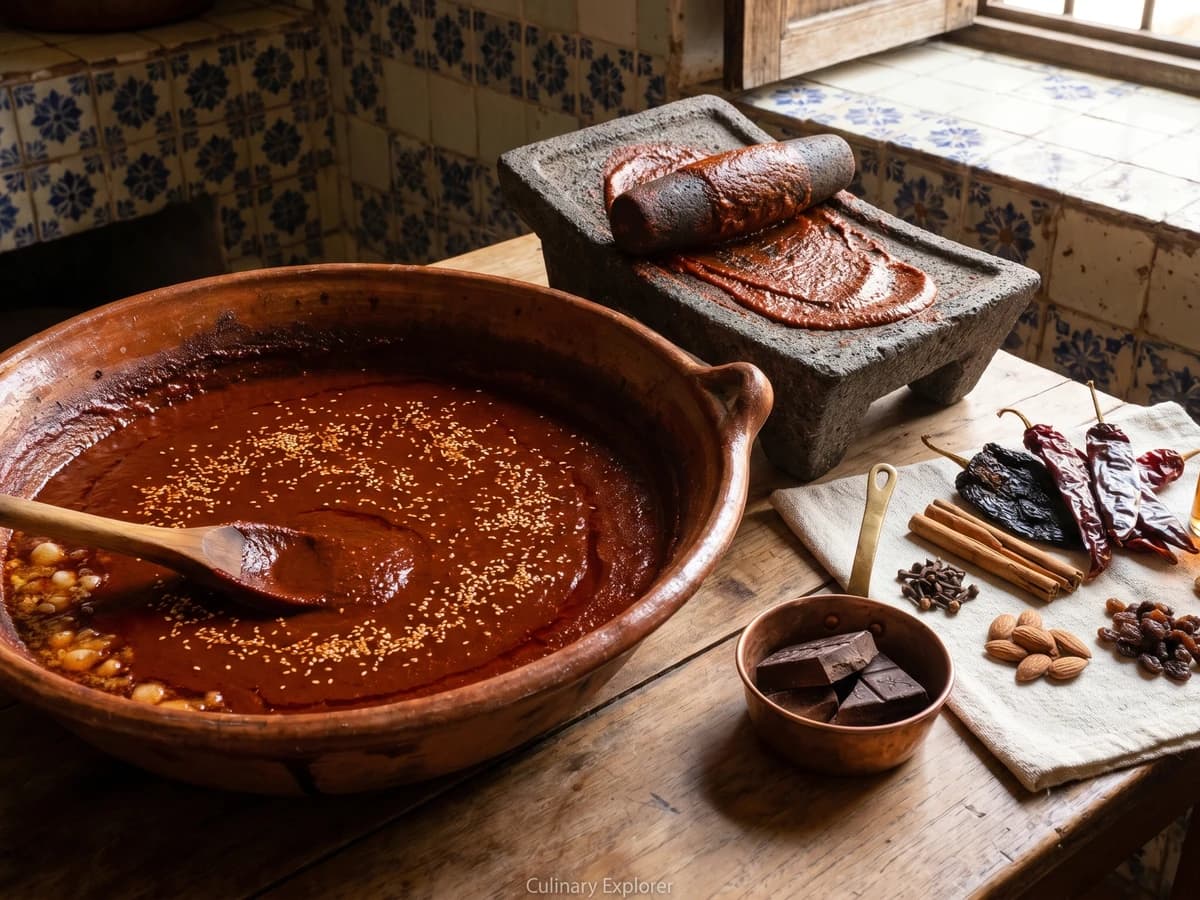
Zacatecas' wedding-table adobo, built from toasted guajillo and ancho, piloncillo, sour orange, chocolate, canela, clavo, almonds, sesame, and lard.

Chef Lupita
Puebla's convent kitchens built this adobo with ancho, guajillo, jerez, almonds, raisins, clove, and lard, a baroque marinade that stains pork loin and finishes as the sauce.