
Chef Lupita
Agua de Chaya con Limón
Yucatán's everyday tonic of boiled chaya leaves blended with lima agria, sugar, and ice. The bright green jarra that sits on every Peninsula table from Mérida to Valladolid.
A cooking platform built around craft, culture, and the stories behind what we eat.
Created by
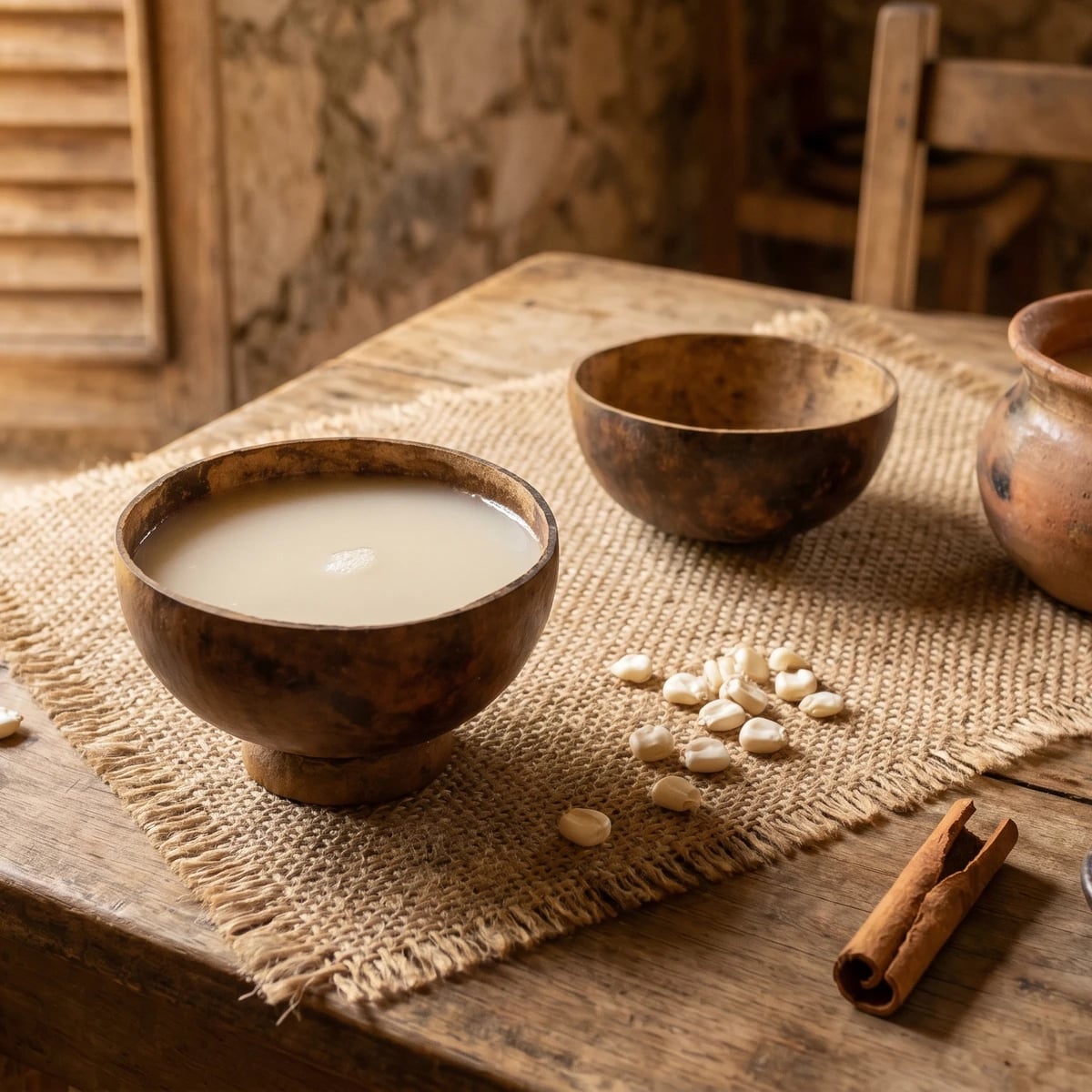
The Maya sacred white-corn drink from Yucatán. Unnixtamalized white corn simmered in clean spring water until the liquid turns the color of bone. Offered to Cháak the rain god before any human tastes it.
Saká is from Yucatán. From the milpas of the Maya, the small cornfields that the milperos still plant and burn and tend the way their grandfathers did. This is not a drink from Mérida sorbeterías. This is a drink from the altar, from the ceremony, from the h-men who pours it into a jícara and sets it down for Cháak the rain god before the planting season begins.
The word saká means white water in Maya. The color comes from the corn and only the corn. White field corn, ixi'im, simmered in clean cenote water until the kernels split and the starches turn the pot the color of bone. There is no cal here. There is no lime, no ash, no nixtamalization. That absence is the point. Atole de masa is the everyday drink. Saká is the older one, the one that exists outside the transformation that corn usually undergoes in a Maya kitchen. The gods receive the corn before human hands have changed it.
I traveled to a small town outside Valladolid in my third year on the road. A milpero named don Anastasio let me sit beside him while he prepared the saká for a Ch'a Cháak ceremony. He drew the water from the cenote himself at first light. He ground the corn on a metate his grandmother had used. He spoke Maya the whole time and translated only when I asked. At the end he handed me a jícara of the warm liquid and said, in Spanish, that I should taste it before he set the rest on the altar. It tasted like clean corn and clean water. Almost nothing. And almost everything. Cada estado, su propia cocina, and this one is Yucatán's at its oldest root.
If you make this for your household, you can add a piece of canela and a spoonful of melipona honey at the end and call it a drink. If you make it for the offering, you add nothing. No me vengas con atajos.
Saká is one of the oldest continuously prepared corn beverages in Mesoamerica, predating the conquest by at least a millennium and likely much longer. Its ritual significance is tied to the Ch'a Cháak ceremony, the Maya rain-petition rite still performed by h-men priests in Yucatán's milpa communities before the planting season, in which saká is offered to the four cardinal Cháak deities alongside balché and ceremonial breads called pibilwah. The drink's defining feature, the absence of nixtamalization, marks it as belonging to a ritual category distinct from everyday corn foods: in Maya cosmology, unnixtamalized corn is the form in which sustenance is presented to the gods, while nixtamalized corn, transformed by cal into masa, is the form in which it is consumed by people. Melipona honey, when added in the household version, comes from the native stingless bee the Maya have cultivated for over two thousand years, a practice still preserved in a handful of Yucatecan villages despite competition from European honeybees.
Quantity
500 grams
rinsed in cold water, any broken or discolored kernels removed
Quantity
3 liters
in the milpa, drawn from a cenote at first light
Quantity
1 small piece
only for the household version, never for the ceremonial offering
Quantity
to taste
only for the household version, never for the ceremonial offering
| Ingredient | Quantity |
|---|---|
| white field corn, unnixtamalized (maíz blanco, ixi'im)rinsed in cold water, any broken or discolored kernels removed | 500 grams |
| fresh spring or filtered waterin the milpa, drawn from a cenote at first light | 3 liters |
| canela (Mexican cinnamon bark) (optional)only for the household version, never for the ceremonial offering | 1 small piece |
| wild honey from melipona bees (optional)only for the household version, never for the ceremonial offering | to taste |
Use white field corn, ixi'im in Maya, the same variety the milperos grow for tortillas. Do not use sweet corn. Do not use yellow corn. Do not use hominy. This drink is defined by the absence of nixtamalization, and the corn must be whole, dry, and white. Rinse the kernels in cold water and pick out anything broken, blackened, or shriveled. Saká is an offering before it is a drink. The corn has to be worthy.
You are not making atole de masa. You are not making champurrado. You are not nixtamalizing. There is no cal in this pot. There is no lime, no ash, no alkaline anything. That absence is the entire point. Saká is corn cooked in plain water, the corn the gods receive before it has been transformed by human hands. The Maya milperos call this the food of Cháak, the rain god. Treat the recipe with the respect that origin demands.
Place the rinsed corn in a heavy clay olla or a stockpot with the three liters of water. The water should be clean and untreated. The h-men, the Maya priests who still perform the Ch'a Cháak rain ceremony in Yucatán, draw it from a cenote at first light. In your kitchen, use spring water or filtered water. No chlorine. No tap. The drink carries the flavor of the water it was made with. Bring the pot to a gentle simmer over medium heat. Do not boil hard. A rolling boil tears the kernels and clouds the liquid.
Simmer uncovered for one hour to one hour and twenty minutes, stirring occasionally with a wooden spoon. The kernels will swell, soften, and split open along the seam. The water will go from clear to milky white as the corn starches release. That cloudy white color is where the name comes from. Saká means white water in Maya. When the kernels are tender enough to crush easily between two fingers, the corn is ready. Pull the pot from the heat and let it rest for fifteen minutes.
In the milpa, the corn is ground on a metate while still warm and then thinned with the cooking water. In the kitchen, a blender does the same work. Ladle the cooked corn with its liquid into the blender in two or three batches. Blend each batch on high for two full minutes. The mixture should be completely smooth, the color of bone, almost the consistency of thin cream. Strain through a fine-mesh sieve back into the clean pot, pressing the solids to extract everything. Discard the hulls that remain in the sieve.
Return the strained liquid to the pot over low heat. Warm it through, stirring constantly so it does not catch on the bottom. Do not let it boil again. For the ceremonial offering, the saká is served exactly here. Nothing added. No sugar. No salt. No spice. The drink that the milpero places on the altar for Cháak before the rains is pure corn and pure water. Así se hace y punto.
Ladle the warm saká into small jícaras, the gourd cups the Maya have used for centuries, or into hand-painted ceramic mugs from Ticul. The drink should be warm, not hot. It tastes of cooked corn and clean water and almost nothing else. That is the dish. People used to a sweetened atole will be surprised. They are tasting the oldest version of a corn drink that has survived in this hemisphere. Saber cocinar es saber vivir.
1 serving (about 250g)
Culinary guides, cultural storytelling, and the editorial depth that makes cooking meaningful.
Discover Culinary Explorer
Chef Lupita
Yucatán's everyday tonic of boiled chaya leaves blended with lima agria, sugar, and ice. The bright green jarra that sits on every Peninsula table from Mérida to Valladolid.

Chef Lupita
Yucatán's signature green agua fresca, chaya leaves blanched and blended with ripe pineapple and lima agria, served ice-cold from a sweating glass jarra against the Mérida heat.

Chef Lupita
Yucatán's hibiscus agua, flor de jamaica steeped off the heat with canela and pimienta gorda, sweetened with piloncillo, and chilled until the deep ruby color is the most-poured drink on the Peninsula.

Chef Lupita
The Peninsula's floral sour-lime refresher, juiced cold and perfumed with a single strip of peel. The aroma is what makes it Yucatecan, and a Persian lime will not get you there.